


Ankle pain can make walking, standing, and everyday tasks harder after military service. Understanding the VA disability rating for ankle pain can help you organize vital evidence that explains those limits. However, pain alone does not determine a percentage; VA also considers service connection, the applicable rating criteria, and the evidence in your file.
An old ankle injury may leave you with reduced movement or episodes of giving way. For example, stairs or uneven ground may become harder to manage. Because symptoms can change over time, a useful record explains your usual limitations as well as your flare-ups.
This guide explains the main ankle rating codes and how service connection works. You will also learn which records to gather and how to prepare for an exam. Together, these steps can help you identify unanswered questions before filing.

Key takeaways
- Limited ankle motion under DC 5271 is evaluated at 10% or 20% when the criteria are met.
- Ankle ankylosis under DC 5270 has 20%, 30%, and 40% levels, depending on joint position.
- In addition to movement measurements, explain pain, weakness, flare-ups, and limitations after repeated use.
- A well-organized application should address the current condition, its connection to service, and its daily effects.
In this guide
- How VA evaluates ankle pain
- Establishing service connection
- Evidence that supports your application
- How to prepare and file
- Common mistakes and next steps
How VA evaluates ankle pain
VA uses the musculoskeletal rating schedule to evaluate ankle conditions. The code depends on the condition and findings, so the same symptom does not always lead to the same evaluation.
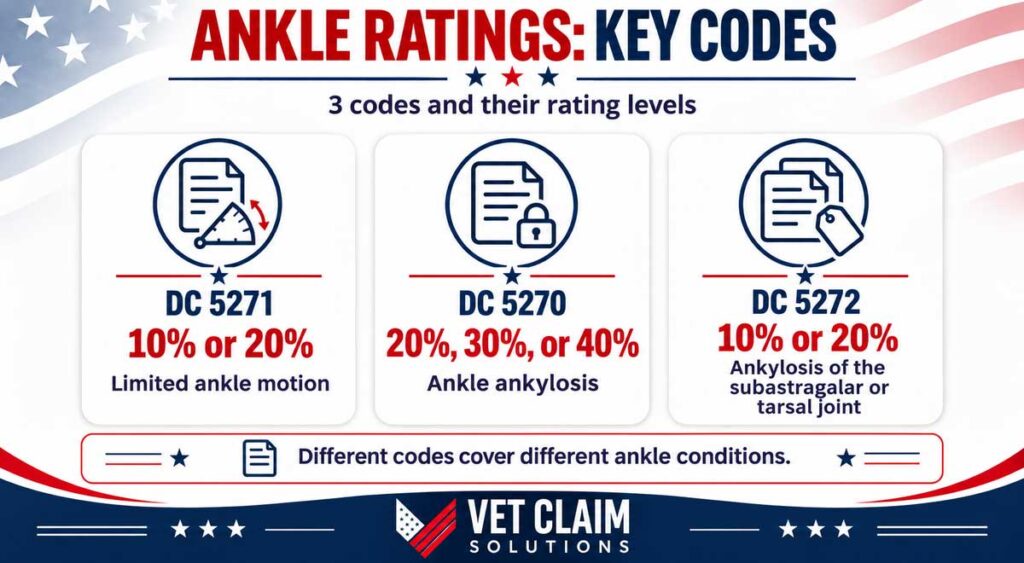
Moving the foot upward is called flexion, while pointing it downward is plantar flexion. Under DC 5271, moderate limitation qualifies for 10% when upward movement is less than 15 degrees or downward movement is less than 30 degrees. A 20% evaluation requires marked limitation: upward movement below 5 degrees or downward movement below 10 degrees.
For a fixed ankle, DC 5270 provides different rating criteria. A position below 30 degrees pointing downward corresponds to 20%; a downward position between 30 and 40 degrees, or an upward position between 0 and 10 degrees, corresponds to 30%. The 40% criteria cover a downward position over 40 degrees, an upward position over 10 degrees, or specified deformities.
The subastragalar joint sits below the main ankle joint. For DC 5272, a good weight-bearing position corresponds to 10%, while a poor position corresponds to 20%. By comparison, DC 5284 covers other foot injuries rather than ankle pain in general.
Movement and daily function
During an evaluation, an examiner may measure ankle movement and assess how pain, weakness, or repeated use affects function. These findings help explain limitations beyond a single measurement. Therefore, describe what happens after activity as well as what you can do at the appointment.
VA rules also address functional loss and painful motion. However, pain does not automatically establish the highest rating. A 0% evaluation may apply when compensable criteria are not met, subject to applicable rules.
If you have other service-connected conditions, VA combines ratings using its combined ratings method rather than simple addition. Consequently, a new ankle rating may not increase your combined percentage by the same amount.
Establishing service connection

Service connection establishes the relationship between a current condition and military service. Evidence may support a direct or secondary relationship. However, the details must fit the circumstances of your case.
Direct service connection
A direct application generally addresses a current condition, an event or injury during service, and a link between them. For example, records of an ankle sprain during training can help establish what happened. Current findings and a supported medical opinion may then help explain whether today’s limitations relate to that injury.
Service treatment records, duty reports, and witness statements can provide useful context. In addition, your own statement can describe when symptoms began and how they continued. Keep firsthand observations separate from conclusions that require professional expertise.
Secondary service connection
An ankle condition may also be related to an existing service-connected condition. For instance, a clinician may evaluate whether a documented change in walking mechanics caused or aggravated a separate ankle problem. Because several causes may be possible, the relationship needs case-specific support.
Other conditions may also be secondary to a service-connected ankle condition when the evidence supports causation or aggravation. However, a diagnosis or a change in gait alone does not establish that relationship. Ask the reviewing clinician to explain how the relevant history supports any opinion.
When describing your history, include the affected side, approximate dates, and changes in activity. As a result, the reviewer can follow the sequence without relying on assumptions.
Evidence that supports your application

Records and supporting statements
Start with relevant service records, VA records, and private provider records. Next, arrange them by date and identify what each document shows. A focused file is easier to follow than a large collection of unrelated or repeated pages.
For example, visit notes may describe swelling or instability, while a personal statement explains the effect on stairs or standing. Statements from family members or coworkers can add observations they personally witnessed. If there are gaps in care, explain the circumstances honestly rather than assuming those gaps decide the outcome.
When a nexus opinion may help
A nexus opinion explains a possible connection between a current condition and service or another service-connected condition. When that connection is unclear, a qualified clinician may review the records and provide a reasoned opinion. However, a separately purchased nexus letter is not required in every case and does not guarantee approval.
If an opinion is needed, provide the relevant history and records first. The clinician should identify the evidence considered and explain how it supports the conclusion. Otherwise, the central question may remain unanswered.
Preparing for a C and P exam
VA may request a compensation and pension exam when it needs more information. However, some applications can be decided from sufficient existing evidence. An exam helps document the condition and its severity; it is not a treatment appointment.
Describe your usual symptoms, better days, and flare-ups accurately. For example, explain how often a flare occurs, how long it lasts, and which activities become harder. Include limitations after repeated use, such as standing through a work shift.
Bring brief notes to help you remember details, and follow instructions for submitting new records. If you cannot attend, contact VA or the contractor promptly. Above all, avoid minimizing or exaggerating your symptoms.
How to prepare and file
A clear sequence can help you keep documents and deadlines organized. Before you submit, review the evidence for the condition you are actually seeking to have evaluated. Then use the filing route that fits your situation.
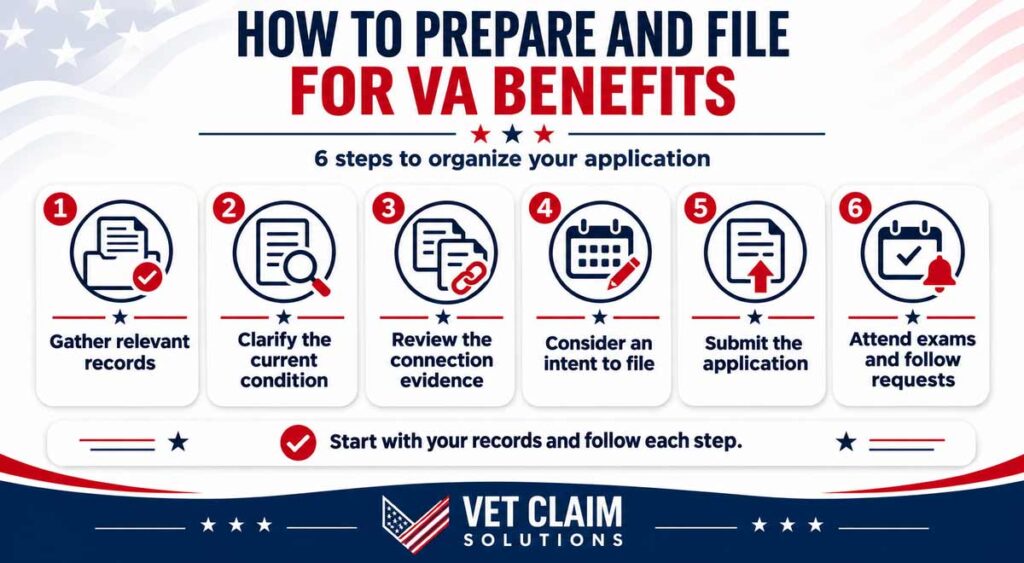
1 Gather relevant records
Collect or identify your separation documents, service treatment records, and relevant VA or private records. A provider list with treatment dates can help you track missing information. In addition, keep copies of submitted documents and any confirmation you receive.
2 Clarify the current condition
Review what your records say about the affected ankle and its limitations. If the condition or history is unclear, discuss it with an appropriate clinician. For an increase, focus on evidence showing how an already service-connected condition has worsened.
3 Review the connection evidence
Check whether the file explains the link to service or another service-connected condition. If that relationship remains unclear, additional records or a supported opinion may help. However, the same type of letter is not necessary for every application.
4 Consider an intent to file
If you need time to gather evidence, an intent to file may preserve a potential effective date. You generally have 1 year afterward to complete and submit the application. However, an intent to file does not guarantee approval or a particular effective date.
Starting the applicable online disability application while signed in with a verified account can automatically establish an intent to file. Therefore, check whether one is already active before submitting a separate form.
5 Submit the application
You can file through VA.gov, use the appropriate paper form, or work with a VA-accredited representative. For a new condition or an increase, VA Form 21-526EZ is the standard application. Before submitting, check that names, dates, the affected side, and attachments are accurate.
6 Attend exams and follow requests
Attend any scheduled exams and respond to VA requests by the stated deadlines. Keeping your contact information current helps notices reach you. If a request is unclear, ask VA or your accredited representative what is needed.
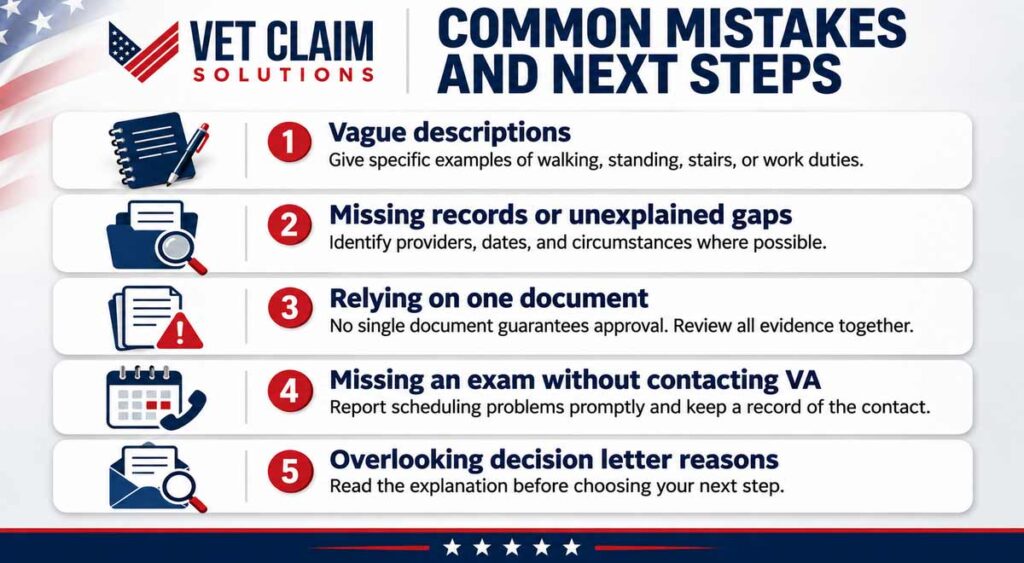
If you disagree with a decision, review VA’s decision review options. A Supplemental Claim allows new and relevant evidence, while Higher-Level Review does not accept new evidence. Because the options have different requirements, review the notice and applicable deadlines carefully.
Stay connected to care and support
Continue appropriate care for your needs and retain relevant records. When your limitations change, describe those changes accurately at appointments. In addition, a simple timeline of symptoms, visits, and submitted documents can make important details easier to find.
For filing or decision-review representation, you can find a VA-accredited representative. Accredited VSO representatives provide benefits representation without charge. If you need education or help organizing questions before your next step, Vet Claim Solutions offers VA Benefits coaching and preparation support.
Prepare for your next step
Understanding the VA disability rating for ankle pain starts with the criteria. Your records then explain how those criteria relate to your situation. Before filing, check whether the evidence addresses service connection, flare-ups, and daily limitations.
A complete, accurate record cannot promise a particular result. However, it can make the facts easier to understand and help you identify unanswered questions before filing.
Get your FREE consultation now at Vet Claim Solutions.