

It feels like you’re running on empty. Some days are a battle just to get out of bed. You know something isn’t right after what you went through in the service, but the thought of fighting the VA seems like another mountain to climb.
You’re not alone in feeling this way. So many veterans get stuck trying to understand the process for a VA PTSD rating. Dealing with PTSD symptoms, a VA claim, and a mental health disability can feel like a full-time job.
You served your country and made sacrifices. Now you need help, but the paperwork and rules feel like another enemy. This guide will show you how to approach your VA disability claim with confidence because you’ll understand what the VA is actually looking for.

What is a VA PTSD Claim Really About?
A VA claim for Post-Traumatic Stress Disorder isn’t about asking for a handout. It’s about getting recognition and disability compensation for a real injury you sustained during your active duty. A mental health condition is just as real as a physical one, it just happens to be an injury you can’t see on an X-ray.
The Department of Veterans Affairs needs to see three basic things to establish service connection for your disability claim. Think of it like a three-legged stool; without all three legs, it falls over. The success of your ptsd claim depends on these elements.
First, you need a current PTSD diagnosis from a qualified medical professional. Second, you must provide evidence of an event, or an in-service stressor, that occurred during your military service. Finally, you need a medical link, often called a “nexus,” connecting your diagnosis to that stressor. This is a medical opinion stating your PTSD is at least as likely as not caused by your service.
Breaking Down the Key PTSD Symptoms the VA Looks For
The VA doesn’t just want to know you have a PTSD diagnosis. They want to know exactly how your PTSD symptoms affect your daily life and cause social impairment. They use a specific framework to understand your symptoms, based on guidelines from the American Psychiatric Association.
This is not about checking boxes. It is about painting a clear picture of your struggles for the person reviewing your file. Knowing these categories helps you tell your story more effectively and can impact your final disability rating.
Re-experiencing the Trauma
This is perhaps the most well-known part of this particular stress disorder. It’s when you feel like you are living through the traumatic event all over again. The VA wants to know if this happens to you.
Do you have unwanted, upsetting memories that pop into your head? Are you dealing with flashbacks or nightmares that bring it all back? These experiences can feel incredibly real and terrifying, disrupting your work, your sleep, and your peace.

Avoiding Reminders
After going through something awful, it’s natural to want to stay away from anything that reminds you of it. This avoidance can take over your entire life. You might stop going to certain places, like crowded stores, or seeing certain people.
Maybe you avoid driving under overpasses or change the channel when a war movie comes on. Perhaps you even try to avoid thinking or talking about what happened, pushing it deep down. This behavior is a clear sign of social impairment and impacts your social relationships.
Negative Thoughts and Feelings
PTSD can change how you see yourself and the world. A dark cloud can seem to follow you everywhere you go. This is a very real part of the health condition.
Do you blame yourself or others for what happened? Have you lost interest in activities you once loved? Many veterans feel isolated and detached from their family and friends, as if they’re living behind a wall no one else can see through.
Feeling on Edge (Hyperarousal)
This is that feeling of being constantly on high alert. Your body’s alarm system is stuck in the “on” position. It is absolutely exhausting and takes a toll on a veteran’s daily life.
Are you jumpy or easily startled by loud noises? Do you feel irritable or have angry outbursts that seem to come from nowhere? Many veterans struggle with sleep, either finding it hard to fall asleep or stay asleep, because they never feel truly safe.

How Your VA PTSD Rating Gets Calculated
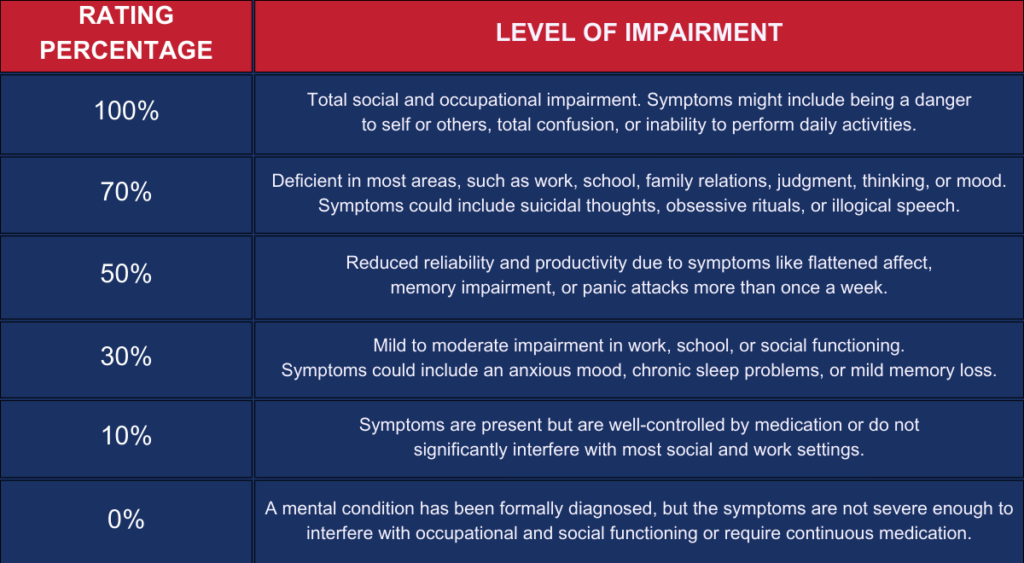
The VA rating isn’t about how “bad” your trauma was. It’s all about how much your symptoms disrupt your ability to function in your daily life. This is called “social and occupational impairment.”
The VA uses a rating schedule that goes from 0% to 100% for all mental disorders. A higher percent rating means your symptoms cause more problems with your job, your schooling, or your relationships. The goal is to get the ptsd disability rating that accurately reflects your level of impairment.
A 10% rating might mean your symptoms are present but don’t cause major issues, while a 100% rating signifies total disability. Understanding the rating criteria is important. You must clearly explain how your symptoms affect your life and your work efficiency to get the VA benefits you deserve.
Filing Your VA Claim: Steps to Take Right Now
Thinking about the claim process can feel overwhelming. The best way to tackle it is one step at a time. Breaking it down makes it much more manageable.
You do not have to do it all in one day. But you do have to start. Your well-being and access to VA disability benefits depend on it.
Getting a Diagnosis
You can’t get a ptsd rating for a condition you haven’t been diagnosed with. If you suspect you have PTSD, your first step is to see a mental health professional. This could be a psychiatrist, psychologist, or a licensed social worker, either through VA health care or a private provider.
A formal PTSD diagnosis from a qualified expert is the foundation of your claim. The VA puts a lot of weight on medical evidence. The more detailed your doctor’s notes are about your mental health condition, the better.
Proving a Service Connection
Next, you have to connect that diagnosis to your military service. You need to identify a specific event, or in-service stressor, that happened while you were in uniform. This is what caused your PTSD.
For combat veterans, this can be straightforward, as the VA may concede the stressor. But what if your trauma wasn’t from combat? According to research from the National Bureau of Economic Research, non-combat trauma can be just as impactful.
It could be from military sexual trauma (MST), a serious training accident, or a rescue operation. Evidence could be from your service records, news articles, or statements from others. This is also true for other health conditions, such as those linked to service at Camp Lejeune.
The C&P Exam: What to Expect
The VA will almost certainly schedule you for a Compensation and Pension (C&P) exam. This is an appointment with a VA doctor or a contractor. Their job is to evaluate your symptoms and give an opinion about your condition using a Disability Benefits Questionnaire.
This meeting is incredibly important for your VA disability claim. Do not downplay your symptoms; be honest about your worst days, not just your best ones. Explain exactly how your PTSD affects you at work, at home, and in your social relationships.
The C&P examiner will likely use a benefits questionnaire to guide the interview. Being prepared to discuss how your mental disorder impacts your veteran’s life is essential. This is your chance to tell your story directly to someone who will heavily influence the VA’s rating decision.

Buddy Statements and Personal Statements
Do not underestimate the power of your own words and the words of those around you. A personal statement, written by you, can tie all the evidence together. You can explain, in your own words, what happened and how your life has changed.
Statements from your spouse, friends, family members, or fellow service members can be very powerful. These are often called “buddy statements” or lay evidence. They can confirm your stressor event or describe the changes they’ve seen in you since you left the service.
These firsthand accounts add a human element that medical records alone cannot capture. They provide real-world context to the medical jargon. This helps the VA rater understand the full scope of your ptsd disability.
Understanding Total Disability Individual Unemployability (TDIU)
Sometimes, a veteran’s PTSD is so severe they cannot maintain substantially gainful employment, even if their disability rating is less than 100 percent. In these cases, you might be eligible for Total Disability Individual Unemployability (TDIU). This is a part of veterans disability law that allows the VA to pay you at the 100% rate.
To qualify, you generally need one service-connected disability rated at 60% or more, or multiple disabilities with a combined rating of 70% where at least one is rated at 40%. You must also show that your service-connected health conditions prevent you from working.
TDIU is a critical VA benefit for those whose PTSD makes steady work impossible. It acknowledges that the numbers on the rating schedule do not always capture the full impact on a veteran’s life. Pursuing TDIU can be a way to get the financial support you need when your ptsd va rating does not reflect your inability to work.
After the Rating Decision: The Appeals Process
After you submit your claim and complete your C&P exam, the VA will mail you a rating decision. This document will detail their findings, your assigned percent disability, and the effective date of your benefits. It is crucial to read this letter carefully.
If you disagree with the VA’s decision, do not give up. You have the right to appeal. The modern appeals process gives veterans several options.
You can file a Supplemental Claim if you have new and relevant evidence to submit. You can request a Higher-Level Review, where a more senior claims adjudicator will review your case. Or you can appeal directly to the Board of Veterans’ Appeals. Understanding the appeals process is vital to getting the correct VA disability rating.

Conclusion
This process is a marathon, not a sprint. It takes patience and preparation, but you can get through it. Understanding how the system works removes a lot of the fear and frustration that comes with filing a VA disability claim.
You are your own best advocate in this fight. Focus on building a strong case piece by piece, from getting a solid PTSD diagnosis to collecting statements from those who know you best. You need to clearly show how your PTSD symptoms affect your veteran’s daily life to get the VA PTSD rating and mental health disability benefits you have earned.
Remember, this isn’t about asking for a favor; it’s about claiming a VA benefit you are rightfully owed for your service and sacrifice. Accessing your earned disability benefits can provide the stability you need to focus on your health. With the right approach, you can get the support you need from the Department of Veterans Affairs.