


If you are looking into a VA MST claim military sexual trauma benefits MST evidence VA, you might feel overwhelmed and unsure where to begin. It is a path that requires immense courage, and you have already taken the first step by seeking answers. You are not alone in this, and help is available from the Department of Veterans Affairs and other organizations.
This guide will explain what military sexual trauma is and how the VA handles these specific claims. We will walk through the kinds of evidence that can support your case, even if you never reported the incident during your active-duty service. This information is meant to help you get the veterans benefits you rightfully earned.
What Exactly is Military Sexual Trauma (MST)?

First, it is important to understand what MST means. According to Veterans Affairs, military sexual trauma is not a diagnosis or a mental condition. Instead, it refers to a deeply personal and traumatic experience a veteran endured during their time in the military.
MST includes sexual assault or repeated, threatening sexual harassment experienced by service members. This covers any sexual activity you were involved in against your will. It could have involved physical force, threats of negative consequences, or situations where you could not give consent.
This trauma can happen to anyone, regardless of gender, and it can occur on or off duty. The federal government recognizes the serious impact of these events. Understanding this definition is the first step in building your MST claim.
Connecting MST to a VA Disability Claim
You do not file a disability claim for the MST experience itself. You file a claim for a medical condition that was caused or made worse by the trauma. Many of these conditions are a direct result of the MST.
These conditions can appear months or even years after the traumatic event. Many veterans with a history of MST are diagnosed with posttraumatic stress disorder (PTSD). However, PTSD is not the only possible diagnosis resulting from MST.
Other common diagnoses include depression, anxiety, other types of stress disorder, and substance use disorders. Your goal when gathering evidence for the claim file is to show the VA that your current diagnosed condition has a clear service connection to the trauma you experienced in service.
The Core Challenge: Finding Evidence for an MST Claim
Gathering evidence is often the hardest part for survivors. Many people who experience MST do not report it at the time for valid reasons. The fear of retaliation, being disbelieved, or damaging one’s military career is very real and understandable.
The VA acknowledges this reality. Because of this, the rules for proving a connection for an MST-related claim are more flexible than for standard claims. You do not need the same level of direct proof, such as an official report made during active duty.
Instead, the VA will look for “markers,” which is another term for indirect evidence. These markers are signs in your records or life that suggest a change in behavior or circumstances. They help point to a traumatic event happening during your military service.

What are ‘Markers’ in a VA MST Claim Military Sexual Trauma Benefits MST Evidence VA?
Markers are the essential clues that help tell your story when official reports are missing from your file. They are crucial pieces of evidence that can establish a link, or nexus, between your trauma and your current physical or mental health condition. Think of them as connecting the dots for the VA claims processor.
The VA has a legal duty to assist you in finding these markers in your official records. However, your claim will be much stronger if you can identify and submit evidence yourself. Let’s look at the kinds of markers that can strengthen your case for disability benefits.
Service Records as Markers
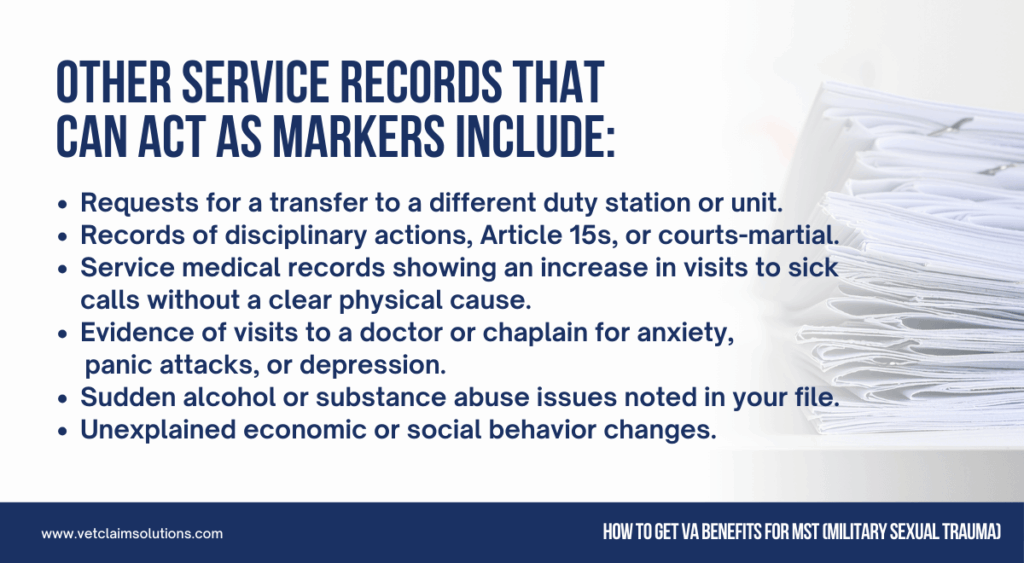
Your official military records, including your service medical records, can hold powerful clues. Often, a person’s behavior and performance change drastically after a traumatic event. These changes can be documented in your files, even if the reason for the change is not.
Look for things like a sudden drop in your performance evaluations. Were you an excellent service member who suddenly began to struggle? That is a significant marker.
Lay Statements and Buddy Letters
What you and others have to say about your experience matters a great deal. A lay statement, often submitted on VA Form 21-10210 (Statement in Support of Claim), is your opportunity to tell your story in your own words. Sharing sensitive information is difficult, but this is a critical piece of evidence needed for your claim.
In this statement, you should describe what happened and, more importantly, how it has affected your life since. Explain the changes you’ve seen in yourself, your relationships, and your ability to work or function day-to-day. You can submit additional evidence at any time during the process.
Buddy letters from people who knew you before and after the trauma are also powerful. These are statements from individuals who can speak to the changes they witnessed.

They can write about the changes they observed in your personality, mood, or behavior. For example, a friend could describe how you became more withdrawn, angry, or anxious after a specific period of your active-duty service.
Civilian and Other Records
Your life outside the military can also hold important evidence for the veteran’s application. These records help paint a complete picture of the trauma’s impact over time. These alternative sources of information are very valuable.
Did you seek help after you left the service? Records from civilian doctors, therapists, or counselors are very strong evidence. These treatment records can establish a timeline for your symptoms and your efforts to get help.
Other documents can include journals or diaries you kept during that time. Even emails or letters sent to family describing your distress can be used to support MST-related claims. Records from a rape crisis center, law enforcement, or student health services can also be submitted.
How to File Your MST-Related Claim
Once you have started gathering evidence, it is time to start the claims process. Breaking it down into manageable steps can make it feel less overwhelming. Here is a general outline of what you need to do.
- Get a Current Diagnosis. You must have a current diagnosis of a mental health condition from a qualified professional, like a psychologist or psychiatrist. This is the condition, such as posttraumatic stress, that you will be claiming is a service-connected disability.
- Gather Your Evidence. Collect all your service records, medical files, lay statements, and buddy letters. Make copies of everything for your own records before you send anything to the VA.
- Complete the Correct Forms. You will file your claim using VA Form 21-526EZ, Application for Disability Compensation. You must also include VA Form 21-0781a, Statement in Support of Claim for Service Connection for PTSD Secondary to Personal Assault. Even if your diagnosis isn’t PTSD, this is the correct form to use for MST claims.
- Submit Your Claim. You can submit your claim online through the VA official website, by mail to the evidence intake center.
What Happens at an MST C&P Exam?
After you file your claim, the VA will likely schedule you for a Compensation and Pension (C&P) exam. This is a medical appointment with a VA or a VA-contracted doctor. This appointment is a key part of the process for getting VA benefits.
The purpose is to evaluate your condition and provide a medical opinion on whether there is a link to your military service. It is completely normal to feel nervous about this appointment, but you have rights that protect you.
The VA’s policy states that your C&P examiner for an MST-related claim must have special training. You also have the right to request a provider of a specific gender if it would make you feel more comfortable. You must make this request when the VA or its contractor calls to schedule the exam.
During the exam, be honest and open about your symptoms and how they impact you every day. Do not downplay your struggles. It is okay to bring notes to make sure you do not forget anything important you want to discuss.
VA Ratings for Conditions Caused by MST
If the VA approves service connection for your condition, you will receive a disability rating. This rating, from 0% to 100%, is based on how much your symptoms affect your daily life and ability to work. This rating determines the amount of your monthly disability compensation.
For mental health conditions like PTSD, ratings are generally given at 0%, 10%, 30%, 50%, 70%, or 100%. A higher rating signifies that the symptoms are more severe and have a greater impact on your social and occupational functioning. Even a 0% rating is valuable, as it establishes a service-connected disability and grants eligibility for VA health care.
Here is a general breakdown of what those ratings often mean for a mental health condition:
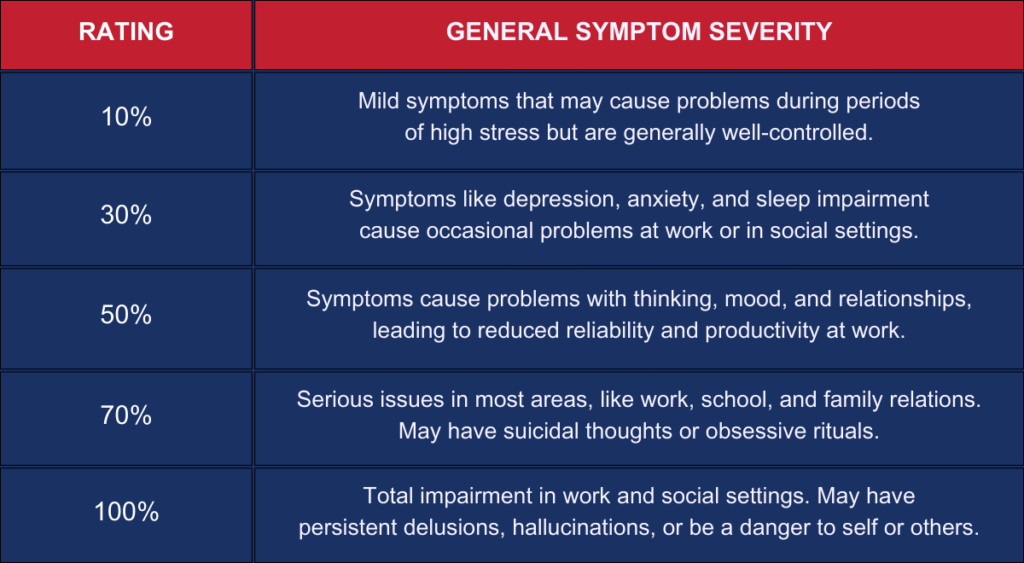
This table is just a general guide. The VA looks at all of your specific symptoms and evidence to assign a rating. A decision will be made by your regional office.
VA Resources for MST Survivors
It is important to know that help is available right now, even before you file a claim. Every VA medical center has an MST Coordinator who can help you access care. They serve as a contact person for MST-related issues and can help you get the health services you need.
You can receive free, confidential counseling and treatment for conditions related to your experience of MST. This VA care is available at every VA health facility. You do not need to have a VA disability rating or be enrolled in VA health care to access these specific services.
Vet Centers also offer confidential counseling for veterans and service members, including for MST-related trauma. These are community-based centers that provide a wide range of social and psychological services. VA outreach programs are designed to connect you with the support you need.
What if Your Claim is Denied?
If your MST claim is denied, do not give up hope. A denial is not the end of the road, and many veterans are successful on appeal. Carefully read the decision letter from the VA to understand why they denied your claim.
You generally have one year from the date of the decision letter to file an appeal. There are three main options: a Supplemental Claim, a Higher-Level Review, or an appeal to the Board of Veterans’ Appeals. A Supplemental Claim is often the best choice if you have new and relevant evidence to submit.

Conclusion
This process is not easy, but you can get through it. The most important thing is to be kind to yourself and persist. Filing for a VA MST claim military sexual trauma benefits MST evidence VA takes incredible courage and strength.
By understanding how the VA looks at these MST claims and by carefully gathering your evidence, you can build a strong case for the disability compensation you need. Your experience was real, it matters, and you deserve support and healing from the Veterans Affairs system.