

Are you dealing with a constantly runny nose or struggling to catch your breath? If your military service left you with allergic rhinitis or asthma, you know the daily struggle. This article covers secondary VA conditions allergic rhinitis VA asthma secondary conditions.
You might be suffering from other ailments directly caused by your service-connected breathing problems, and you deserve compensation for them. It’s not just about the initial diagnosis; it’s about the full impact on your health. Knowing about secondary VA conditions allergic rhinitis VA asthma secondary conditions can be a game-changer for your disability claim.

Understanding Service-Connected Allergic Rhinitis and Asthma
Allergic rhinitis is more than a simple case of the sniffles for many veterans. It is a chronic inflammation inside your nose, leading to persistent sneezing, severe nasal congestion, and an itchy, runny nose that never seems to stop. Asthma is an even more serious disorder, as it inflames and narrows your airways, making breathing a constant challenge.
For many who served, these conditions are a direct result of military service. Exposures during deployments are often the root cause of these respiratory issues. Consider the air quality in locations like Iraq and Afghanistan, with prolonged exposure to burn pits and fine particulate matter from sand and dust.
The PACT Act has significantly expanded disability benefits for veterans exposed to these and other toxins. This legislation makes it easier to establish a secondary service connection for conditions like chronic rhinitis and asthma. This law helps prove the link between your time in service and your current health problems.
What Is a Secondary Service-Connected Condition?
What does “secondary” actually mean in the context of a VA claim? Think of it as a domino effect within your body. You have a primary condition that the VA has already determined is a service-connected condition, such as allergic rhinitis or asthma.
A secondary condition is a new health issue that is caused or aggravated by that primary service-connected disability. For example, a veteran with a service-connected knee injury from a parachute jump might later develop arthritis in that knee. The arthritis would be considered one of the conditions secondary to the initial injury.
The key to a successful claim is proving the connection, or what the VA calls a “medical nexus.” You must provide evidence showing that your secondary health problem would not have occurred, or would not be as severe, without the primary one. This is crucial for establishing secondary service for any new diagnosis.

The Connection: Secondary VA Conditions Allergic Rhinitis VA Asthma Secondary Conditions
Living with chronic breathing issues takes a significant toll on your entire body. The constant inflammation and stress from service-connected allergic rhinitis and asthma can trigger a cascade of other health problems. These are not separate, unrelated issues; they are often direct results of your primary condition recognized by the VA.
Sleep Apnea
Do you wake up feeling tired no matter how much you slept? Do you snore loudly or find yourself gasping for air during the night? You may have obstructive sleep apnea (OSA), a serious condition where your breathing stops and starts repeatedly during sleep.
The link between these conditions is quite direct. The chronic nasal congestion from allergic rhinitis blocks your nasal passages. This obstruction makes it much harder for air to flow, which can lead to the airway collapsing that defines sleep apnea secondary to rhinitis.
A medical review found a strong association between allergic rhinitis and sleep apnea, showing this is a well-established medical connection. The struggle for air during apnea sleep episodes can disrupt your rest and affect your health in other ways, like raising your blood pressure. For many veterans, developing obstructive sleep apnea is a direct consequence of their rhinitis.
Sinusitis and Headaches
If you have allergic rhinitis va disability, your sinuses are likely in a constant state of irritation. This persistent inflammation can easily lead to chronic sinusitis. This condition involves swollen and inflamed cavities around your nasal passages, causing facial pain, pressure, and thick nasal discharge.
This sinus pressure often does not stay confined to your face. It can radiate outward, causing persistent, throbbing headaches or even triggering severe migraines secondary to the sinus issues. If you are battling frequent headaches along with your rhinitis symptoms, they could be connected and considered for a secondary VA rating.
GERD (Gastroesophageal Reflux Disease)
The relationship between service-connected asthma and GERD can be a two-way street. GERD is a disorder where stomach acid frequently flows back into the esophagus. This reflux can cause painful heartburn and damage the lining of your esophagus over time.
Some medications for allergies asthma secondary conditions, particularly certain inhalers, can relax the muscle at the bottom of the esophagus. This makes it easier for stomach acid to move upward. Additionally, the physical strain of frequent coughing from an asthma attack can put pressure on your abdomen, which may be how the asthma triggered the reflux.
Hypertension
Hypertension, or high blood pressure, is another condition that can be linked to your primary respiratory issues. The connection is often made through another secondary condition, like sleep apnea. When you have sleep apnea, your body is repeatedly deprived of oxygen during the night.
These drops in oxygen signal your blood vessels to tighten to increase oxygen flow to your heart and brain. This process puts a significant strain on your cardiovascular system and can lead to a sustained increase in your blood pressure over time. Therefore, you could claim hypertension secondary to sleep apnea, which is itself secondary to allergic rhinitis.
Depression and Anxiety
The mental and emotional burden of a chronic illness cannot be overstated. Struggling for breath or never getting a full night of restorative sleep is exhausting and incredibly stressful. It can limit your ability to work, enjoy your hobbies, or manage your daily activities.
This constant struggle can understandably lead to mental health conditions like depression and anxiety. If your life has been negatively impacted by the daily grind of managing allergic rhinitis symptoms or asthma, a resulting mental health diagnosis could be a valid disorder secondary claim. Your mental well-being is just as important as your physical health when pursuing disability benefits.
How to Prove Your Secondary Condition

Simply knowing you have a secondary condition is not enough; you must prove it to the VA. This process requires gathering the right medical evidence to build a strong va claim. You need to clearly connect the dots for the VA rater who will be reviewing your file.
First, you need a current diagnosis for the secondary condition from a qualified medical professional. If you suspect you have sleep apnea, you must complete a sleep study. If you believe you have GERD, you need a diagnosis from your doctor based on your medical records and symptoms.
The most crucial piece of evidence is often a medical nexus letter. This is a statement from a doctor that clearly explains the medical link between your primary and secondary conditions. The doctor should use specific language, such as “it is at least as likely as not,” that your service-connected allergic rhinitis caused or worsened your sleep apnea.
A strong nexus letter can be the deciding factor in your claim. Do not forget other supporting documents like treatment records and your own written statement. Explaining how your primary condition impacts your life and contributes to your secondary symptoms provides valuable context for the VA.
The VA Rating Process for Secondary Conditions
After you have established a service connection for a secondary condition, the VA will assign it a VA disability rating. This rating, or va rate, is based on the severity of your symptoms, just like any other condition. Each disability has its own rating criteria under the VA Schedule for Rating Disabilities (VASRD), found in 38 CFR § 4.
Your secondary condition rating is then combined with your other va rates. The VA uses a method often called “VA Math” to calculate your total disability percentage. It is not a simple addition; a 50% rating and a 30% rating do not result in an 80% rating.
The VA combines ratings using a specific formula to determine your overall percentage. The logic is that the VA considers you a whole person, so each additional disability rating is applied to your remaining “healthy” percentage. For those with multiple ratings, an expert-level va claim professional can help you understand the calculation.
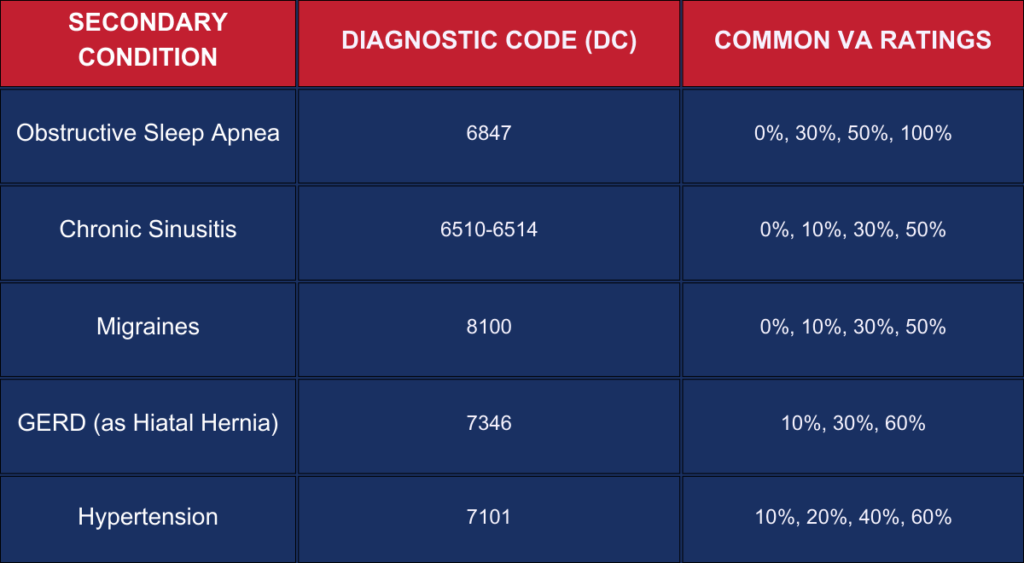
To help you understand how these conditions are rated, here is a table of common allergic rhinitis secondary conditions and their potential VA ratings.
A veteran reported that getting all their medical evidence in order was the most important step. To provide medical evidence effectively, make sure all your treatment records are complete. Evidence showing a consistent history of symptoms is very persuasive.
Conclusion
Your fight did not end when you left the service. For many, the daily battle with health issues is a constant reminder of their sacrifices. If you are service-connected for allergic rhinitis or asthma, take a hard look at your overall health.
Those seemingly separate problems like headaches, poor sleep, or depression might be directly connected. Pursuing a claim for secondary VA conditions allergic rhinitis VA asthma secondary conditions is about getting the full benefits you have rightfully earned. Do not underestimate how these conditions are linked, because addressing them can lead to the support and compensation you deserve.