


If you’re dealing with numbness, tingling, or weakness in your hands, you might have carpal tunnel. That pain is real, and it can seriously affect your life. Many veterans face this after their service, and figuring out the VA carpal tunnel rating peripheral nerve VA claims CTS veterans process can feel like a huge challenge.
But you’re not alone in this fight. This is about getting the benefits you rightfully earned for a condition linked to your time in the military. You’ll learn the steps and what you need to know about the VA carpal tunnel rating peripheral nerve VA claims CTS veterans system.

What Exactly Is Carpal Tunnel Syndrome?
Let’s break it down simply. Carpal Tunnel Syndrome, or CTS, happens when the median nerve gets squeezed. This is one of the main peripheral nerves that runs from your forearm into the palm of your hand. It controls feelings and movement in your thumb, index finger, middle finger, and half of the ring finger.
The carpal tunnel itself is a narrow passageway of bone and ligament at the base of your hand that houses the median nerve and tendons. When this area gets swollen or irritated, it puts pressure on the nerve, causing a lot of problems. This pressure can lead to symptoms that are often classified as a type of peripheral neuropathy.
You might feel a gradual numbness, a tingling sensation like pins and needles, or outright weakness in your hand carpal tunnel area. Many veterans report dropping things or having trouble with simple tasks like buttoning a shirt. The symptoms often start slow and can get worse over time, especially at night, sometimes waking you from sleep.
The specific sensations you feel, known medically as paresthesias and/or dysesthesias, are key indicators of nerve compression. A doctor may test your ability to feel light touch or check for other sensory deficits during an examination.
Connecting Carpal Tunnel to Your Military Service
So, how do you prove your CTS is from your service? The VA needs to see a clear link for you to receive a service-connected disability rating. For the veteran’s carpal tunnel syndrome, this often comes down to the repetitive tasks you performed in uniform.
Think about your Military Occupational Specialty (MOS). Were you a mechanic constantly using vibrating tools? A communications specialist who typed all day long? Maybe you were an infantryman who repeatedly handled a rifle, loaded magazines, or performed other demanding tasks with your hands.
All these jobs involve frequent and repetitive use of the hands and wrists, including forceful gripping or repeated palmar flexion. This constant motion can lead to irritation and swelling in the wrist, causing CTS. The VA recognizes that these types of activities put you at risk, making your military duties a key piece of the puzzle for a successful VA claim.
Proving Your Claim: The Three Main Pillars
To win your claim, the VA needs you to show three things. This is the foundation of any successful VA disability claim, including one for CTS. Without all three, the claim will likely be denied.

A Current Medical Diagnosis
First, you need a current diagnosis of carpal tunnel syndrome from a qualified doctor. You cannot self-diagnose; you must have formal medical evidence. This means a report in your treatment records from your doctor, or even from private treatment, that officially states you have CTS.
Your doctor might use physical tests to help confirm the diagnosis. A Phalen’s maneuver, where you flex your wrist, or a Tinel’s sign, involving tapping over the nerve, are common. For more objective and probative evidence, an Electromyography (EMG) or a Nerve Conduction Study can measure how well your median nerve is working.
These tests are powerful tools in a VA claim because they provide concrete data on nerve damage. They can help establish the severity of your condition, which directly impacts your potential percent disability rating.
An In-Service Event or Injury
Next, you must point to something that happened during your service. This could be a specific injury, like a fracture to your left wrist, that later caused problems. More often for CTS, it’s the cumulative wear and tear from your daily duties.
Gather evidence of these duties from your service records. Your job description, performance reports, or even buddy statements from fellow service members can help paint a picture for the VA. You are showing them that your job required the kind of motions that cause the veteran’s carpal tunnel condition.
If you complained about hand or wrist pain while in service, finding those notes in your service treatment records is invaluable. This establishes a documented history of the problem beginning during your military tenure.
The All-Important Nexus Letter
Finally, you need to connect the first two pillars. A nexus letter is a statement from a medical professional that links your current CTS diagnosis to your in-service event or duties. This is a critical piece of evidence that can make or break your claim.
The doctor essentially states that it is “at least as likely as not” that your military service caused or aggravated your carpal tunnel syndrome. This specific phrasing is important because it meets the VA’s standard of proof, which is to resolve reasonable doubt in favor of the veteran.
Without this medical opinion, the VA might not see the connection. Finding a doctor who understands VA terminology and is willing to review your service records can make a significant difference in the strength of your claim.

How the VA Rates Carpal Tunnel Syndrome
The VA does not have a specific diagnostic code just for carpal tunnel syndrome. Instead, it rates the condition based on the specific peripheral nerve affected—in this case, the median nerve. The disability ratings are found under Diagnostic Codes 8515, 8615, and 8715 for the median nerve, depending on the severity of the nerve issue.
The VA evaluates the severity of your symptoms based on three main levels of incomplete paralysis: mild, moderate, and severe. There is also a rating for complete paralysis. The rating criteria consider the loss of sensation and loss of muscle function, which can be observed through signs like muscle atrophy.
Here’s how the ratings generally break down for the median nerve:
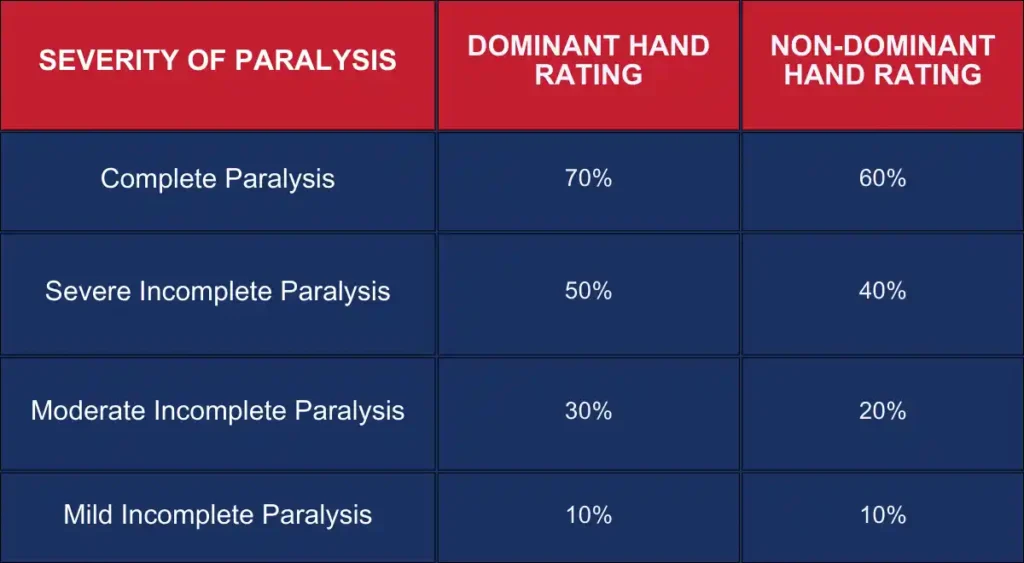
Your assigned percent rating will depend heavily on the medical evidence and the findings from your Compensation and Pension (C&P) exam. During VA examinations, the VA examiner will assess your muscle strength, range of motion, and sensory feelings. The final rating decision will be based on these collected facts.
Understanding Your Dominant vs. Non-Dominant Hand
Did you notice the different ratings in the table? The VA gives a higher VA disability rating if your carpal tunnel affects your dominant hand. This is because a disability in the hand you use for most tasks is considered more limiting to your overall earning capacity.
When you file your claim, you’ll need to specify which hand is your dominant one. Be honest and consistent during your C&P exam about how your CTS impacts daily activities. Simple things like writing, holding a cup, or using a computer mouse can become very difficult, affecting your VA carpal tunnel rating peripheral nerve VA claims CTS veterans outcome.
This higher rating for the dominant hand acknowledges the greater impact the condition has on your everyday life. Make sure your doctor’s reports and your own statements clearly explain these difficulties to justify a rating greater than the minimum.
What If You Have Carpal Tunnel in Both Hands?
It is very common for veterans to develop CTS in both hands, a condition called bilateral carpal tunnel. If you get a service-connected disability for both your right and left hands, the VA applies what’s known as the bilateral factor. This is an important detail that affects your monthly compensation.
Here’s how it works. The VA combines your two ratings using their special “VA Math.” Then, they add an extra 10% of that combined value to your total disability rating. This is meant to compensate for the more significant disability of having issues with both bilateral upper extremities.
For example, let’s say you get a 30% rating for moderate incomplete paralysis in your dominant right hand and a 20% rating for moderate incomplete paralysis in your non-dominant hand. The VA’s math would combine these to 44%, and then the bilateral factor would add another 4.4% (rounded to 4%), resulting in a 48% combined rating (which rounds up to a 50% percent disabling payment). This rule can significantly boost your final compensation.

Secondary Conditions Related to Carpal Tunnel
Sometimes, carpal tunnel isn’t a direct result of your service but is caused by another service-connected condition. This is known as a secondary service connection. It is another valid path for your claim and can apply to many service-connected disabilities.
For example, you might have a service-connected wrist injury, hypothyroidism, arthritis, or even diabetes mellitus. These conditions are known risk factors for developing CTS. Other issues like a ganglion cyst on the wrist can also cause median nerve compression.
If your doctor can write a nexus letter connecting your primary service-connected condition to the development of your carpal tunnel, you can file a claim on a secondary basis. The board finds this type of evidence compelling when properly documented. You could also develop other problems because of your veteran’s carpal tunnel; chronic pain could lead to depression or anxiety, which could also be claimed as secondary conditions.
Taking the Steps to File Your Claim
Ready to get the process started? Filing your claim involves collecting all your evidence and submitting it to the VA. This is where all your preparation pays off in establishing your service connected status.
You can file your claim online, by mail, or in person at a VA regional office. The standard form for compensation is the VA Form 21-526EZ, Application for Disability Compensation and Related Compensation Benefits. Be thorough and attach all your supporting documents.
This includes your medical diagnosis from your treatment record, your nexus letter, your service records highlighting relevant duties, and buddy statements. The more complete your initial application is, the smoother the process will be. If your condition worsens after a decision, you can also file for an increased rating.

The C&P Exam for Carpal Tunnel
After you file, the VA will likely schedule you for a Compensation & Pension (C&P) exam. This appointment with a VA examiner or a contracted physician is crucial. The examiner’s report will heavily influence the VA’s rating decision.
During the exam, the doctor will ask about your symptoms and how they affect your daily life. Be honest and specific. They will perform physical tests, checking your grip strength, range of motion, and sensation to light touch.
They will also look for physical signs of nerve damage, like muscle atrophy in the thumb pad. It is important to attend this VA examination and describe all your symptoms accurately. This is your chance to show the VA how your service-connected carpal tunnel truly impacts you.
Conclusion
Working through the claims process takes patience, but it’s manageable when you understand the steps. Proving your carpal tunnel is linked to your service is about connecting the dots for the VA. With a current diagnosis, proof of an in-service cause, and a strong medical nexus, you are on the right path.
Understanding the details of the VA carpal tunnel rating peripheral nerve VA claims CTS veterans system helps you build a stronger case. This knowledge empowers you to gather the right evidence and clearly explain your condition. Ultimately, it helps you secure the monthly compensation and benefits you rightfully deserve for your service to our country.