


You are probably here because you feel stuck. You have a service-connected condition, new problems have piled on, and now you are trying to figure out how a secondary VA claim VA nexus letter VA disability increase all work together. You know your health is worse, but the rating on paper has not caught up with your reality yet.
Maybe your PTSD meds led to weight gain and now you are dealing with sleep apnea. Maybe years of walking funny from a bad back led to knee or hip pain. Or your constant tinnitus has triggered brutal migraines that knock you out for days.
You are not making this stuff up. VA rules actually allow you to connect these follow-on conditions, raise your combined rating, and get paid more. That is where a secondary VA claim VA nexus letter VA disability increase strategy comes into play.
We are going to break down this process in plain English. We will cover how to identify a secondary service connection. We will also discuss the medical evidence showing you deserve a higher rating.

What A Secondary VA Claim Really Is
The VA has a name for those “one thing led to another” health problems. They call them secondary conditions. This is distinct from a primary service-connected disability, which happened directly during your military service.
The VA explains that a secondary VA condition is a disability that is either caused or made worse by a condition that is already service connected at 0 percent or higher. That part matters greatly for your success. If your first condition is not service connected, the VA will not even look at the secondary link.
The legal backbone is found in 38 CFR 3.310(a) and (b) and in more detail at 38 CFR § 3.310. These rules say the VA can grant service connection for a disability that is approximately due to, the result of, or aggravated by an existing service-connected condition. This concept allows you to link a new health condition to an old one.
Here are a few everyday examples you might see in real life.
- PTSD causing or aggravating obstructive sleep apnea.
- Chronic back pain causing radiculopathy down your legs.
- Long-term diabetes causing diabetic neuropathy in your feet.
- Severe tinnitus triggering regular migraines.

Once you understand that secondary claims are built into the law, you stop feeling like you are asking for something extra. You are just asking the VA to recognize what is already happening in your body. This is a standard part of the claims process.
Why Secondary Claims Matter For Your VA Disability Increase
Maybe your first rating was low because you were just trying to get something on the books. Then time went by, your body took more hits, and suddenly that old rating no longer matches your life. You need to file a new VA claim to fix this.
Secondary conditions can help raise your combined rating significantly. The VA uses a special combined rating chart, not simple addition. So 50 percent and 30 percent do not add up to 80 percent the way you might expect.
This is why some veterans leave money on the table. They look at one condition at a time instead of the bigger picture of all their linked issues. By stacking secondary ratings the right way, you may move from 40 to 70, from 70 to 90, or even toward unemployability.
If your primary condition is something like back pain, it can spread. Our guide on back pain and VA disability explains how pain that changes the way you walk can later cause hip, knee, or nerve issues that may qualify as secondary. This is often referred to as a secondary disability.
Same idea for other chronic problems. Hiatal hernia or reflux can cause long-term digestive trouble. You can learn more about that link in this hiatal hernia and VA disability breakdown, especially if meds for other conditions make your reflux worse.
Conditions like fibromyalgia often connect with sleep trouble, mental health, or stomach issues. If you are already service connected for one of those and later diagnosed with fibromyalgia, check out our guide to a fibromyalgia VA disability rating. You may have more paths to an increase va rating than you think.
The Missing Piece: Causation And Aggravation
Secondary claims usually live or die on one word. Causation. You must prove the relationship between your disabilities.
In plain language, causation means one thing actually caused the other. If your service-connected diabetes led to nerve damage in your feet, that neuropathy can be rated as a secondary condition. This is a direct line of sight between the two.
But the law also recognizes aggravation. This is when your primary condition did not create the new issue from scratch, but it did make it permanently worse. The phrase “not caused” usually applies here, meaning the secondary issue existed before but was mild.
Under 38 CFR § 3.310, the VA has to look at how much worse the condition got because of your service-connected disability. Here is how causation or aggravation can look in real life.
- Chronic stress from PTSD raises your baseline anxiety and weight, then you start showing symptoms of obstructive sleep apnea.
- Persistent tinnitus and PTSD keep your nervous system on edge and become regular triggers for migraines.
- Decades of altered gait from back pain cause compression of spinal nerves, which then becomes clear radiculopathy with shooting pain.
On bad days, this chain reaction feels like your body is working against you. The goal with a secondary VA claim is to connect that chain on paper using strong medical reasoning. This is essential for proving secondary connections.

Why The VA Nexus Letter Matters So Much
You can have a clear story in your head and still lose your claim. The gap is often a missing or weak VA nexus letter. A nexus link is vital for success.
A Nexus Letter is an independent medical opinion written by a licensed provider. It explains, using medical logic and records, how your primary condition caused or aggravated your secondary condition. Think of it as the bridge between “what you know is true” and “what the VA needs to see.”
For secondary conditions, the provider might also frame it as a Nexus Letter for a secondary condition. That version focuses on cause and effect between the original service-connected disability and the new problem. Without this, your claim is weaker.
If you have ever read VA language like “no nexus established” on a denial letter, that is exactly what they mean. They did not see a solid medical link. The right VA nexus letter can change that story and support your VA disability benefits.
What A Strong Nexus Letter Usually Includes
Every doctor writes a little differently. But solid nexus letters share a few common parts that matter a lot in secondary claims. These elements satisfy the rater.
- A review of your service records and post-service medical records.
- A clear current medical diagnosis for both primary and secondary conditions.
- Medical research or accepted science explaining how one can affect the other.
- Language such as “at least as likely as not” to describe the connection.
- Discussion of aggravation, not just causation, if your condition got worse over time.
Finding a doctor who understands how to write this way can feel like a job by itself. Resources like this nexus letter doctors guide for 2025 can help you learn what to look for, how much you might pay, and what questions to ask. A good medical professional is your best ally here.

How DBQs Support Your Secondary VA Claim
The VA also loves standard forms. One of the most useful tools for a veteran is the Disability Benefits Questionnaire. This form helps streamline the process.
A Disability Benefits Questionnaire (DBQ) is a template used by the VA to evaluate and rate conditions. Some private providers fill these out. Sometimes the VA orders its own exam, which you will hear called a C & P exam.
For secondary claims, a DBQ that matches your condition helps the rater see the symptoms and limits clearly. If that DBQ and your nexus letter line up, your chances improve. You want your medical evidence to speak the same language the VA speaks.
Step By Step: Filing A Secondary VA Claim The Right Way
Now let us tie this together and walk through the process. This is where many vets overthink it or miss easy points. Keep it simple and systematic to secure your VA benefits.
1. Confirm Your Primary Service Connected Condition
Start by looking at your most recent rating decision. Circle the conditions that already have a service connection, even if the rating is only 0 percent. This is your starting point.
Remember, you can only build secondary conditions off something that is already linked to your service. If you see gaps in that list, you may need a separate direct service connection claim first. Do not skip that step.
2. Identify Each Suspected Secondary Condition
Write down every new problem you have been treated for since discharge. Then mark the ones your doctor has hinted may be tied to your primary issues, meds, or physical changes. Look for common secondary patterns.
Some common chains look like this.
- PTSD leading to sleep apnea or GERD.
- Back pain leading to leg radiculopathy or knee damage.
- Service-connected tinnitus later connecting to a separate migraine rating.
If you have questions about tinnitus ratings, this overview of tinnitus and VA disability breaks down typical ratings and what the VA looks for. It is a very common starting point for secondary VA claims.
3. Build A Clean Medical Evidence Trail
Next, gather your treatment records for both the primary and the new secondary condition. Make sure your doctors are documenting symptoms, changes over time, and functional limits. This is the raw fuel your nexus provider will use for your VA claims.
If your private doctor is willing, ask if they will complete a DBQ for your secondary issue. Some will, some will not. If they say no, that is okay, but try to at least get detailed chart notes that describe your limitations.
You need a credible medical history. Without medical evidence showing the severity, the claim will likely fail. Gather everything you can find.

4. Get A Strong VA Nexus Letter For Each Secondary Issue
Now is where many veterans bring in help. An experienced medical provider who writes VA nexus letters can review your file, then explain how one condition caused or aggravated another. This creates the nexus link.
The Nexus Letter itself is often short but very dense. It might be only a couple of pages long but carry more weight than dozens of generic treatment notes. It connects your health condition to your service.
If you are aiming to file for a specific set of conditions, you can study how other vets have approached similar paths. VA expert Brian Reese has laid out paths for cases such as sleep apnea secondary to PTSD, migraines secondary to tinnitus, GERD secondary to anxiety, and radiculopathy secondary to back pain. His work has helped shape strategies for many veterans filing secondary VA claims.
5. File Your Secondary Claim With The Right Forms
Veterans filing for new secondary conditions usually use VA Form 21 526EZ. You can learn about it and apply online, go in person to a regional VA office, or print the form directly at VA Form 21-526EZ. This is the standard form for a condition claim.
VA guidance sometimes mentions the 20 0995 form in relation to supplemental claims. Many vets stick with VA Form 21-526EZ for new secondary issues. Just be sure you are clearly labeling the new disability as “secondary to” whatever condition is already service connected.
Attach your nexus letters and any DBQs you have. Do not assume the VA will hunt for this stuff on their own. You want it right in front of the rater for your secondary VA claim.
6. Prepare For The C And P Exam
Once your claim is in, you will likely be sent for a Compensation and Pension exam. This visit can feel tense, but your job is simple. Be honest and consistent with what you already reported regarding your current service-connected condition.
Describe your worst days, not your best days. If you have radiculopathy from back pain, mention how far pain shoots down your leg, and how often. If migraines hit you because of tinnitus and PTSD, describe the number of days per month you lose to them.
Remember, your goal is not to impress the examiner. Your goal is to give a real picture of how your secondary condition limits your work, relationships, and daily life. Those details become rating factors later for your disability compensation.

Common Secondary Conditions To Look For
It helps to know what other veterans are filing for. Many health issues create a domino effect in the body. Identifying these can lead to a valid secondary VA claim.
Mental Health Conditions Secondary to Physical Pain
Chronic pain takes a toll on the mind. If you have a physical service-connected disability that causes constant pain, you might develop depression or anxiety. Depression secondary to chronic pain is a very common claim.
You can receive a rating for a mental health condition that is linked to a physical injury. This is often called a somatic symptom disorder. The pain from your service-connected condition rated for your back or knees can directly cause this mental distress.
Sleep Apnea Secondary to Other Issues
Sleep apnea is a high-value claim because it often carries a 50 percent rating if you use a CPAP. However, it is hard to connect directly to service. Many veterans successfully include sleep apnea as a secondary condition.
It can be secondary to PTSD due to weight gain or medication side effects. It can also be secondary to sinusitis or rhinitis. You must have a current medical diagnosis of sleep apnea and a nexus letter to prove this.
Medication Side Effects
The pills you take for your primary disability can cause new problems. NSAIDs for joint pain can cause GERD or stomach ulcers. Mental health meds can cause weight gain or sexual dysfunction.
If a doctor prescribed medication for your service-connected disease, the side effects are rateable. You are filing for the condition caused by the treatment of your veteran filing. This is a valid secondary service connection path.
How Secondary Conditions Can Raise Your Combined Rating
Let us say you have one service-connected issue already, maybe 40 percent. If you get a new 30 percent rating for a secondary condition, it will not simply become 70 percent on paper. The VA math uses the combined rating chart to factor in what it calls remaining efficiency.
Here is a simple way to picture it.
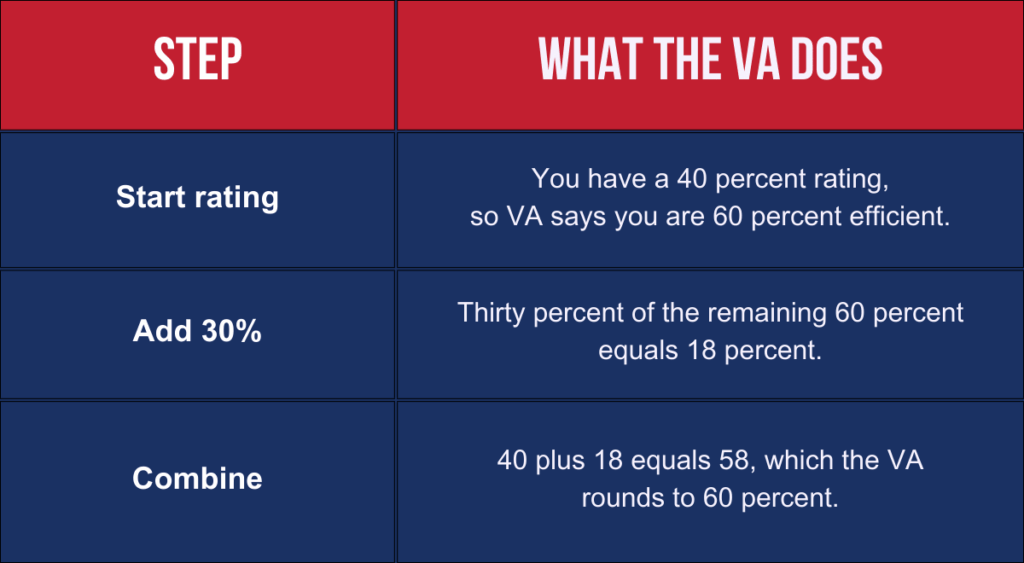
One solid secondary condition can bump you to a new bracket. Two or three can shift you into a completely different monthly payment range. That is why serious planning around a secondary VA claim VA nexus letter VA disability increase can be life changing.
If your combined rating ends up high and you still cannot work, you might explore unemployability options. The VA discusses those as part of its broader VA disability claim process. Sometimes the right mix of primary and secondary conditions opens the door to that path too.
What If Your Secondary VA Claim Gets Denied
You can do many things right and still see the word “denied” on that envelope. That is not the end of your story. It is just a signal that the VA did not see enough connection or severity.
When you see a VA claim denied, check the reasoning carefully. Under the Veteran Appeals Improvement and Modernization Act, you usually have three tracks to keep fighting. You can submit a supplemental claim with new evidence.
You can also ask for a higher level review, or go straight to the Board in some situations. If you feel lost on why you were denied, you can grab the VA Claims Denial Manual. That resource explains common reasons claims fail and how to shore up weak points.
You can then start your intake to see if deeper case review might help. Sometimes, fixing a denial is as simple as strengthening the nexus letter. Sometimes, you need more detailed lay or buddy statements from people who see what you live with daily.
Using Lay And Buddy Statements To Support Your Case
The VA allows what it calls lay evidence. These are written statements from family, friends, co-workers, or fellow service members. They provide a personal perspective on your health condition.
You can use lay or buddy statements to show how your condition has worsened since your original rating or how your secondary symptoms impact real life. Someone who has seen your panic attacks or watched you lose days to migraines can often paint a fuller picture than a short clinic visit. This is powerful evidence showing the reality of your disability.
These statements should stay specific and factual. How many days do you miss work. How many nights does your spouse watch you choke or stop breathing due to chronic sleep issues.
Planning For Long Term Financial Impact
VA disability benefits are tax-related in ways many people do not understand. If your combined rating goes up, your tax picture may change. It is smart to look ahead.
Before you build your long-term plan, it helps to know how the IRS treats this income. This guide on VA disability and taxes lays out common questions so you can plan for the extra income without guesswork. Maximizing your benefits is the goal.
On a bigger level, remember that your health picture may keep changing. Some studies, such as broader insurance reviews like this global insurance report, suggest that claims landscapes shift over time. Veterans who keep good records and stay engaged with their file often do better long term than those who give up after the first rating.
Extra Support, Training, And Coaching For Your Claim
You do not have to do all this on your own. Many vets choose to lean on people who spend all day in this system. Some of them are veterans who once fought for their own ratings and then turned around to help others.

Real Life Chains Of Secondary Conditions
Sometimes it helps to see specific chains of cause and effect. You might spot your own situation hiding inside these patterns. This helps you identify a condition service-connected to your current state.
Take PTSD for example. Ongoing stress keeps your nervous system stuck on high alert. Chronic stress changes hormones, breathing, and sleep, and can even increase weight, which then feeds into obstructive sleep apnea.
Or look at constant ear ringing. Long-term tinnitus can act like a drip of water that never stops. It makes sleep harder, raises stress, and can spark migraine level headaches that turn into a separate diagnosis and rating.
Back pain offers another clear chain. Your spine goes first. Then the altered posture leads to nerve pain like radiculopathy, knee strain, or hip trouble.
None of these chains are “complaining.” They are exactly the type of link 38 CFR 3.310(a) and (b) and the VA’s own rules describe. Your job is to document them and tie them to a well written VA nexus letter.
Conclusion
You live every single day with the snowball effect of your service-connected conditions. A carefully built strategy around a secondary VA claim VA nexus letter VA disability increase simply asks the VA to catch up to that reality on paper. It is about getting the benefits you earned.
You now know that the law in 38 CFR § 3.310 supports service connection for disabilities caused or aggravated by an existing one. You know what a Nexus Letter does, how DBQs support your file, and how secondary ratings plug into the combined rating chart. The process is defined and accessible.
The path is not always fast or easy, but it is clear. Map your conditions, gather records, work with strong medical support, and do not give up at the first “no.” Your body, your time in service, and your future income deserve the work.
If your gut says your rating does not reflect the truth, trust that. Rebuild your case with better evidence and support. Your story as a veteran is worth more than a rushed first decision letter, and you are allowed to fight for the rating that actually matches your life.