

Filing a strong VA disability claim requires detailed evidence from your military service, treatment history, and prior VA decisions. The Department of Veterans Affairs stores much of this information in a veteran’s VA claims file, also known as a VA C-file. If you want to understand a past denial, prepare for an appeal, review your rating decision, or check what evidence the VA used, you may need to get a copy of Cfile from VA before taking your next step.
Your claims file serves as the complete historical record of your interactions with the Veterans Benefits Administration. It may include documents related to your VA claim, disability compensation, prior rating decisions, medical exams, service records, and correspondence with VA offices. Veterans often request their C-file because it can reveal missing evidence, outdated medical notes, incorrect exam findings, or gaps that may have affected their disability benefits.
A complete VA claims file may contain your military personnel records, DD Form 214, service treatment records, VA medical records, private treatment records, Compensation and Pension exam reports, nexus letters, and other documents used to evaluate your claim. These records can help you see how the VA reviewed your condition, what evidence was considered, and whether your symptoms were fully documented.

To request your C-file, many veterans use VA Form 20-10206, the official FOIA request and Privacy Act request form. You may be able to download VA Form 20-10206, complete the request form, and submit it by mail, fax, or another accepted method. In some cases, veterans may also look for options to file online or contact a regional office for guidance on requesting records. Knowing how to request your C-file properly can help you avoid delays and make sure you receive the records needed to strengthen your VA disability claim.
Medical professionals and VA examiners often use Disability Benefits Questionnaires during evaluations to document symptoms, limitations, and medical findings. These forms can be important because raters may use them to assign a disability rating and determine compensation. Reviewing your C-file allows you to check whether the examiner accurately recorded your pain levels, functional limitations, treatment records, and other evidence that could affect your claim.
Key Takeaways
- Your file contains all medical records, service documents, and previous claim decisions.
- The folder acts as the single source of truth for government disability raters.
- Reviewing Disability Benefits Questionnaires helps you verify the accuracy of your medical exams.
Why Veterans Need to Get a Copy of Cfile From VA for Disability Claims

https://www.archives.gov/veteransVeterans should get a copy of Cfile from VA before filing an appeal or reopening a VA disability claim. Your VA C-file contains your VA claims file, medical records, service treatment records, exam reports, and prior rating decisions. Reviewing these documents helps you understand what evidence the VA used and what may be missing from your claim.
Many denied VA claims happen because the file does not clearly connect the condition to military service. Your C-file may reveal missing service records, incomplete VA medical records, weak nexus evidence, or errors in a Compensation and Pension exam. Once you find these gaps, you can submit stronger medical evidence, nexus letters, buddy statements, or updated treatment records to support your disability benefits claim.
Pro Tip: Always work with an accredited Veterans Service Officer when reviewing your medical files. These professionals know exactly what raters look for and can help you spot missing evidence easily.
Veterans planning to file an appeal under the Appeals Modernization Act absolutely need this documentation on hand. You cannot effectively argue against a rating decision if you do not know the rationale behind the denial. The file contains examiner notes that explicitly state why a condition was considered non-service connected.
Step-by-Step: How to Get a Copy of Cfile From VA

The process of obtaining your records requires submitting a formal Freedom of Information Act or Privacy Act request. The government requires specific forms to release this highly sensitive personal information to you or your representative. You must complete VA Form 20-10206 to initiate the retrieval process and receive your documents.
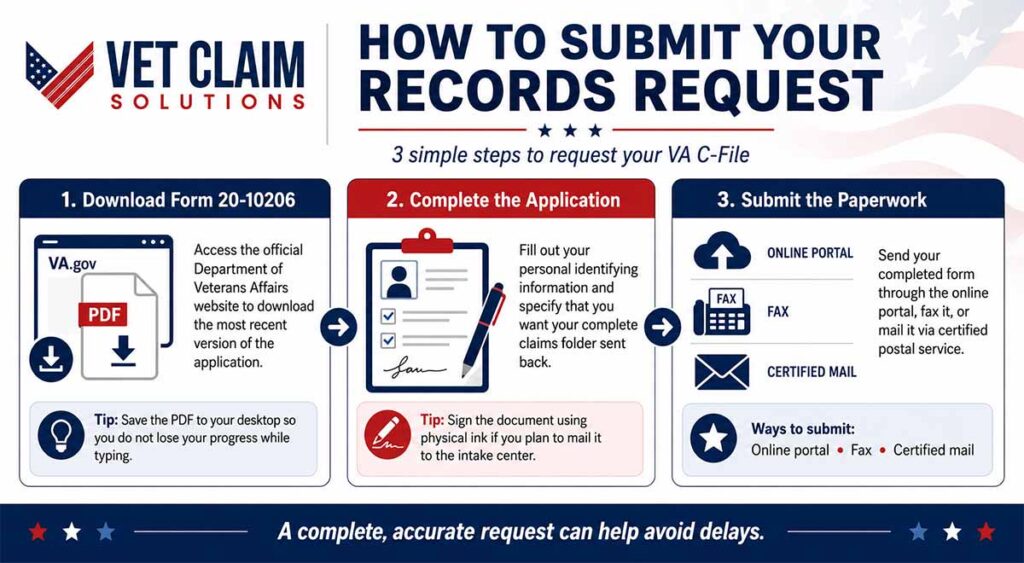
How to Submit Your Records Request
- Download Form 20-10206
Access the official Department of Veterans Affairs website to download the most recent version of the application.
Tip: Save the PDF to your desktop so you do not lose your progress while typing.
- Complete the Application
Fill out your personal identifying information and specify that you want your complete claims folder sent back.
Tip: Sign the document using physical ink if you plan to mail it to the intake center.
- Submit the Paperwork
Send your completed form through the online portal, fax it, or mail it via certified postal service.
Submission Methods for VA Form 20-10206 and Your VA C-File Request
After completing the necessary paperwork, you have several options for sending the request to the federal government. Traditional methods include mailing the physical form directly to the Department of Veterans Affairs Evidence Intake Center. You can also fax the document directly to their centralized processing facility for immediate receipt.
Many modern veterans prefer submitting their requests digitally through the AccessVA portal using the QuickSubmit feature. This digital portal provides immediate confirmation that the agency received your documents safely and started the process. Using the digital upload method prevents your important paperwork from getting lost in the physical mail system.
If you work with a Veterans Service Organization, your representative can submit the request on your behalf. These accredited professionals handle the paperwork and track the status of your Freedom of Information Act request. Working with an expert often reduces the chances of administrative errors delaying your important claims file.
Avoid These Common Mistakes When You Get a Copy of Cfile From VA
Many veterans inadvertently delay their own record requests by making simple administrative errors on the application form. Failing to sign and date the document remains the most common reason for an immediate paperwork rejection. The agency strictly enforces signature rules to protect your private health information from unauthorized public access.
Another frequent mistake involves using outdated forms instead of the current version available on the official website. The government updates paperwork periodically, and using an obsolete form will force you to start over completely. Always download the newest Form 20-10206 directly from the official Department of Veterans Affairs online database.
Have you double-checked your form for accuracy before dropping it in the mail or submitting it online? Some applicants forget to specify exactly which documents they want the agency to reproduce and send back. Checking the wrong box might result in receiving only your medical records instead of the entire file.
️ Warning: Never submit duplicate record requests through multiple channels while waiting for your initial application to process. This creates administrative confusion and will significantly delay the arrival of your important medical files.
Processing Timeline and Expectations for Receiving Your VA Claims File

Veterans frequently ask how long it takes to receive their complete records after submitting the required forms. The reality is that the agency processes hundreds of thousands of these requests every single year nationwide. You should prepare yourself for a significant wait time that often stretches across several long months.
Current data suggests that simple requests might take roughly three to four months to process completely. However, veterans with extensive medical histories or decades of previous claims often wait six months to a year. The massive backlog of records requests continues to cause widespread frustration across the entire veteran community.
Some veterans attempt to speed up the process by submitting multiple requests through different channels simultaneously. This strategy actually backfires and creates duplicate files that confuse the administrative staff processing your paperwork. Submitting a single, accurate request and waiting patiently remains the most efficient path to success.
Reviewing the Records: Understanding What Arrives After You Get a Copy of Cfile From VA
In the past, the government mailed massive boxes filled with thousands of printed paper documents to veterans. Today, the agency has modernized the distribution process to save money and protect sensitive personal information better. You will almost certainly receive a digital CD-ROM containing your records as a secure PDF file.
The compact disc arrives in a standard envelope and requires a computer with a functional disc drive. Because modern laptops rarely include disc drives, you might need to purchase an external USB drive beforehand. The PDF file on the disc is password protected using your social security number for security purposes.
Some veterans struggle with the digital format and prefer reviewing physical papers with a highlighter in hand. If you genuinely cannot access a computer, you must explicitly state your need for paper copies initially. Just remember that printing a massive file will likely increase the processing time significantly for your request.
Key Takeaways
- Expect to wait anywhere from three months to over a year for your complete records.
- The agency will mail your records on a secure, password-protected CD-ROM rather than printed paper.
- Using the QuickSubmit portal provides the fastest and most secure method for sending your application.
Conclusion: Final Steps to Get a Copy of Cfile From VA

Securing your military and medical history is a critical step in winning the disability benefits you deserve. While the waiting period requires patience, the information contained in those records provides immense tactical value. Take the time to submit your request correctly so you can build the strongest possible appeal case.
Reviewing your records thoroughly helps you identify the specific medical evidence needed to overturn a previous denial. You can share this comprehensive file with private doctors or legal representatives to formulate a winning strategy. Taking control of your documentation puts you in the driver’s seat of your own claims journey.