


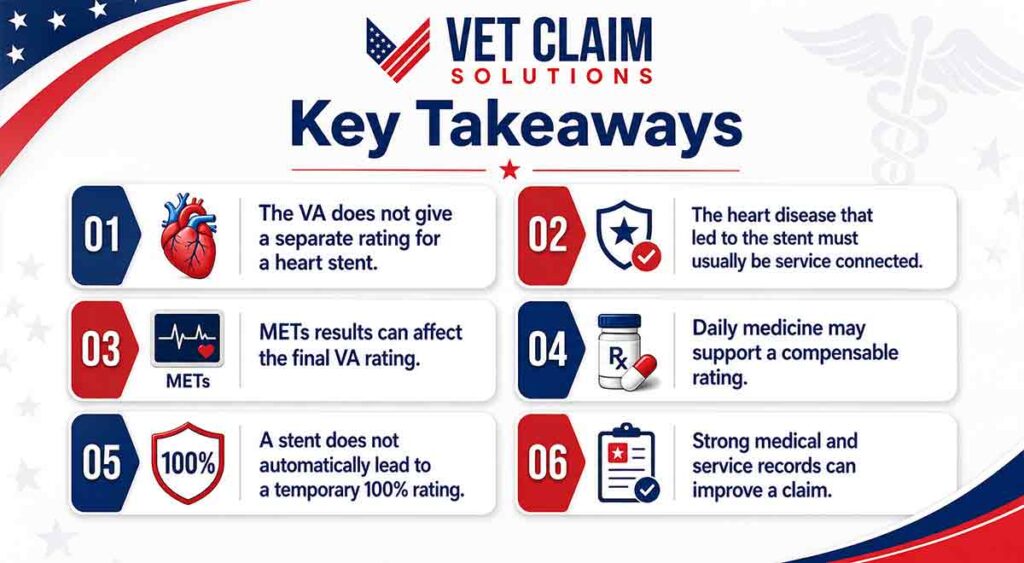
Heart stents can save lives. However, having a stent does not automatically qualify a veteran for VA disability compensation. Instead, the VA rates the heart disease that led to the stent. This may include coronary artery disease or ischemic heart disease.
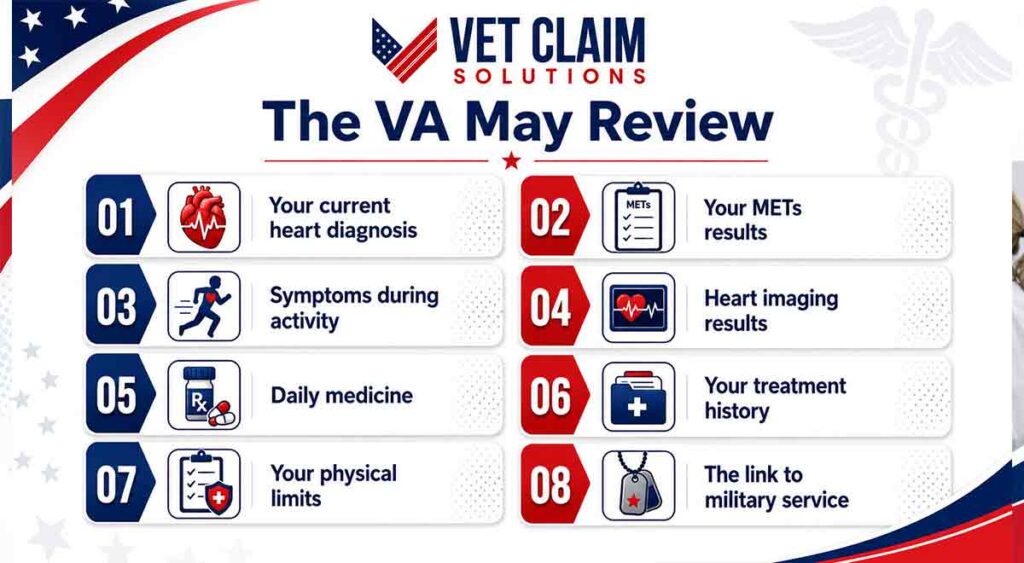
The VA also reviews your symptoms, treatment, medicine, and physical limits. For example, it may consider chest pain, shortness of breath, fatigue, dizziness, or an uneven heartbeat. These symptoms can make work and daily tasks harder. Therefore, clear medical records are important.
A heart stent can support your claim. It shows that your condition needed serious care. However, the stent does not receive its own VA disability rating. This guide explains how the VA rates heart conditions involving stents. It also covers service connection, medical records, temporary ratings, and appeals.
What Is a Heart Stent?
A heart stent is a small mesh tube. A doctor places it inside a narrow or blocked artery. The stent helps keep the artery open. As a result, blood can flow more freely to the heart. Doctors often use stents to treat coronary artery disease. This disease happens when plaque builds up inside the arteries.
Over time, plaque can reduce blood flow. Therefore, a veteran may have chest pain, fatigue, breathing problems, or other symptoms. A stent may improve blood flow. However, it does not cure the heart disease. Because of this, veterans may still need medicine and follow-up care. Some may also have symptoms after the procedure. These ongoing problems can affect a VA disability claim.
Do Heart Stents Qualify for VA Disability?
A heart stent does not qualify for its own VA disability rating. Instead, the VA reviews the condition that caused the veteran to need the stent. Next, it decides whether that condition is linked to military service.
For example, the VA rates coronary artery disease under Diagnostic Code 7005. This code appears in the VA schedule for heart conditions. The stent may show that the disease required major care. However, it does not set the final VA rating by itself.
The current heart rating rules appear in 38 C.F.R. § 4.104. Coronary artery disease appears under Diagnostic Code 7005. Veterans who need help preparing their records can also review available VA disability claim support.
How the VA Rates Heart Conditions
The VA rates many heart diseases under one general formula. In most cases, the formula focuses on METs. METs show how much activity your heart can handle before symptoms begin. Therefore, a lower METs level may support a higher VA rating.
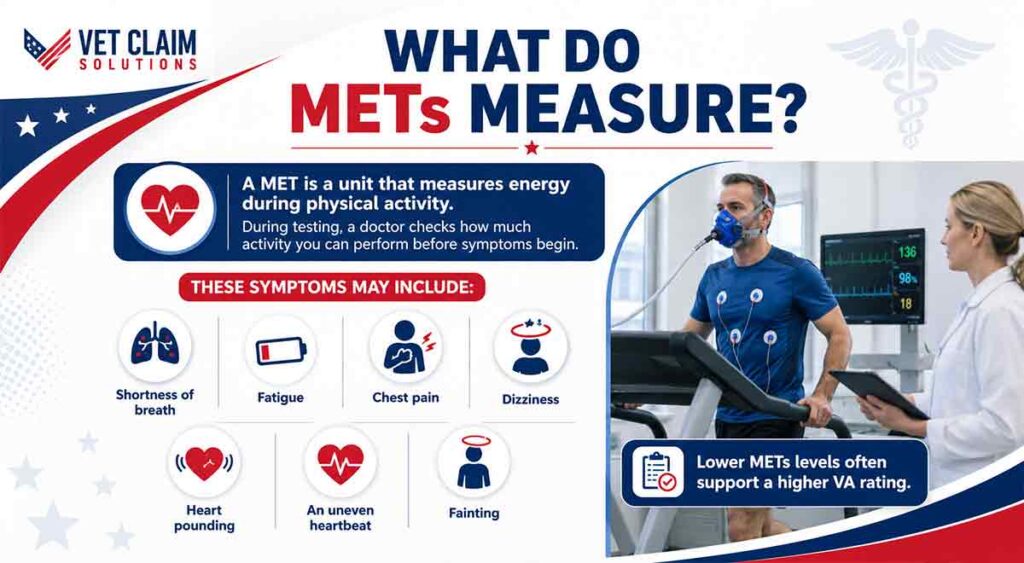
Exercise testing may give an exact METs result. However, exercise testing is not always safe. In that case, an examiner may estimate your METs level. The examiner should explain which activities cause symptoms. For example, the report may state that climbing stairs causes chest pain or fatigue
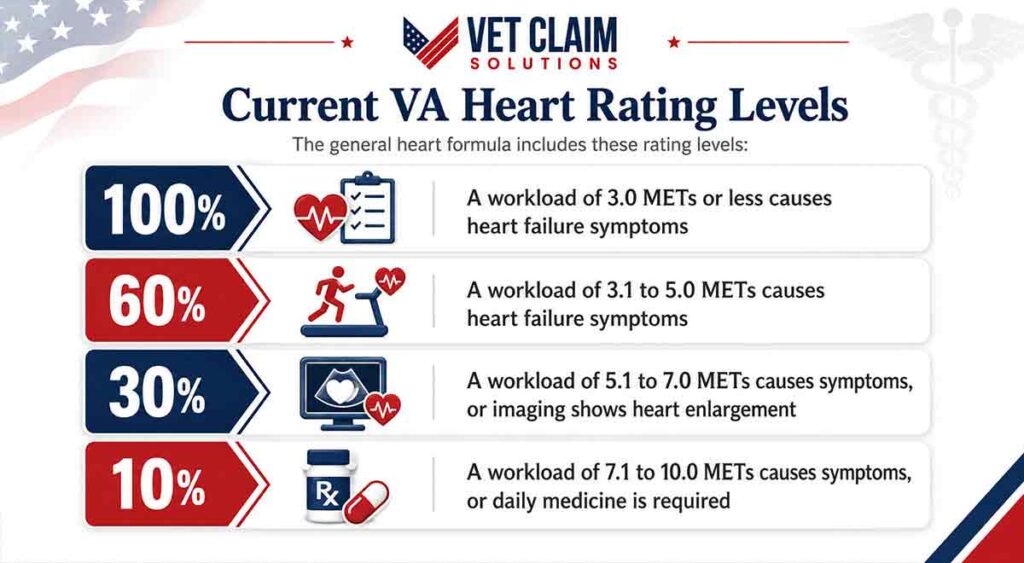
These levels come from the current VA schedule for heart conditions.
Does Ejection Fraction Affect the Rating?
Ejection fraction shows how well the heart pumps blood. Therefore, an echocardiogram may provide useful proof. It can help show heart damage or poor heart function. However, the current general rating formula mainly focuses on METs. It also looks at symptoms, medicine, and certain imaging results. Veterans should still submit all heart test results. These records help show the full history of the condition.
Can a Heart Stent Lead to a Temporary 100% Rating?
Many veterans believe every heart procedure leads to a temporary 100% rating. However, that is not always true.
Stent Placement
Diagnostic Code 7005 does not give an automatic temporary 100% rating for routine stent placement. Instead, the VA continues to rate the heart disease. The rating depends on your symptoms and limits after the procedure.
Heart Attack
A confirmed heart attack may qualify for a 100% rating during the event. The rating may also continue for three months afterward. After that period, the VA rates the remaining heart condition under the general formula.
Coronary Bypass Surgery
Coronary bypass surgery may receive a 100% rating for three months after hospital admission. Next, the VA reviews the veteran’s remaining symptoms. It then assigns a rating under the general heart formula.
Recovery Ratings
A temporary recovery rating may apply in some cases. For example, treatment for a service-connected condition may require a long recovery. Serious problems after surgery may also support this rating However, routine stent placement does not always meet these rules. The VA will review the medical records and recovery time.
Veterans can read the official recovery rules in 38 C.F.R. § 4.30.

How to Establish Service Connection
Before the VA pays compensation, the veteran must usually prove service connection. In simple terms, the evidence must link the heart disease to military service.
The VA may review:
- A current heart diagnosis
- Service records
- Medical records
- Exposure history
- Medical opinions
- Statements from the veteran
- Statements from family or coworkers

The VA explains these rules on its disability claim evidence page. There are three common ways to establish service connection.
Direct Service Connection
Direct service connection may apply when the heart condition began during active duty.
For example, helpful records may include:
- Reports of chest pain during service
- High blood pressure readings
- Heart pounding or skipped beats
- Shortness of breath
- Unusual heart test results
- Service treatment records
- Hospital records
- Statements about early symptoms
Sometimes, the final diagnosis happens years after discharge. Therefore, a medical opinion may be needed. The doctor should explain why the current heart disease is linked to military service.
Presumptive Service Connection
Some veterans may qualify through presumptive service connection. For example, the VA links ischemic heart disease to certain types of Agent Orange exposure. Coronary artery disease may fall within this group. However, the veteran must still meet the service and exposure rules.
Veterans can review the official VA information about ischemic heart disease and Agent Orange. A presumption can help prove the link to service. However, it does not guarantee a certain VA rating. The VA must still review the current level of the disease.
Secondary Service Connection
Secondary service connection may apply when another service-connected condition causes or worsens heart disease.
For example, a claim may involve:
- High blood pressure
- Diabetes
- Kidney disease
- Medicine side effects
- Reduced physical activity
- Another heart or blood vessel condition
However, having both conditions is not enough. A doctor should explain how the first condition caused or worsened the heart disease. Also, the opinion should discuss aggravation when it applies. Aggravation means the heart disease became worse because of another service-connected condition.
Secondary Conditions Related to Heart Disease
Heart disease may also cause or worsen other health problems. For example, possible secondary conditions may include:
- Heart rhythm problems
- Surgical scars
- Depression or anxiety
- Kidney problems
- Reduced movement
- Medicine side effects
However, each condition needs medical proof. The evidence should show that the service-connected heart disease caused or worsened the second condition.

Can the VA Assign Separate Heart Ratings?
The VA cannot pay twice for the same symptom. For example, two heart diagnoses may cause the same limits during activity. In that case, the VA may assign one rating. However, a separate rating may be possible when another condition causes different symptoms. Therefore, the correct rating depends on the medical records and the symptoms involved.
Evidence Needed for a Strong Heart Claim
A strong VA claim should show three main points:
- You have a current heart diagnosis.
- The condition is linked to military service.
- The records show how serious the condition is.
The VA accepts medical records and supporting statements. These records may come from VA doctors or private medical offices.

Medical Records
First, gather records such as:
- Heart doctor treatment notes
- Stent procedure reports
- Hospital discharge records
- Stress-test results
- METs results
- Echocardiograms
- Electrocardiograms
- Medicine lists
- Blood pressure records
- Emergency room records
Include both older and newer records. Older records show the history of the disease. Meanwhile, recent records show your current health.
Personal and Lay Statements
Next, write a statement about how the condition affects daily life. Use clear examples, such as:
- Needing breaks while walking
- Having trouble climbing stairs
- Feeling chest pain during activity
- Feeling tired after simple tasks
- Feeling dizzy while standing
- Missing work
- Reducing work duties
- Avoiding activity because of heart symptoms
Family members and coworkers may also provide statements. The VA accepts a Lay or Witness Statement to support a disability claim.
Medical Nexus Opinion
A nexus opinion may help when service connection is not presumed. First, the opinion should name the correct heart diagnosis. Next, it should review the veteran’s service and medical history.
Finally, it should explain why the condition is linked to service. A strong opinion gives clear medical reasons. It should not include only a short answer.
What to Expect During a C&P Exam
The VA may schedule a Compensation and Pension exam.
During the exam, the examiner may review:
- Your heart diagnosis
- Current medicine
- Treatment history
- Past procedures
- Activity limits
- METs results
- Imaging results
- Symptoms during activity
The examiner may use exercise testing when it is safe. However, the examiner may estimate your METs level if testing is unsafe. The estimate should include examples of activities that cause symptoms.
How to Prepare for the C&P Exam
Before the exam:
- Review your symptoms.
- Make a list of your medicine.
- Bring recent private records.
- Note which activities cause symptoms.
- Explain your good and bad days.
- Do not hide your limits.
- Do not overstate your symptoms.
Also, give clear examples. For instance, explain whether climbing one flight of stairs causes chest pain. Then state how long you need to rest. This is more useful than saying you “get tired easily.”
How to Appeal a Denied Heart Claim
The VA may deny service connection. It may also assign a rating that seems too low. First, read the decision letter carefully. Next, review the reasons for the decision. Also, check which records the VA reviewed.
Common Reasons for Denial
A heart claim may be denied because:
- There is no confirmed diagnosis.
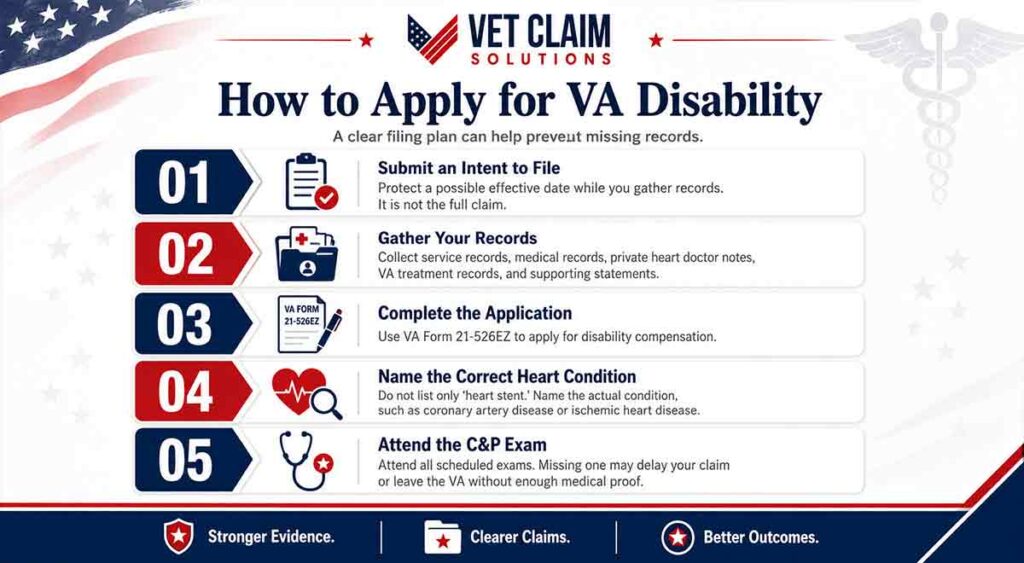
- The claim lists only a heart stent.
- The link to service is unclear.
- A medical opinion lacks clear reasons.
- Important private records are missing.
- The METs estimate does not show the true limits.
- Recent medical records were not submitted.
- The records do not support a higher rating.
After you find the problem, choose the review option that addresses it.
Higher-Level Review
A Higher-Level Review asks a senior VA reviewer to check the current file. However, you cannot submit new records with this option. Therefore, this path may help when the VA missed evidence or used a rule incorrectly. The VA explains the process on its Higher-Level Review page.
Supplemental Claim
A Supplemental Claim allows new and relevant evidence.
For example, new evidence may include:
- Updated heart doctor notes
- A new medical opinion
- Recent METs results
- Missing hospital records
- A detailed personal statement
- Proof of qualifying exposure
Therefore, this option may help when the first claim lacked important records. Veterans can review the official Supplemental Claim process.
Board Appeal
A Board Appeal asks a Veterans Law Judge to review the case. The veteran can choose from several Board review options. Therefore, the best choice depends on whether new evidence or a hearing is needed. The VA explains these choices on its decision review options page.

Conclusion
Heart stents show that a veteran needed serious heart care. However, the VA does not rate the device by itself. Instead, the VA rates the heart disease that led to the procedure. It also reviews symptoms, METs results, medicine, imaging, and physical limits. Service connection is also required. A veteran may qualify through direct, secondary, or presumptive service connection.
Therefore, strong records are important. Include procedure reports, test results, medicine history, and clear examples of daily limits. Also, check the exact rules before claiming a temporary 100% rating. Stent placement alone does not automatically create that benefit. If the VA denies the claim, review the decision letter. Then, choose the appeal option that addresses the reason for the denial.
Ultimately, a clear and well-supported claim can help a veteran receive a fair VA rating based on the true effects of the heart condition.