


Heavy physical exertion during military service frequently causes premature degeneration of the skeletal system. Service members often develop chronic stiffness and joint pain that gradually progresses into severe spinal arthritis. Determining your spondylosis VA rating allows you to secure the disability compensation required to cover healthcare expenses and ongoing rehabilitation.
This detailed guide covers everything regarding the spondylosis VA disability rating veterans need to understand to navigate the Department of Veterans Affairs claims process successfully. Spinal trauma sustained during active duty often remains latent for years before manifesting as debilitating back or neck pain.
Daily military duties such as airborne operations, prolonged marching with heavy rucksacks, and repetitive mechanics place excessive compressive loads on the vertebrae. Over time, these structural stresses erode the cushioning cartilage, producing lasting anatomical changes that warrant an appropriate va disability rating.
Understanding how the Department of Veterans Affairs rates degenerative back conditions can seem overwhelming due to complex diagnostic criteria and medical terminology. By understanding how the VA evaluates range of motion measurements, incapacitating episodes, and secondary complications, veterans can better prepare a well-supported VA claim. The following breakdown walks you through each stage of rating lumbar spondylosis and cervical spine conditions.
Spondylosis is an age-accelerated condition characterized by the gradual breakdown of the spine. Years of physical strain from rucking, parachuting, and vehicular vibration contribute directly to premature degenerative disc disease. This spinal wear damages bone surfaces and soft cushions, frequently leading to localized lumbar spondylosis.
In many instances, the degeneration produces bone spurs that restrict the spinal canal and compress the spinal cord. Doctors refer to this narrowing as spinal stenosis, a condition that can cause chronic pain and weakness in the limbs.
Veterans who suffer from degenerative disc changes face unique physical limitations that require comprehensive medical documentation and clear evidence of military service connection.
The progression of degenerative disc disease often involves the drying out and thinning of the intervertebral disc cushions. As these structural discs flatten, the space between adjacent vertebrae narrows significantly, forcing spinal joints into unnatural friction.
This mechanical friction accelerates bone spur development, known as osteophytosis, which destabilizes spinal contour and irritates the surrounding nerve root network.
Spondylosis VA Disability Rating Veterans Need to Understand for VA Disability Benefits
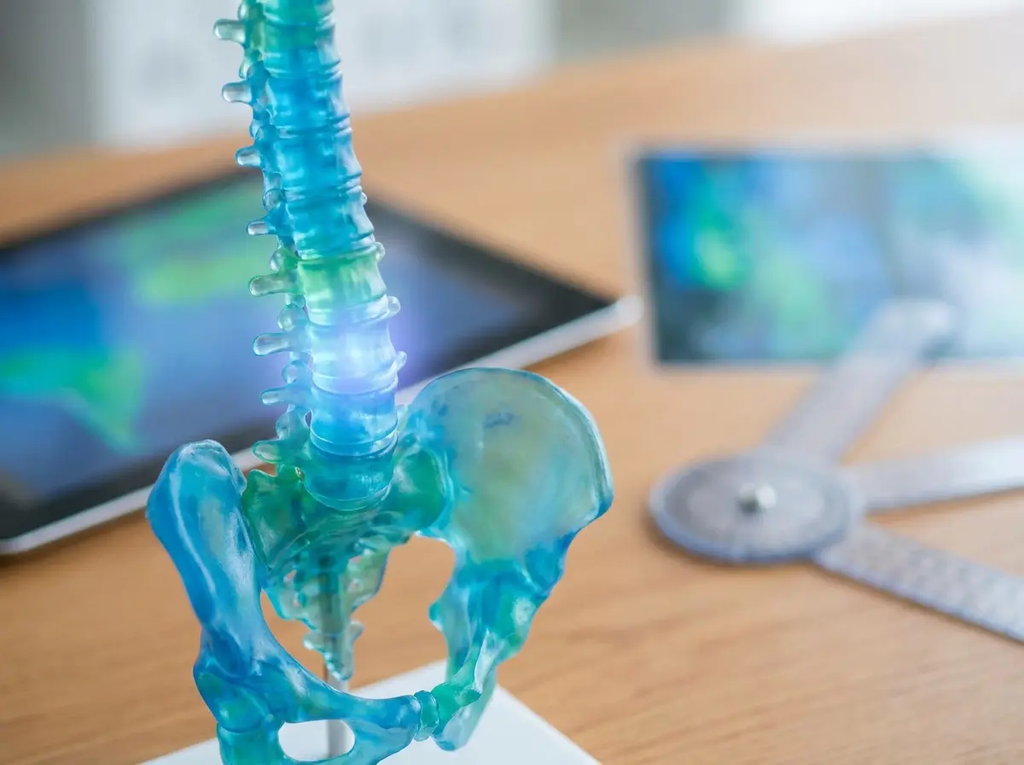
The term spondylosis is an umbrella medical term encompassing osteoarthritis, degenerative disc disease, and bone spur development in the spinal column. When cartilage between vertebrae wears away, friction produces localized inflammation and stiffness that can severely diminish a veteran’s daily mobility.
Obtaining an accurate disability rating ensures that former service members receive monthly compensation and specialized treatment options through the VA healthcare network.
Without adequate care, chronic degeneration can lead to significant nerve root compression that radiates shooting pain down the extremities. Whether your condition affects the lower back or neck, securing a proper diagnostic code from a licensed physician is essential for your pending VA claim. Medical records showing regular physical therapy, prescription medication, and imaging results establish the ongoing severity of your back disorder.
Furthermore, disc disease can progress silently before acute flare-ups cause total functional incapacity. Veterans frequently attempt to power through back discomfort until microtraumas accumulate into severe spinal stenosis or herniation. Documenting every clinical visit creates an unbroken longitudinal record that substantiates how significantly your back disorder interferes with your working capacity and daily activities.
The VA Rating Schedule for Spine Conditions: General Rating Formula Criteria
The Department of Veterans Affairs assesses back conditions using 38 CFR § 4.71a, known formally as the general rating formula for diseases and injuries of the spine. This rating formula focuses primarily on objective range of motion measurements rather than subjective pain reports alone. An examiner utilizes a device called a goniometer to determine exact degrees of forward flexion, extension, lateral flexion, and rotation.
Under this general rating framework, the VA evaluates your spine condition by measuring how far you can bend before experiencing pain or mechanical resistance.
The VA breaks the spinal column into two main segments: the cervical spine (neck) and the thoracolumbar spine (middle and lower back). Understanding these specific measurement thresholds helps veterans prepare thoroughly for an upcoming compensation and pension examination.
During an evaluation, examiners must also account for functional loss resulting from repetitive motion, fatigue, weakness, and pain. Under the landmark legal precedent established in DeLuca v. Brown, adjudicators must factor in how your range of motion deteriorates during periodic flare-ups. A veteran may demonstrate normal flexibility during a brief morning exam but experience severe mobility loss after daily activities. The VA must consider these functional limitations when determining the appropriate disability rating.
Rating Formula Breakdown for Spine Conditions and VA Disability
The general rating criteria provide graduated percentages starting at 10% and reaching up to 100% for complete immobilization. The VA assigns a 10% disability rating when forward flexion of the thoracolumbar spine exceeds 60 degrees but does not exceed 85 degrees, or when the combined range of motion measures more than 120 degrees but no more than 235 degrees.
The VA also assigns a 10% disability rating when an examiner identifies muscle spasms, guarding, or localized tenderness that does not cause an abnormal gait or abnormal spinal contour.
When mobility deteriorates further, a 20% va disability rating applies if forward flexion of the thoracolumbar spine is between 30 and 60 degrees. Furthermore, if you exhibit an abnormal gait or abnormal spinal contour such as scoliosis or reversed lordosis, the rating criteria typically justify this level. Demonstrating these functional deficits through standardized medical exams protects your right to equitable disability benefits.
The rating percentages reflect increasing levels of vocational and physical impairment documented by clinical providers. If pain begins immediately at the beginning of motion, the examiner must record that specific degree as the limit of your functional range. Consequently, stopping the movement as soon as pain begins during your C&P exam is crucial for generating an accurate reflection of your spinal limitations.
Rating Lumbar Spondylosis and the Thoracolumbar Spine: VA Disability Rating Standards
The lower back absorbs tremendous mechanical shock during military training, making lumbar spondylosis one of the most common service-connected claims. Because the lumbar region combines with the thoracic vertebrae for evaluation purposes, the VA rates these sections together as the thoracolumbar spine. When filing a va claim for lower back issues, understanding how your thoracolumbar spine motion is tested remains critical.
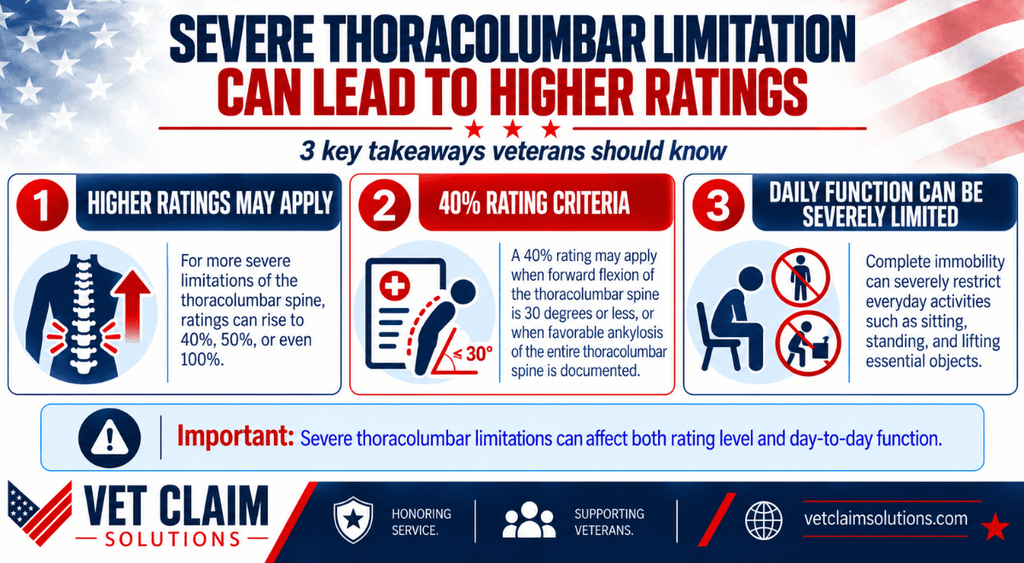
A reduced range of motion in the lumbar vertebrae also hampers fundamental body mechanics required for gainful employment. Tasks such as prolonged desk sitting, heavy lifting, or repetitive bending become completely unsustainable as degeneration advances. In cases where forward flexion cannot exceed 30 degrees, the physical impact extends to common household tasks and basic personal care.
Unfavorable Ankylosis and Favorable Ankylosis of the Thoracolumbar Spine
Ankylosis refers to the complete bony fusion and rigidity of the spinal joints, which can occur naturally from severe spondylosis. The VA distinguishes between favorable ankylosis and unfavorable ankylosis when evaluating spinal fixation. Favorable ankylosis indicates that the spine is fixed in a relatively neutral or upright alignment, whereas unfavorable ankylosis means the spine is frozen in a curved, bent, or distorted position.
If an examiner identifies unfavorable ankylosis of the entire thoracolumbar spine, the VA assigns a substantial 50% va disability rating. The maximum 100% rating is reserved for cases exhibiting unfavorable ankylosis of the entire spine, encompassing both the cervical and thoracolumbar spine sections. Severe abnormal spinal curvature and total spinal rigidity prevent individuals from maintaining substantial gainful employment.
When the spine becomes frozen in an abnormal position, the body expends continuous muscular effort simply to maintain balance. This perpetual strain generates severe muscle spasm throughout the surrounding musculature, triggering chronic fatigue and postural instability. The rating schedule recognizes that an unfavorable fusion inflicts much greater functional impairment than a spine fused in an anatomical, neutral position.
Lumbar Spondylosis, Spinal Stenosis, and Thoracolumbar Spine Limitations
When spinal stenosis develops in the lumbar region, the narrowing of the vertebral canal causes intermittent neurogenic claudication. This condition produces severe cramping, numbness, and burning pain during prolonged standing or walking. Because spinal stenosis frequently accompanies lumbar spondylosis, tracking changes along the thoracolumbar spine helps support increased rating requests over time.
If forward flexion of the thoracolumbar spine greater than normal ranges is blocked by mechanical obstruction, medical documentation must record these limitations precisely. The VA requires doctors to conduct range of motion tests under repeated use to assess additional weakness and fatigue. Documenting flare-ups ensures the thoracolumbar spine receives an accurate disability rating reflecting your worst days.
Clinical imaging like magnetic resonance imaging (MRI) scans and computed tomography (CT) scans helps substantiate these internal structural blockages. These diagnostics reveal the exact degree of thecal sac compression and nerve impingement causing physical limitations. Submitting detailed radiologist narratives alongside your clinical movement evaluations ensures the VA claims adjudicator has full visibility into your spinal pathology.
Rating Cervical Spondylosis and Neck Limitations: Cervical Spine VA Rating
Cervical spondylosis affects the vertebrae and discs of the neck, commonly aggravated by wearing heavy ballistic helmets and body armor. A chronic neck condition can generate unrelenting neck pain, severe headaches, and reduced peripheral visibility. The VA evaluates cervical spine disorders using dedicated range of motion measurements under the same general rating formula.
A normal cervical spine flexes forward up to 45 degrees, extends backward 45 degrees, and rotates 80 degrees in each direction. When cervical spondylosis impairs mobility, a 10% disability rating is granted if forward flexion of the cervical spine is greater than 30 degrees but not greater than 40 degrees. A 10% rating also applies when the combined range of motion of the entire cervical spine is between 170 and 335 degrees.
Restricted neck mobility affects everyday awareness and vocational performance in profound ways. Simple tasks like checking blind spots while driving or looking down at reading materials become excruciatingly painful over time. Chronic stiffness also alters head posture, leading to secondary tension headaches, occipital neuralgia, and upper trapezius spasms that further worsen daily discomfort.
Cervical Spine Forward Flexion and Disability Rating Thresholds

If forward flexion of the cervical spine is restricted to 15 degrees or less, the VA awards a 30% disability rating. A 30% rating is likewise granted if a veteran experiences favorable ankylosis of the entire cervical spine. When neck pain becomes constant and severe, turning the head while driving or performing basic vocational tasks becomes impossible.
Should severe inflammation lead to unfavorable ankylosis of the entire cervical spine, the rating jumps directly to 40%. The VA recognizes that a neck frozen in flexion or distortion severely impairs a veteran’s visual field and balance. Consequently, thorough imaging showing spinal contour degradation and osteophyte growth in the cervical spine proves critical during adjudication.
Medical evaluations must measure all four planes of cervical motion: flexion, extension, left and right lateral flexion, and rotation. If an examiner measures only forward bending, the assessment fails to adhere to VA rating regulations. Making sure your physician measures each specific movement plane ensures that combined range limitations are properly reflected in your final determination.
Intervertebral Disc Syndrome and Incapacitating Episodes: Alternative VA Rating Formula
While most spine conditions are rated on range of motion, disc disease can alternatively be evaluated under diagnostic code 5243 for intervertebral disc syndrome (IVDS). This alternative formula rates spinal pathology according to the frequency and duration of incapacitating episodes. An incapacitating episode is defined as a period of acute back pain requiring bed rest prescribed by a physician.
Under this code, having incapacitating episodes lasting at least one week but less than two weeks over the preceding 12 months warrants a 10% rating. If incapacitating episodes total between two and four weeks annually, a 20% rating is awarded. Severe disc flare-ups lasting four to six weeks result in a 40% rating, while episodes lasting six weeks or more yield a 60% disability rating.
Evaluating your condition under the intervertebral disc syndrome criteria is particularly beneficial when range of motion between attacks remains relatively functional. Many veterans maintain moderate spinal mobility during pain-free intervals yet experience sudden, catastrophic flare-ups that leave them completely bedridden. Diagnostic code 5243 exists precisely to compensate individuals whose primary impairment manifests through episodic, incapacitating attacks.
Documenting Incapacitating Episodes for Lumbar Spondylosis and Spinal Stenosis
To succeed using the incapacitating episodes criteria, veterans must secure written documentation from a medical provider prescribing formal bed rest. Subjective rest taken on personal initiative without a direct medical order does not satisfy the VA regulatory definition. Veterans suffering from disc disease alongside spinal stenosis often find this rating path beneficial when joint stiffness is less pronounced than debilitating episodic flare-ups.
During an evaluation, the VA is legally required to assign whichever rating method results in the highest level of compensation. For example, if your thoracolumbar spine range of motion yields 20% but your documented incapacitating episodes warrant 40%, the adjudicator must award the higher percentage. Maintaining an accurate symptom log and keeping detailed clinical visit summaries reinforces your position.
Whenever you experience a severe spinal flare-up, schedule an urgent visit or telehealth appointment with your doctor. Explicitly ask your treating provider to note in your medical record that strict bed rest is medically indicated for your recovery. Keeping a dedicated binder containing each written bed rest recommendation creates undeniable proof when filing your annual evidence updates.
How to Service Connect Your Spine Condition: Winning Your Spondylosis VA Claim
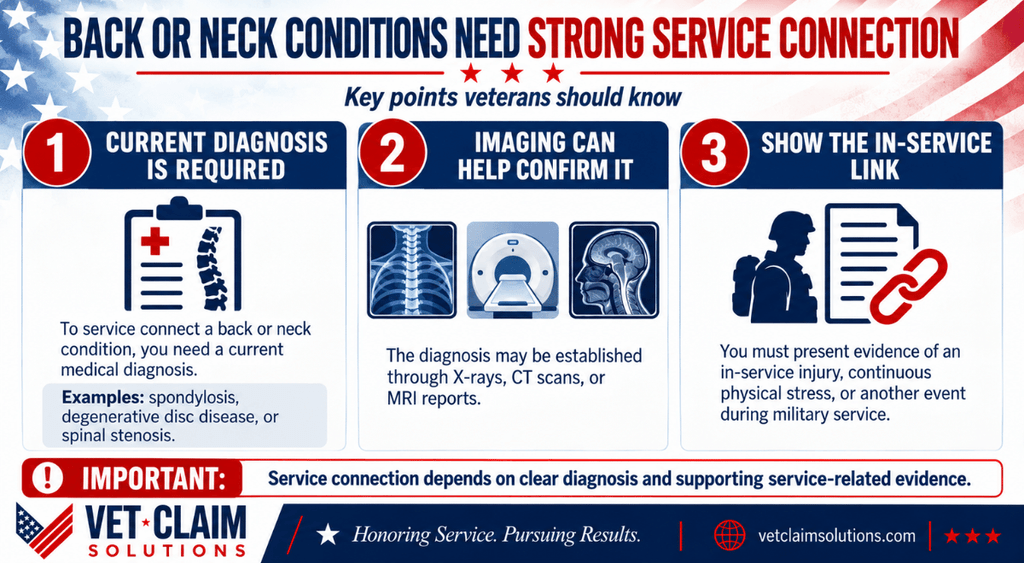
Finally, your claim requires a medical nexus linking your diagnosed spinal degeneration to your active duty military service. A well-reasoned nexus letter from an orthopedic specialist or chiropractor provides the decisive link required by VA claims processors. The medical expert must state that it is “at least as likely as not” that your spine condition originated from your service duties.
Veterans should also be aware of the presumptive period for chronic arthritis under 38 CFR § 3.309(a). If your spondylosis or degenerative arthritis manifested to a compensable degree of 10% within one year of discharge, you may qualify for direct presumptive service connection. This provision eliminates the need to prove a specific in-service incident, provided your post-discharge medical records confirm symptoms within that initial twelve-month window.
Medical Evidence to Service Connect Lumbar Spondylosis and Thoracolumbar Spine Disorders
Obtaining service connection requires gathering comprehensive service treatment records, private healthcare files, and buddy statements. Buddy letters from fellow service members who witnessed heavy lifting accidents, falls, or training collisions provide valuable corroboration. These statements establish continuous symptoms even when early medical documentation in active duty files is sparse.
When attending your Compensation and Pension exam, explain your symptoms honestly without pushing past the onset of physical pain. Under established legal precedents like DeLuca v. Brown, examiners must estimate how pain, weakness, and repetitive motion restrict your spine greater than single measurements indicate. Clear descriptions of how back stiffness prevents normal bending or creates abnormal spinal contour help raters assign fair percentages.
In addition, provide personal lay statements detailing the progression of your spinal condition from military discharge to the present day. Explain how your lumbar spondylosis impairs your ability to sit, stand, walk, or perform basic domestic chores. Personal declarations bridge historical treatment gaps by describing your ongoing symptoms, reliance on over-the-counter pain medications, and modifications made to daily physical routines.
Secondary Conditions and Combined VA Ratings for Lumbar Spondylosis and Spinal Stenosis
Spinal disorders rarely remain isolated to the vertebral column and frequently generate secondary medical complications. When bone spurs or herniated discs pinch an adjacent nerve root, veterans often develop peripheral neuropathy or radiculopathy. Radiculopathy causes shooting electrical sensations, numbness, and tingling across the sciatic nerve down the thighs, calves, and feet.
Because peripheral neuropathy is evaluated under its own diagnostic code, it can be claimed as a secondary condition to lumbar spondylosis. Veterans can receive separate bilateral ratings for both legs alongside their thoracolumbar spine va rating. Adding secondary nerve ratings significantly increases an individual’s overall combined disability percentage.
Cervical spondylosis can similarly impinge nerve roots in the upper spinal cord, creating cervical radiculopathy across the shoulder, arm, and hand. This compression frequently impairs hand grip strength, fine motor coordination, and sensory perception in the fingers. Claiming radiculopathy for both arms as secondary to your cervical spine condition adds independent ratings that boost your total monthly disability compensation.
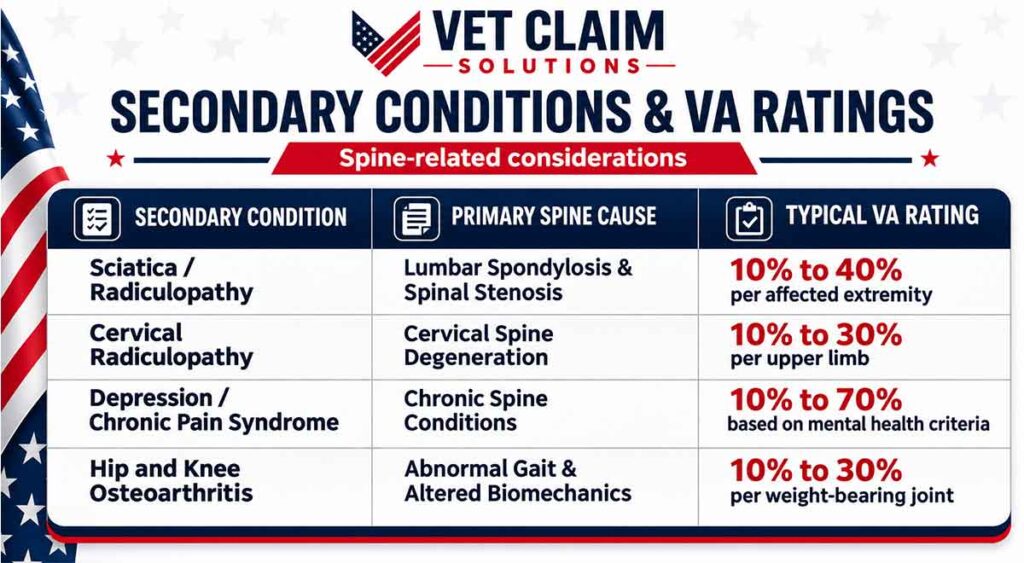
Veterans coping with persistent back pain frequently suffer from altered biomechanics, leading to knee, hip, and ankle degradation. When an abnormal gait shifts weight unevenly onto unaffected joints, secondary degenerative arthritis often develops in those weight-bearing areas. Reviewing your full medical history with an accredited representative ensures that every secondary condition linked to your primary back impairment is claimed properly.
Chronic spinal pain also takes a profound psychological toll, often triggering secondary depression, anxiety, or sleep disturbances. Living with daily discomfort and physical restrictions frequently disrupts vocational stability, marital relationships, and social engagement. When supported by a nexus from a mental health professional, secondary psychiatric conditions can provide substantial additional ratings under the general mental health formula.
Total Disability Individual Unemployability (TDIU) for Severe Spondylosis

When severe lumbar spondylosis or cervical spine limitations prevent you from securing substantially gainful employment, you may qualify for TDIU benefits. Total Disability based on Individual Unemployability pays veterans at the 100% compensation rate even if their combined rating is lower. To qualify under schedular rules, you typically need one service-connected disability rated at 60% or a combined rating of 70% with one single condition rated at 40% or higher.
Because physical labor requires consistent bending, twisting, lifting, and walking, advanced spinal stenosis often prevents veterans from continuing trade work. Even sedentary desk jobs can become untenable due to intense pain from prolonged sitting or cervical radiculopathy impacting computer use. Documenting vocational limitations through an independent vocational expert evaluation can establish an indisputable case for TDIU compensation.
Final Thoughts on Spondylosis VA Claims and Disability Rating Success
Navigating the complex regulations governing spinal disorders requires diligence, accurate medical documentation, and patience. Securing an equitable va disability rating for lumbar spondylosis or cervical spine limitations can fundamentally improve your quality of life. Accessing specialized physical therapy, pain clinics, and mobility aids ensures long-term comfort and independence.
If your initial decision falls short of the rating formula criteria you believe your spine condition satisfies, remember that appeals options remain available. Veterans may file a Higher-Level Review, submit a Supplemental Claim with new imaging evidence, or appeal directly to the Board of Veterans’ Appeals. To learn more about navigating claims, check out our guide on how to file a va claim or explore our analysis of va disability compensation rates to maximize your earned benefits.
Ultimately, thorough preparation and detailed clinical evidence serve as the foundation for any successful disability claim. Keep consistent medical appointments, request regular imaging to monitor spinal degeneration, and ensure your functional limitations are accurately charted. With persistence and accurate medical records, veterans can obtain the full disability benefits and lifelong healthcare they rightfully earned.