


Many veterans return home facing internal battles that require significant medical support to manage their symptoms effectively. You might experience extreme shifts in energy and mood that disrupt your daily living and personal relationships. Learning how to get a VA rating for bipolar disorder is essential for securing the compensation you deserve through the Veterans Affairs system.
Securing a proper VA disability rating for bipolar disorder requires specific medical evidence and a clear strategy to ensure your application is processed correctly. We will walk you through exactly how to build a strong case and get the benefits you deserve. Understanding the system helps you submit a successful VA disability claims application for your bipolar disorder while navigating complex federal regulations.
You must learn how the department evaluates this specific mental health condition to prepare your evidence effectively. Evaluators look closely at your medical records to assess your level of social impairment and occupational limitations. Your final disability rating depends heavily on how your symptoms restrict your daily functioning and overall quality of life.
Bipolar disorder causes intense emotional states that typically occur during distinct periods of time throughout the year. Veterans with this mental health condition often cycle between elevated moods and severe depression, impacting their stability. The va disability framework treats bipolar disorder under its general rating schedule for mental disorders to determine compensation.
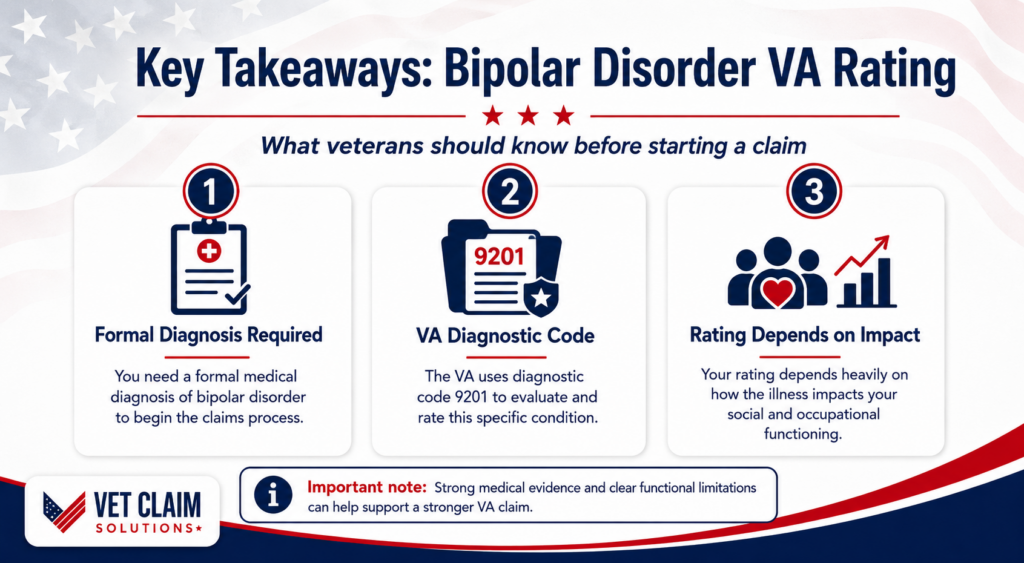
You must meet specific diagnostic criteria to successfully establish your claim for bipolar disorder and receive benefits. The Veterans Benefits Administration requires a formal medical diagnosis before they review your paperwork for any potential rating. Doctors usually categorize bipolar disorder into different types based on the frequency of your manic episodes during specific cycles.
You might also receive a diagnosis for cyclothymic disorder if your symptoms remain milder but chronic over time. Regardless of the specific label, your health condition requires thorough documentation to secure VA disability benefits for your service. Veterans often wonder how the department calculates VA claims for bipolar disorder cases when multiple symptoms are present.
The system evaluates how severely your bipolar disorder interferes with your ability to work and maintain healthy relationships. Evaluators look closely at your medical records to assess your level of social impairment across various environments. Your final disability rating for bipolar disorder depends heavily on how your symptoms restrict your daily functioning and independence.
How to Get a VA Rating for Bipolar Disorder: What Qualifies as a Mental Disorder?
The psychiatric community defines bipolar disorder as a serious mental disorder that requires ongoing management and clinical support. Your medical provider will look for a history of manic episodes to confirm the diagnosis according to standards. Depressive episodes also feature prominently in most bipolar disorder cases, causing profound sadness and a significant lack of energy.
These severe mood swings can make keeping a job or maintaining a steady routine nearly impossible for many veterans. A valid diagnosis for bipolar disorder must align with the National Institute of Mental Health guidelines for clinical accuracy. The VA uses diagnostic code 9201 specifically for bipolar disorder cases to categorize the severity of the condition.
Your medical records must explicitly list this condition to move forward with your VA disability claim and evaluation. Vague references to mood issues will not satisfy the strict requirements for a va rating under current law. A documented history of bipolar disorder provides the foundation for your VA claim and future medical support.
Service Connection Strategies: Establishing Service Connection for VA Disability Claims
You cannot receive a VA disability rating simply by proving you have bipolar disorder without showing a service link. The law requires you to demonstrate a direct link between your illness and your military service for compensation. This link, known as service connection, forms the foundation of every successful claim for bipolar disorder and treatment.
You must show that your military service either caused or significantly aggravated your mental health condition during your enlistment. Many veterans develop their first bipolar disorder symptoms during active duty deployments or stressful training cycles in the field. If your medical records from active duty show treatment for mood swings, you have a strong starting point.
Even informal complaints about sleep issues or erratic behavior can support your disability claim for bipolar disorder effectively. The VA will review your entire service treatment record to find evidence of early onset bipolar disorder symptoms. Establishing service connection requires careful documentation and expert medical opinions for va claims to be approved.
Direct vs. Secondary Connection: Direct Service Connection vs. Secondary Connection

Sometimes symptoms of bipolar disorder do not fully manifest until years after discharge from military service has occurred. You must connect your current bipolar disorder diagnosis to a specific event or pattern during your service history. Secondary service connection might apply if another service-connected health condition caused your mental health issues to develop.
For example, chronic pain from a physical injury could trigger severe depressive episodes associated with bipolar disorder symptoms. You must provide compelling medical evidence that links your bipolar disorder to your primary service-connected condition for review. The department evaluates these secondary va claims using the same stringent criteria as any direct service connection claim.
The Importance of a Nexus Letter: The Importance of a Nexus Letter
A nexus letter bridges the gap between your current bipolar disorder and your military service for the examiner. This document comes from a qualified medical professional who reviews your complete file and provides a clinical opinion. The doctor must state that your bipolar disorder is “at least as likely as not” caused by your service.
Without this specific language, claims examiners frequently deny the va claim for bipolar disorder during the initial review. You should ask your psychiatrist to write this letter detailing how your military service impacted your mental health. A strong nexus letter dramatically increases your chances of securing a favorable va rating for your condition.
Pro Tip: Always provide your doctor with your complete military medical records before they write a nexus letter. This allows them to reference specific service events, making their medical opinion much stronger during the review process.
Mental Health Rating Criteria: The VA Ratings Schedule for Mental Health
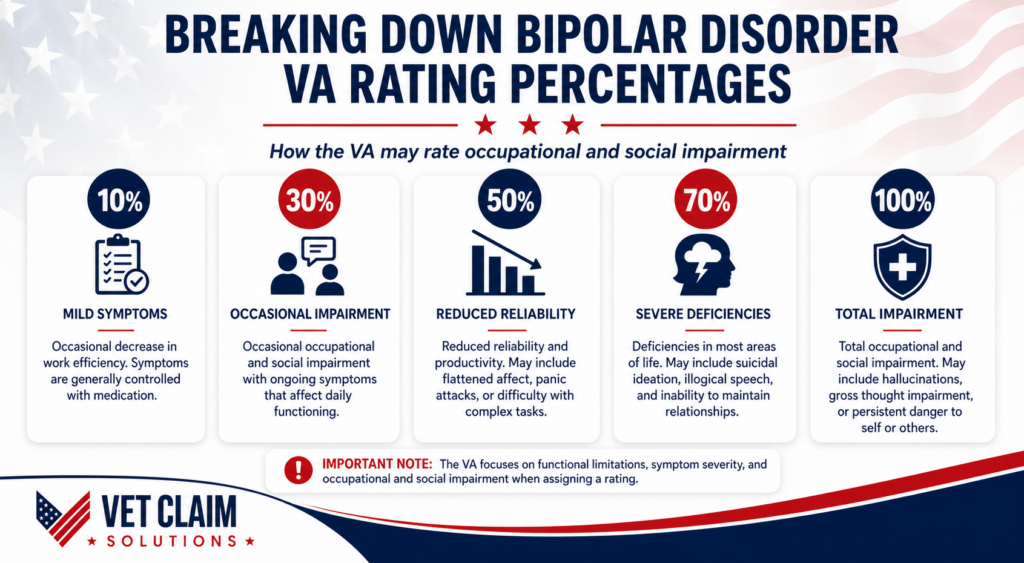
The VA evaluates all mental health conditions using the general rating formula for mental disorders found in federal law. Your bipolar disorder va rating depends on your specific level of impairment, not just the diagnosis itself. The department assigns disability ratings at 0%, 10%, 30%, 50%, 70%, or 100% based on severity.
A higher va rating indicates a more severe impact on your blank” rel=”noopener noreferrer”>occupational and social impairment levels. To determine your percentage, the VA examines your bipolar disorder symptoms against their published rating criteria and standards. Evaluators consider factors like panic attacks, memory loss, and your ability to interact with others in social settings.
They want to understand exactly how bipolar disorder affects your ability to hold a job and earn a living. Frequent manic episodes usually result in a higher disability rating for your bipolar disorder due to increased instability. The rating criteria focus heavily on your functional limitations rather than your specific symptoms or medical labels.
Step-by-Step Process: How to File a VA Disability Claim for Bipolar Disorder
Filing your VA claim for bipolar disorder requires careful preparation and attention to detail throughout the entire process. You can find free resources online to help organize your evidence before submitting your application to the department. The process for disability claims can take several months, so starting early helps you secure your effective date.
How to Submit Your Claim
- Gather Your Medical Evidence
Collect all civilian and military medical records related to your bipolar disorder. Your disability claim requires comprehensive documentation of your mental health history.
Tip: Create a checklist to make certain you do not miss any medical records from private doctors.
- Submit an Intent to File
Secure your effective date while you finish building your VA disability claim. This formal step gives you up to one year to gather evidence for your bipolar disorder claim.
- Complete the Application
Fill out the application for VA disability benefits accurately and completely. You can file VA claims online, by mail, or with an accredited representative.
Supporting Documentation: Common Evidence Needed for a Strong VA Claim
Building a strong case for bipolar disorder requires more than just a doctor’s note for the examiner. You must submit comprehensive evidence that paints a clear picture of your daily struggles with bipolar disorder symptoms. Your va claim should include treatment notes, psychiatric evaluations, and records of any hospitalizations you have experienced.
The more proof you provide regarding your bipolar disorder, the better your chances of approval for benefits. Buddy statements from fellow service members can powerfully support your VA disability claim and provide context. These letters describe the changes in your behavior that others witnessed during your military service and deployments.
Family members can also write statements detailing how your bipolar disorder affects your home life and relationships. These personal accounts help examiners understand the true impact of your mental health condition on daily living. They provide vital context that medical records alone might miss regarding your bipolar disorder and functional capacity.
Veterans frequently search for specific terms when researching their options online for mental health support. If you want a bipolar disorder rating, you must understand how the system works for your claim. A standard disorder va rating relies heavily on the frequency of your symptoms and their impact.
Many advocates suggest searching for bipolar va resources to find accurate paperwork guidelines and submission tips. A successful VA claims process for bipolar disorder hinges on clear medical documentation and clinical evidence. Any disorder va claim requires patience and persistence to achieve the right outcome for your future.
Key Takeaways
- Buddy letters from fellow service members provide crucial context about your behavior changes.
- Family statements help examiners understand how your condition affects your personal life.
- Comprehensive treatment records offer the strongest proof of your daily struggles.
Increasing Your Benefits: Upgrading Your Disability Rating

Many veterans receive an initial VA disability rating that feels too low for their actual bipolar disorder symptoms. If your bipolar disorder worsens over time, you can file for an increased disability rating with the VA. You will need to submit new medical evidence showing that your bipolar disorder has deteriorated since your last rating.
The VA will review your updated records and apply the current rating criteria to your bipolar disorder case. Filing for an increase follows a similar process to your original va claim and requires new documentation. You must demonstrate that your bipolar disorder now causes greater occupational and social impairment than before.
Consistent treatment records provide the best evidence for upgrading your VA disability rating and securing higher compensation. Sometimes, veterans search for information on VA rates bipolar to see if compensation levels changed for their condition. The actual dollar amounts for VA rates adjust annually based on the cost of living and inflation.
However, the way the department rates bipolar cases remains tied to the standard mental health schedule and criteria. Understanding how the system rates bipolar disorder helps you know when to file for an increase in benefits. Knowing the specific VA rates bipolar disorder criteria empowers you to advocate for yourself during the review process.
Individual Unemployability: Total Disability Based on Individual Unemployability
If your bipolar disorder prevents you from keeping a job, you might qualify for individual unemployability benefits. This program allows veterans to receive compensation at the 100% rate, even if their combined rating is lower. Your bipolar disorder must be the primary reason you cannot secure substantially gainful employment in any field.
This option provides a critical lifeline for veterans severely impacted by their mental health condition and symptoms. To apply for this benefit, your bipolar disorder va rating must meet specific threshold requirements for eligibility. You generally need one condition rated at 60%, or a combined rating of 70% with one condition at 40%.
The VA will carefully review your employment history and the specific limitations caused by your bipolar disorder. You must prove that your daily living activities are so restricted that working is impossible for you. Bipolar disorder frequently qualifies veterans for this benefit due to its disruptive nature and unpredictable symptoms.
Warning: Never miss a scheduled Compensation and Pension (C&P) exam for your claim. Failing to attend this critical appointment usually results in an automatic denial of your benefits.
Final Summary: Conclusion and Next Steps
Living with bipolar disorder presents daily challenges that most civilians will never fully comprehend or experience. Securing a proper va rating for this condition requires persistence, thorough documentation, and a clear clinical strategy. By understanding the rating criteria and gathering strong medical evidence, you can successfully manage the entire process.
Your military service earned you the right to seek support and compensation for your health challenges. Take the first step today by reviewing your records and consulting with a medical professional about your symptoms. Your journey toward stability and fair compensation begins with a single, well-prepared application for benefits.