


An Other Than Honorable (OTH) discharge can feel like a final chapter. It can make you think the door to your VA benefits is shut and locked for good. You served your country, but now a piece of paper is holding you back.
You might be feeling frustrated, lost, and completely cut off from the help you earned. But there is a path forward for appealing an OTH discharge for VA benefits Here’s how to apply and win your VA claim. This process isn’t about changing your military record; it’s about showing the VA that your service was still honorable, despite the circumstances of your separation.
Appealing an OTH discharge is possible, and this guide will show you how. We will explain how to get the disability compensation you’re entitled to. It is time to fight for the benefits you deserve.
Understanding Your OTH Discharge and VA Benefits
First, an OTH discharge is not an automatic bar to all VA benefits. Many veterans with “bad paper” wrongly believe they can’t get any help from the Department of Veterans Affairs. That is simply not true, and you may still be eligible for critical support.
The VA has a special process to review the facts of your service and your discharge. The VA is a separate entity from the Department of Defense (DoD). This is a really important point to understand as you begin.
The DoD handles upgrading your discharge, which is a different and often much harder process. The VA, on the other hand, just wants to decide if you are eligible for their programs. This includes key veterans benefits like health care, disability benefits, and housing assistance.
The Two Paths: VA Review vs. Discharge Upgrade
It’s easy to get these two processes mixed up, but they have very different goals. A Discharge Upgrade is when you petition your military branch’s review board, like the Discharge Review Board (DRB), to change the characterization on your DD-214. This is a complex legal action to correct discharge papers.
A Character of Discharge review is a VA-specific process that happens internally. The VA decides if your service was “under honorable conditions” for VA benefit purposes only. This review does not change your DD-214 but can open the door to VA health care, education benefits, and a VA loan.
You can pursue both at the same time, but you don’t need a discharge upgrade to get VA benefits. This guide focuses on the VA’s Character of Discharge review. It’s often the most direct route to getting the VA health benefits you need right now.
The First Step: The VA Character of Discharge Determination
When you first apply for a VA benefit with an OTH discharge, it triggers an automatic review. The VA Regional Office (VARO) will start what’s called a Character of Discharge determination. They will pull your service records to figure out what happened and why you received the discharge.
The VA looks at the law, specifically 38 C.F.R. § 3.12, to guide their decision. This regulation lists specific reasons that create a statutory bar to benefits. These bars are for the most serious offenses and include being a spy, sedition, sabotage, or desertion.
If the reason for your discharge falls under one of these statutory bars, getting benefits is very difficult. However, most OTH discharges do not fall under these automatic bars. They are often for things like misconduct, a pattern of misbehavior, or substance abuse.
Insanity Exception and Other Considerations
Even if the reason for your discharge is a statutory bar, there is a potential exception. The VA must consider if you were legally “insane” at the time of the offense. The legal definition of insanity for VA purposes is different from what you see in movies.
It generally means that because of a mental disease or defect, you did not know the nature of your actions or that they were wrong. A condition like severe Post-Traumatic Stress Disorder (PTSD), a Traumatic Brain Injury (TBI), or another serious mental illness could potentially qualify. For instance, a veteran from the Air Force who experienced a traumatic brain injury during the Gulf War might have a strong case.
You will need strong medical evidence to support an insanity plea, often from a qualified mental health professional. This evidence must clearly link your mental health issues to the incident that led to your OTH discharge. The process requires a thorough examination of your state of mind at the time.

Building Your Case for a Favorable Review
If your discharge doesn’t fall under a statutory bar, the VA then decides if your service was “under conditions other than dishonorable.” This is where you have the best chance to win your VA claim. You must show the VA that your service, when viewed as a whole, was honorable.
The VA will look for what they call “mitigating circumstances.” You need to paint a full picture for them, going beyond the single event that led to your separation. What was going on in your life and in your mind at the time of your misconduct?
This is your opportunity to tell your side of the story. Don’t let the DD-214 be the only thing that speaks for you. Your voice and the additional evidence you provide are what matter most here.
Building a Case with Compelling Evidence
You can’t just tell the VA that things were tough. You need to prove it with solid evidence. Your goal is to connect your in-service experiences, like combat or a personal injury, to the actions that led to your OTH discharge.
Here’s a list of powerful evidence you can use:
- Service Medical Records: Get your complete medical file from your time in service. Look for any mention of mental health services, injuries, hearing loss, or combat stress. These records are a cornerstone of your case.
- Private Medical Records: Have you seen a doctor or therapist since you left the military? These records can show a continued history of a condition, proving your health issues didn’t just disappear after service.
- Buddy Statements: Ask friends you served with, whether from the Coast Guard or any other branch, to write letters. Did they see a change in your behavior after a certain event? Their statements, submitted on a VA Form 21-10210, are very powerful personal accounts.
- Your Personal Statement: Write a detailed account of your service. Explain the good and the bad. Connect your PTSD, TBI, or experience with Military Sexual Trauma (MST) to the events leading to your discharge.
- Performance Reviews: Positive performance reports, awards, or decorations show the VA that you were a good service member before things went wrong. They help establish a pattern of good conduct.
- Post-Service Character Evidence: Information showing you’ve been a productive member of society since your discharge can also help. This could include employment records, letters from community leaders, or proof of volunteer work.

Organizing this evidence is critical. You are building an argument, piece by piece, that your misconduct was an outlier caused by a service-connected disability. Be methodical and present your case clearly.
How Mental Health Plays a Critical Role
Conditions like PTSD, TBI, and experiences with MST are incredibly important in these cases. The VA has been directed to give liberal consideration to veterans with these conditions. This is due to a better understanding of how these health issues can affect behavior.
This consideration comes from initiatives like the Hagel Memo and the Kurta Memo. These policies from the federal government recognize that unseen wounds can directly lead to the type of behavior that results in OTH discharges. Sharing sensitive information about a sexual assault or sexual harassment can be difficult, but it is often essential for your case.
If you suffered from a traumatic event, combat, or military sexual trauma, you must make that the central point of your argument. Show the VA a clear timeline. For example: “I was a good soldier until my deployment. After an IED attack, I started drinking heavily to cope with my traumatic brain injury. This led directly to the incidents on my record.”
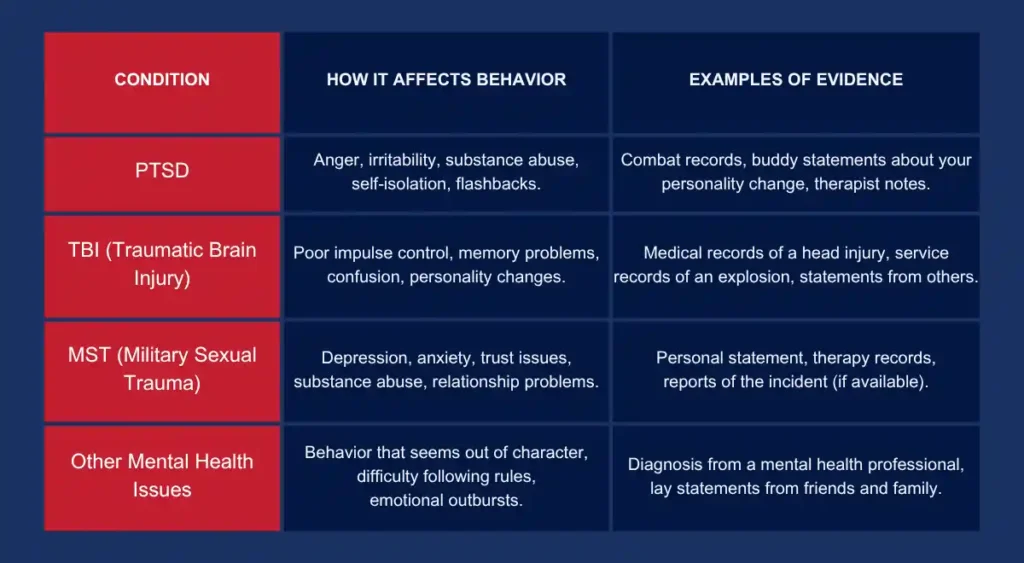
Many veterans, including homeless veterans, struggle to access mental health services. If you are struggling, contact the Veterans Crisis Line for immediate support. Getting help for your mental illness is a sign of strength and can also strengthen your VA claim.
Filing Your VA Claim for a Favorable Review
To start this whole process, you simply need to apply for a VA benefit. The easiest way is to file a VA claim for disability compensation using VA Form 21-526EZ. This is what formally kicks off the Character of Discharge review.
You can submit your application online through the VA’s official website, which is a federal government site. You can also mail the form. When you fill out the application, list all the service-connected disabilities you believe you have, from hearing loss to PTSD.
When you file the claim, you should submit all of the compelling evidence you gathered. Don’t wait for the VA to ask for it. Be proactive and send them everything upfront to build the strongest possible case from day one and increase your chances of getting a good disability rating.
What to Do if the VA Denies You
It is possible that the VA will initially deny your claim. They may issue an unfavorable Character of Discharge determination. Do not give up if this happens; this is not the end of the road.
You have the right to appeal this decision under the Appeals Modernization Act (AMA). You have three options. You can file a Supplemental Claim with new and relevant evidence that wasn’t previously considered.
Alternatively, you can request a Higher-Level Review, where a more experienced VA employee reviews the same evidence. Or, you can appeal directly to the Board of Veterans’ Appeals. An initial denial can be frustrating, but many veterans win their cases on appeal.
Sometimes, the first person who looks at your file just gets it wrong. Appealing gives you a fresh set of eyes on your case and your life-changing care benefits. This is often the point where getting help from an accredited VA attorney or claims agent can make a big difference.

Conclusion
If you received discharge papers that weren’t an honorable discharge, it can leave you feeling isolated and undeserving. But your service still counts, and the door to VA benefits like life insurance and burial benefits is not closed forever. You didn’t receive the honorable conditions you hoped for, but that does not erase your sacrifice.
You have the power to show the VA the full story of your service and the challenges you faced. Building a strong case with compelling evidence is your path to the health care benefits and compensation you earned. Success is absolutely possible when appealing an OTH discharge for VA benefits Here’s how to apply and win your VA claim.
Gather your records, tell your story, and fight for the veterans disability benefits you rightfully deserve. If you’re eligible, you owe it to yourself to pursue your VA disability claim. Your fight isn’t over.