

Military service can place heavy strain on the body, especially for service members who spend years lifting heavy objects, carrying gear, wearing restrictive body armor, completing intense physical activities, and working in high-stress environments. Over time, those demands may contribute to a hiatal hernia military condition that continues long after active duty discharge. A hiatal hernia occurs when part of the stomach pushes upward through the diaphragm into the chest or abdominal cavity, often causing chronic heartburn, acid reflux, stomach pain, chest discomfort, regurgitation, and difficulty swallowing.
For veterans, this condition can become more than a minor digestive issue. In severe cases, hiatal hernias can disrupt sleep, limit eating habits, interfere with work, and affect normal daily activities. Symptoms include heartburn regurgitation, chronic coughing, swallowing fatigue, nausea, abdominal pain, and severe symptoms that may require long-term treatment. When these symptoms are clearly documented in your current medical records, the VA recognizes hiatal hernias as a condition that may qualify for VA disability benefits if the evidence supports service connection.
Proving service connection is one of the most important parts of a successful VA disability claim. Veterans must show that the condition began during military service, was aggravated by service, or was caused by another service-connected condition. This may involve service records, medical records, a diagnosis, lay statements, and a medical nexus explaining how the condition caused ongoing symptoms. For example, repeated lifting of heavy objects, abdominal strain, physical activities, chronic coughing, or another digestive condition may help support a claim when the evidence clearly connects the hernia to service.

The VA rating process for hiatal hernia claims depends on the severity of symptoms and how they affect daily life. The VA evaluates symptoms such as pain, vomiting, weight loss, difficulty swallowing, acid reflux, regurgitation, chest pain, and overall health impairment. Veterans with severe cases may receive a higher disability rating when their records show persistent symptoms, frequent treatment, or functional limitations. This is why it is important to maintain detailed medical records and explain exactly how the condition affects your work, sleep, diet, and quality of life.
Understanding how the VA evaluates hiatal hernia claims can help disabled veterans avoid common mistakes. Whether your condition developed during service, worsened after discharge, or became a secondary condition related to another disability, strong documentation is key. This guide explains how hiatal hernias develop, what symptoms matter most, how the VA rating schedule works, and what evidence veterans need to build a stronger claim for disability benefits.
A hiatal hernia occurs when the upper part of your stomach pushes through your diaphragm muscle, specifically through the esophageal hiatus. Your diaphragm acts as a solid muscle wall separating your abdomen from your sensitive chest cavity, maintaining the pressure balance required for breathing. Normally, your esophagus passes through a small opening in this muscle, but when that opening weakens, the stomach pushes upward. When that opening weakens or stretches, your stomach bulges up into your chest, creating abnormal internal pressure and structural displacement. This anatomical shift creates a perfect environment for highly acidic stomach contents to escape into your esophagus, leading to chronic acid reflux and potential esophageal damage.

Veterans often confuse this specific condition with a standard groin injury like an inguinal hernia, which is a common mistake during the va disability process. However, these two medical issues affect completely different parts of your internal body structure and have different va rating criteria. An inguinal hernia involves intestinal tissue pushing through the lower wall of your abdominal cavity, often caused by heavy lifting. A hiatal hernia specifically affects the upper digestive tract and the surrounding diaphragm muscle tissue, often exacerbated by military service. Symptoms of a hiatal hernia include persistent heartburn, abdominal pain, and a noticeable difficulty swallowing that can make eating a painful and stressful experience.
Medical professionals generally categorize hiatal hernias into two primary types for diagnosis and treatment planning, which directly impacts your disability rating. Sliding hiatal hernias represent the vast majority of medical cases diagnosed in military veterans today, where the junction of the esophagus and stomach moves. The stomach and the section of the esophagus that joins the stomach slide up into the chest through the hiatus. This movement often fluctuates, meaning hiatal hernia symptoms may come and go depending on your daily activities and physical strain. Paraesophageal hiatal hernias happen much less frequently but present a significantly higher medical risk profile for disabled veterans due to potential complications.
In a paraesophageal hernia, the stomach squeezes through the hiatus opening and rests directly next to the lower esophagus, potentially becoming trapped. In severe cases, the blood supply to the stomach gets cut off, creating a life-threatening strangulated hernia that requires emergency medical attention. This condition requires immediate surgical intervention to prevent tissue death and other catastrophic internal failures within the abdominal cavity. For those seeking a va rating, the severity of these symptoms and the type of hernia diagnosed will play a major role in the final disability rating assigned. It is vital to provide medical records that clearly distinguish between these types to ensure an accurate evaluation of your va disability benefits.
Key Takeaways
- A hiatal hernia develops when the stomach pushes upward through the diaphragm muscle.
- Sliding and paraesophageal represent the two primary types of hiatal hernias diagnosed in veterans.
- Severe paraesophageal cases risk becoming a dangerous strangulated hernia requiring emergency surgery.
The Link Between Hiatal Hernia Military Service and VA Disability

Active duty requires constant physical exertion that directly impacts the core muscles surrounding your stomach and diaphragm. Service members routinely carry heavy rucksacks weighing upwards of eighty pounds during long training marches and combat patrols. This constant heavy lifting dramatically increases intra-abdominal pressure over months and years of military service, weakening the internal structures. That sustained pressure weakens the diaphragm and forces the stomach upward into the chest, making a hiatal hernia military connection very common among infantry, engineers, and logistics personnel. Even routine physical training can contribute to the gradual development of hiatal hernias over a standard twenty-year career.
Your military service basically creates the exact mechanical conditions needed for a hiatal hernia to form and worsen over time. Physical trauma during combat or training exercises also contributes to significant diaphragm tissue damage, which may not be immediately apparent. A sudden impact to the abdomen can tear the muscle tissue surrounding the esophageal hiatus, leading to long-term abdominal pain and digestive dysfunction. High-stress environments alter your eating habits and digestive health during long combat deployments overseas, which can exacerbate acid reflux and other gastrointestinal issues. These factors combined make hiatal hernia a significant concern for disabled veterans seeking va disability benefits.
Pro Tip: Keep a detailed log of your physical training requirements and any abdominal injuries sustained during service. This documentation provides crucial evidence when filing your va disability claim and helps establish a clear service connection for your hiatal hernia.
Veterans frequently consume meals rapidly or eat highly processed military rations (MREs) out of pure necessity during field exercises. These environmental factors compound the physical strain and accelerate the development of a hiatal hernia by increasing gastric pressure. Toxic exposures might also play a critical role in developing severe gastrointestinal problems over time for many disabled veterans. Veterans exposed to Agent Orange or toxic burn pits often suffer from chronic coughing fits, which violently spikes pressure inside the abdominal cavity, further stressing the delicate diaphragm muscle. This chronic respiratory strain is a frequently overlooked factor in hiatal hernia military claims.
While research continues to evolve, the mechanical strain of coughing clearly worsens an existing hiatal hernia and its associated symptoms. You must document all these physical demands and exposures in your official service records to support your va disability application effectively. Chronic strain from heavy lifting and respiratory issues are primary drivers for this condition in the veteran population. By linking these factors to your service, you increase the likelihood of a favorable va rating for your digestive health issues. Ensure your medical records reflect the full scope of your military service duties to provide a complete picture to the VA.
Establishing Service Connection and Disability Rating for Hiatal Hernia

Winning your va disability claim requires establishing a clear service connection for your hiatal hernia through the “Caluza Triangle.” The Department of Veterans Affairs requires three specific elements to grant you va disability benefits and a monthly disability compensation. First, you need a current medical diagnosis of a hiatal hernia from a qualified physician or gastroenterologist. This diagnosis should be supported by objective evidence, such as an X-ray, barium swallow, or an endoscopy, to prove the existence of the hernia. Without a formal diagnosis in your medical records, the VA will likely deny your claim regardless of your symptoms.
Second, you must show an in-service event, injury, or illness that directly caused or aggravated the condition during your active duty. This could be a specific injury during training, a combat-related trauma, or the cumulative effect of years of heavy lifting. Third, you need a precise medical nexus letter linking your current diagnosis to that in-service event or environment. Your medical records serve as the absolute foundation of your entire va disability claim and will determine your eventual disability rating. A strong medical nexus should state that your condition is “at least as likely as not” related to your military service.
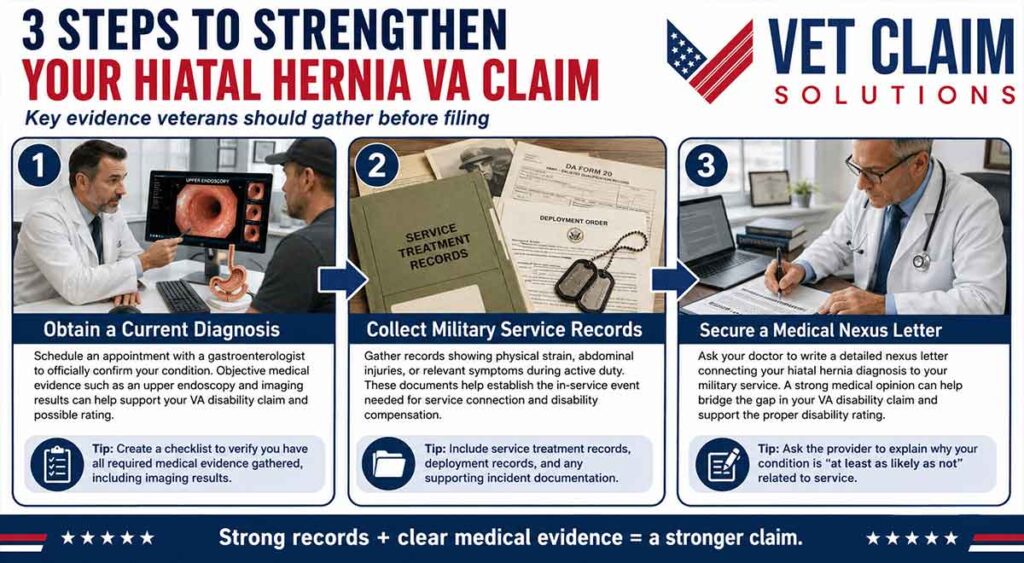
How to Prove Your Claim
- Obtain a Current Diagnosis
Schedule an appointment with a gastroenterologist to officially confirm your internal condition. You need objective medical evidence like an upper endoscopy to proceed with your filing for veterans disability and secure a va rating.
Tip: Create a checklist to verify you have all required medical evidence gathered for your va disability claim, including imaging results.
- Collect Military Service Records
Gather all documentation showing physical strain or abdominal injuries during active duty. These service records establish the necessary in-service event required for disability compensation and service connection.
- Secure a Medical Nexus Letter
Ask your doctor to write a detailed medical nexus letter connecting your hiatal hernia diagnosis to your military service. This bridges the gap for your va disability claim approval and disability rating.
You should gather all treatment notes, imaging results, and pharmacy records related to your condition to build a bulletproof case. If you have experienced significant weight loss due to difficulty swallowing or chronic nausea, ensure this is documented in your medical records. The VA will look for evidence that your condition has persisted and requires ongoing medical management or dietary changes. Providing a comprehensive picture of how the hiatal hernia affects your daily activities and work performance will help the rater understand the true impact of the disability. Don’t forget to include “buddy statements” from fellow service members who witnessed your physical struggles during active duty.
Analyzing the VA Rating Schedule and VA Disability Benefits

The VA evaluates a hiatal hernia under Diagnostic Code 7346 in the Schedule for Rating Disabilities, which focuses on diaphragmatic issues. This code covers several diaphragmatic issues, including hiatal hernias and paraesophageal hernias, based on the severity of symptoms. The va rating you receive depends on the frequency and intensity of your hiatal hernia symptoms. A 10% disability rating is typically assigned if you have two or more symptoms of the 30% category, such as mild epigastric distress or occasional acid reflux. This lower rating acknowledges the condition exists but may not be fully debilitating yet.
A 30% va rating is granted when a veteran experiences persistently recurring epigastric distress with dysphagia (difficulty swallowing), pyrosis (heartburn), and regurgitation. These symptoms are often accompanied by substernal or precordial chest pain that can be mistaken for cardiac issues. These symptoms must be severe enough to interfere with your daily life and require consistent medical intervention. For the most severe cases, a 60% disability rating is available under the current schedule. This higher rating requires symptoms of the 30% category but with additional complications like vomiting, hematemesis (vomiting blood), or melena (bloody stool), often leading to moderate anemia and significant weight loss.
It is important to note that the VA does not offer a 100% rating for a hiatal hernia alone under Diagnostic Code 7346. However, the symptoms can be so debilitating that they prevent you from maintaining gainful employment or performing daily activities. If your hiatal hernia combined with other service-connected conditions makes work impossible, you may qualify for total disability individual unemployability (TDIU). Using a va disability disability calculator can help you understand how multiple ratings combine to determine your total monthly va disability benefits. Understanding the “pyramiding” rules is also vital, as the VA generally won’t rate GERD and hiatal hernia separately if they share the same symptoms.
When preparing for your Compensation and Pension (C&P) exam, be ready to describe your “worst days” rather than your “best days” to the examiner. The examiner needs to know how the hiatal hernia limits your daily activities and whether you require special dietary restrictions or daily medications. Be specific about the frequency of your abdominal pain and how often you experience severe acid reflux or chest pain. This detailed testimony, backed by your medical records, is vital for securing the correct va disability benefits for your situation. Always be honest about the impact on your daily life, including any missed work or social engagements due to your condition.
Filing for Hiatal Hernia Secondary Conditions and Hernia Secondary Claims
Many veterans suffer from secondary conditions that are either caused or aggravated by their primary service-connected hiatal hernia. One of the most common connections is sleep apnea, which can be linked to the physiological changes caused by a hernia. The chronic acid reflux associated with a hiatal hernia can irritate the airway, leading to inflammation and obstruction during sleep. If you have a service-connected hiatal hernia and later develop sleep apnea, you may be able to file for sleep apnea as a hiatal hernia secondary condition. This can significantly increase your overall disability rating and va disability benefits.
Another frequent connection involves mental health, which is often overlooked in gastrointestinal claims for disabled veterans. The chronic pain and discomfort of a hiatal hernia can exacerbate symptoms of PTSD, anxiety, or depression. Conversely, the stress and physiological changes associated with a ptsd va rating can lead to increased stomach acid and digestive distress, worsening a hiatal hernia. Filing a hernia secondary claim to your ptsd va status is a common strategy for disabled veterans to ensure their total health picture is recognized. Your medical records should reflect how these conditions interact and worsen each other over time.
Other secondary conditions might include gastroesophageal reflux disease (GERD), Barrett’s esophagus, or even dental issues caused by chronic acid exposure. When filing for these, you must provide a medical nexus showing that the secondary condition is “at least as likely as not” caused by the primary hiatal hernia. This comprehensive approach to your secondary conditions ensures that you receive the maximum va rating possible for the full extent of your service-related injuries. Don’t overlook the impact of weight loss or anemia as potential secondary conditions that warrant additional va disability compensation.
The Impact on TDIU and Veterans Disability Ratings

A hiatal hernia can have a profound impact on your ability to work, especially if your job requires physical labor or long hours. If your va rating for a hiatal hernia is 60%, or if you have a combined disability rating of 70% with at least one condition at 40%, you may be eligible for total disability individual unemployability. This benefit pays veterans at the 100% rate even if their individual ratings don’t add up to 100% mathematically. For many disabled veterans, individual unemployability is the only way to achieve financial stability when chronic illness prevents traditional employment.
The abdominal pain and difficulty swallowing associated with a severe hiatal hernia can lead to frequent absences from work and decreased productivity. If you are a veteran struggling with these issues, it is essential to document how your symptoms interfere with your professional responsibilities in your medical records. The VA considers both physical and sedentary work limitations when evaluating disability individual unemployability claims. For disabled veterans, this va disability benefit can be a lifeline when a hiatal hernia makes maintaining a career unsustainable. Be sure to include vocational evidence if your daily life is severely impacted.
To support a total disability individual claim, you may need vocational evidence in addition to your medical records and service records. An expert can testify to how your acid reflux, fatigue from sleep apnea, and chronic abdominal pain prevent you from performing essential tasks. By combining your hiatal hernia rating with other conditions like a ptsd va rating, you can build a strong case for total disability individual unemployability. Always use a disability calculator to track your combined ratings and identify the best path forward for your va disability benefits. Individual unemployability is a powerful tool for those whose military service has left them unable to work.
Managing Hiatal Hernia Symptoms and Daily Activities
Living with a hiatal hernia requires significant adjustments to your daily life and how you approach daily activities. Many veterans find relief through lifestyle changes, such as eating smaller, more frequent meals and avoiding triggers like spicy or acidic foods. Elevating the head of your bed can also help reduce acid reflux during the night, which may improve your sleep quality if you also struggle with sleep apnea. These management strategies are important for maintaining your quality of life while you navigate the va disability process and wait for your va rating decision.
Medical management often includes proton pump inhibitors (PPIs) or H2 blockers to control stomach acid and prevent further damage. In some cases, surgery may be necessary to repair the diaphragm and move the stomach back into its proper position within the abdominal cavity. If you undergo surgery for your hiatal hernia, you may be eligible for a temporary 100% va rating during your convalescence period. Be sure to submit your surgical medical records to the VA to trigger this temporary increase in disability benefits. Surgery is often a last resort but can be life-changing for disabled veterans suffering from a strangulated hernia.
It is also vital to monitor for complications like weight loss or anemia, which can indicate that the hiatal hernia is worsening. Regular follow-ups with a gastroenterologist will ensure that your condition is properly managed and that any new secondary conditions are identified early. For disabled veterans, staying proactive about health is the best way to ensure that your va disability claim accurately reflects your current medical needs. Keep a detailed diary of your hiatal hernia symptoms and how they affect your daily activities to provide as evidence during your next va rating review or C&P exam.
Securing Your VA Benefits for Hiatal Hernia

Navigating the va disability system for a hiatal hernia can be complex, but it is a necessary step to ensure you receive the support you deserve. By establishing a clear hiatal hernia military connection and documenting the impact on your daily life, you can secure a fair va rating. Whether you are filing for a primary condition or exploring secondary conditions like sleep apnea or ptsd va, the key is thorough documentation and professional medical support. Your military service has a lasting impact on your health, and the VA is obligated to compensate you for those service-connected injuries.
Remember that your service-connected hiatal hernia is a recognized disability that entitles you to va disability benefits and disability compensation. Don’t hesitate to use a disability calculator to understand your potential compensation and seek help from veteran service officers if your claim is denied. With the right medical records, a strong medical nexus, and a clear understanding of the disability rating schedule, you can successfully manage your health. Your veterans disability claim is a vital part of your post-service life, ensuring you have the resources to manage your hiatal hernia symptoms for years to come