


Hip impingement disability ratings can play a major role in how the VA evaluates chronic hip pain, limited mobility, and painful motion. For veterans, this condition may make it harder to walk, stand, sit for long periods, climb stairs, work, exercise, or complete normal daily activities. When hip symptoms are clearly documented in your medical records, the VA may assign a disability rating based on range of motion, functional loss, painful movement, and how the condition affects your quality of life.
The medical term for hip impingement is femoroacetabular impingement, or FAI. This happens when abnormal contact between the hip joint bones causes pain, stiffness, inflammation, and reduced movement. Veterans with FAI may also develop related hip conditions, including labral tears, arthritis, weakness, or worsening joint damage over time. In some cases, severe hip damage may eventually lead to hip replacement, which the VA evaluates under separate diagnostic codes and rating criteria.

To qualify for a proper VA rating, veterans must show more than just hip pain. The VA usually looks for a current diagnosis, an in-service event, a medical nexus, and strong medical evidence connecting the hip condition to military service. Veterans may also pursue service connection on a direct basis, as a secondary condition, or through aggravation if another service-connected condition made the hip problem worse. Understanding how the VA rates hip pain, painful motion, limited range of motion, and functional loss can help veterans build a stronger VA disability claim and avoid a lower rating than they may deserve.
Femoroacetabular impingement, or hip impingement, occurs when extra bone forms along one or both bones of the hip joint. This irregular growth creates friction during movement, which can damage cartilage and cause a labral tear over time. Veterans may experience chronic hip pain, stiffness, painful motion, and limited hip range, all of which can affect how the VA rates hip conditions for a possible VA disability rating. Strong medical evidence, including medical records, imaging, and documentation of functional loss, can help support a stronger VA disability claim for hip impingement.
The Mechanics of Femoroacetabular Impingement (FAI) and Hip Impingement Disability Ratings
Medical professionals generally classify femoroacetabular impingement, or FAI, into three main types based on where abnormal bone growth develops in the hip joint. Cam impingement occurs when extra bone forms on the femoral head, while pincer impingement involves extra bone along the acetabulum, the socket portion of the hip joint. Some veterans develop a combined form of hip impingement, which may increase friction, worsen hip pain, damage cartilage, and contribute to a hip labral tear over time.
These physical limitations can directly affect hip impingement disability ratings because the VA evaluates hip conditions based on painful motion, limited range of motion, functional loss, weakness, and the impact on daily activities. When the VA rates hip pain, it often looks at how far the veteran can move the hip, whether movement causes pain, and whether the condition interferes with walking, standing, sitting, climbing stairs, or performing work-related tasks. Severe symptoms may support a higher VA rating when they are clearly documented.
Strong medical evidence is critical for any VA disability claim involving hip impingement. Veterans should make sure their medical records include a clear diagnosis, imaging results, treatment history, range-of-motion findings, and notes describing painful motion or limited mobility. To establish service connection, the claim may also need evidence of an in-service event, a medical nexus, or proof that another service-connected condition caused or aggravated the hip condition.
Key Takeaways
- Hip impingement involves abnormal bone growth that causes harmful joint friction.
- The condition leads to severe cartilage damage and reduced range of motion.
- Evaluators require objective evidence showing exactly how the condition limits your daily activities.
VA Hip Impingement Disability Ratings and Service Connection Criteria

The Department of Veterans Affairs evaluates hip conditions using specific diagnostic codes found in their official schedule of ratings. Evaluators reference 38 CFR 4.71a to match your physical limitations with a corresponding percentage. The assigned VA hip impingement disability rating directly correlates with how far you can bend or extend your affected leg.
VA Diagnostic Codes for Hip Impingement Disability Ratings and Range of Motion
Veterans most commonly receive ratings under Code 5252, which focuses specifically on the limitation of thigh flexion. A 10 percent rating typically applies when your thigh flexion is limited to 45 degrees. If you cannot flex your thigh past 30 degrees, the VA assigns a 20 percent disability rating.
Severe cases involving ankylosis, where the joint becomes completely stiff, warrant higher evaluations under Code 5250. An unfavorable ankylosis can result in up to a 90 percent rating depending on the specific joint angle. The VA also applies the painful motion principle, granting a minimum 10 percent rating if movement causes documented pain.
The Bilateral Factor in Hip Impingement Disability Ratings
Veterans suffering from bilateral hip impingement receive additional compensation through a specialized mathematical calculation. The VA applies a bilateral factor when service-connected disabilities affect both sides of the lower extremities. This adjustment recognizes that bilateral conditions create a much greater functional limitation than unilateral problems.
Pro Tip: Always attend your Compensation and Pension examinations during a symptom flare-up if possible. Evaluators must measure your range of motion based on your worst days to provide an accurate disability rating.
Social Security Disability Benefits and SSA Hip Impingement Disability Ratings

Applying for Social Security Disability Insurance requires proving that your hip impingement prevents substantial gainful activity. The Social Security Administration evaluates these claims under their official guidelines for major joint abnormalities. You must demonstrate chronic joint pain accompanied by physical signs of limited motion or abnormal movement to qualify for SSA disability for hip impingement.
Meeting SSA Blue Book Requirements for Hip Impingement Disability Ratings
To qualify automatically, applicants must meet the strict criteria outlined in Section 1.18 of the Blue Book. You must provide medical imaging confirming joint space narrowing, bony destruction, or ankylosis of the affected hip. Furthermore, you must show a documented medical need for a walker, bilateral canes, or a wheelchair.
If you do not require assistive devices, winning a claim based solely on the official listing becomes difficult. The administration maintains strict requirements regarding your ability to ambulate effectively in a standard work environment. Many applicants fail at this stage because they lack the specific medical documentation required by the federal examiners.
Residual Functional Capacity for Hip Impingement Disability Ratings

When your condition falls short of the official listing, the administration assesses your Residual Functional Capacity (RFC). This evaluation determines the maximum amount of physical work you can still perform despite your severe hip pain. If the assessment concludes you cannot stand, walk, or sit long enough for sedentary work, you may receive approval.
How to Build a Strong Claim for Hip Impingement Disability Ratings
Gathering compelling medical evidence forms the core foundation of any successful disability application. You must provide comprehensive documentation that clearly illustrates the severity of your physical limitations. Follow these standardized procedures to build a robust file for your evaluating agency.
Steps to Document Your Hip Condition
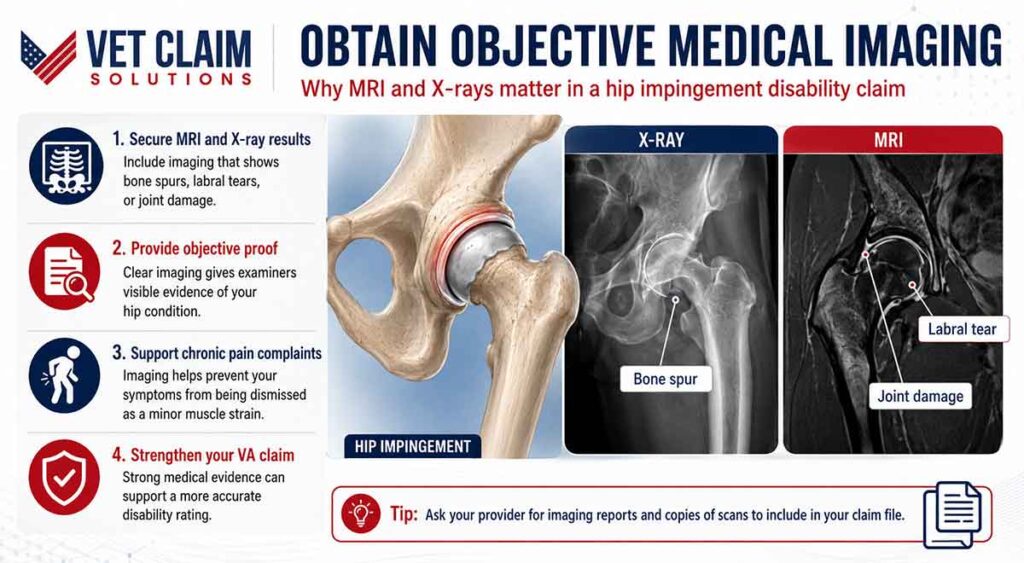
- Obtain Objective Medical Imaging
Secure MRI and X-ray results showing bone spurs or labral tears in your hip joint. Clear imaging prevents examiners from dismissing your chronic pain as a minor muscle strain.
Tip: Request an MR arthrogram, which uses injected dye to provide better visibility of labral tears.
- Document Your Range of Motion
Ask your orthopedic specialist to record exact degree measurements using a medical goniometer. Disability agencies rely heavily on these precise measurements rather than vague descriptions of joint stiffness.
- Secure Medical Source Statements
Obtain detailed letters from your treating physicians regarding your daily physical limitations. A medical professional’s written opinion carries significant weight during the formal disability review process.
Workers Compensation and Hip Impingement Disability Ratings for Impairment
Employees who develop hip impingement from repetitive workplace activity, heavy lifting, falls, or prolonged standing may qualify for workers’ compensation benefits. Insurance companies usually review medical records, imaging, work restrictions, and rating criteria to determine how the hip disability affects the worker’s ability to walk, stand, bend, climb stairs, or perform job duties.
A qualified medical evaluator may assign an impairment rating based on hip pain, reduced range of motion, weakness, stiffness, x-ray evidence, MRI findings, hip labral tear, or residual symptoms after surgery. If the condition progresses to severe arthritis, major functional loss, or hip replacement, the impairment rating may increase. For veterans, the same evidence may also help support a separate VA claim for hip pain VA disability when the hip condition is connected to military service, an in-service event, or another service-connected disability.
Maximum Medical Improvement and Hip Impingement Disability Ratings
Physicians must determine that you have reached Maximum Medical Improvement (MMI) before assigning a final impairment rating. This term means your hip condition has stabilized and will likely not improve further with additional medical treatment. Once you reach this plateau, the insurance company finalizes your permanent disability settlement based on the remaining deficits.
️ Warning: Do not skip physical therapy sessions or ignore doctor recommendations while your compensation claim remains pending. Insurance adjusters frequently use gaps in medical treatment to argue that your condition has improved.
Appealing Denied Hip Impingement Disability Ratings
Denied hip impingement disability ratings often happen when the VA does not have enough medical evidence, service records, or proof connecting hip pain to military service. Veterans should review the denial letter carefully to see whether the VA rejected the claim because of missing diagnosis details, lack of an in-service event, weak nexus evidence, or insufficient proof of painful motion and functional loss.
A stronger appeal may include updated medical records, range-of-motion tests, x-ray evidence, MRI results, surgical reports, physician statements, and documentation of hip pain, residual weakness, limited range, or hip labral tear symptoms. Veterans may also argue secondary service connection if another service-connected condition worsened the hip disability. When the evidence clearly matches the VA’s diagnostic codes and rating criteria, the veteran may have a stronger chance of securing a proper VA rating or higher rating.
Key Takeaways
- Initial denials are common, but you have the right to appeal the decision.
- Successful appeals require submitting new medical evidence that directly addresses the denial reasons.
- Working with a legal professional helps protect your claim from missed deadlines or technical errors.
Final Thoughts on Hip Impingement Disability Ratings

Securing accurate hip impingement disability ratings requires strong medical evidence, consistent treatment, and a clear understanding of how the VA evaluates hip pain, painful motion, limited range of motion, and functional loss. For veterans, the strongest VA disability claim usually includes a current diagnosis, detailed medical records, imaging results, x-ray evidence, range-of-motion measurements, and documentation showing how the hip disability affects daily life. The more clearly your evidence matches the VA’s diagnostic codes and rating criteria, the harder it is for the VA to underestimate the severity of your condition.
Veterans should also focus on proving service connection. This may involve showing an in-service event, service treatment records, a medical nexus, or evidence connecting the hip condition to military service. Some veterans may qualify through secondary service connection if another service-connected condition, such as a back, knee, ankle, or gait issue, caused or aggravated the hip condition. If your records show a hip labral tear, chronic hip pain, residual weakness, or worsening mobility, those details should be clearly documented before filing or appealing a VA claim.
Consistent medical treatment can strengthen your case over time. Ask your provider to document exact range-of-motion results, painful motion, stiffness, weakness, flare-ups, and how symptoms affect walking, standing, sitting, climbing stairs, and work-related activities. Veterans who have undergone surgery, developed severe arthritis, or required hip replacement should make sure their records describe any long-term symptoms, including limited range, instability, or markedly severe residual impairment.
If the VA denies your claim or assigns a lower VA rating than your symptoms support, do not stop there. Review the denial letter, gather updated medical records, request supportive statements from your orthopedic specialist, and submit new and relevant evidence before the appeal deadline. A well-documented, evidence-based appeal can help support a higher rating for hip impingement, hip pain, painful motion, and long-term functional loss.