

Securing a fair PTSD rating requires specific evidence connecting your condition to your military service. Many veterans struggle with the claims process because they misunderstand what documentation actually matters to evaluators. Understanding the PTSD VA Rating Evidence Veterans Need to Understand is critical if you want a successful outcome for your VA disability claim. We will break down the exact rules the government uses to evaluate your mental health and overall stability. This guide explains the medical evidence you need to submit for a successful disability claim and long-term disability compensation.
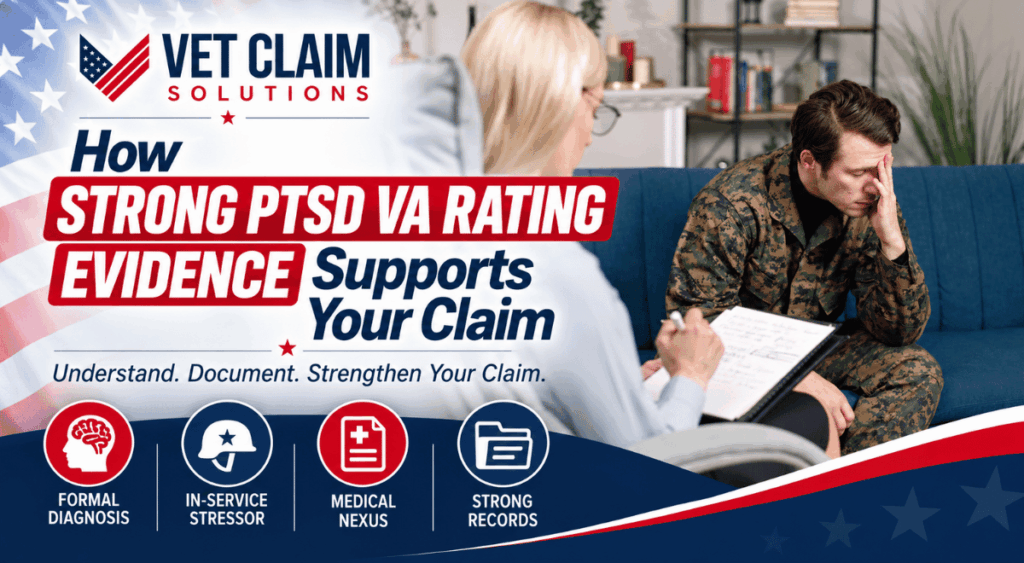
Veterans must provide three specific pieces of evidence to establish service connection for their condition. First, you need a current PTSD diagnosis from a qualified medical professional confirming you have post-traumatic stress disorder. Second, you must provide proof of an in-service stressor that caused your psychological trauma during your time in uniform. Finally, your records must show a clear medical nexus or link between those traumatic events and your daily life today.
Without these three foundational elements, a va rating decision will likely result in a denial of your application. The government strictly enforces this three-part test for all mental disorders and related mental health conditions. You cannot substitute a self-diagnosis or buddy statements for an official evaluation from a licensed psychiatrist or psychologist. Evaluators need objective medical facts to approve your application for disability benefits and monthly financial support.
While buddy statements cannot replace a doctor’s evaluation, they provide valuable context for your official claims file. Fellow service members can write letters detailing the changes they observed in your behavior after the specific incident occurred. These lay statements help paint a complete picture of your mental health for the evaluator reviewing your case. Do you know what documents actually matter to the evaluator when they are determining your PTSD rating?
In addition to buddy statements, your personal statement in support of the claim is a vital piece of evidence. You should describe how the traumatic event changed your personality, work performance, and your ability to maintain relationships. This narrative helps the Department of Veterans Affairs understand the human element behind the clinical medical codes. Providing a detailed account of your PTSD symptoms ensures that the rater sees the full scope of your daily struggles.
The medical nexus is often the most difficult part of the “Caluza Triangle” to establish for many veterans. A nexus is a professional medical opinion that links your current diagnosis to the event that happened during service. Without a strong nexus statement, the VA may argue that your condition is related to post-service life events. Ensuring your doctor uses the specific phrase “at least as likely as not” can significantly strengthen your claim’s validity.
Understanding PTSD Ratings and How the Department of Veterans Affairs Determines Your VA PTSD Rating
The government evaluates a mental health condition based on how severely it impacts your work and daily life. You need to understand how PTSD rating criteria work before you file your paperwork with the regional office. A VA PTSD rating ranges from 0% to 100%, depending on the frequency and severity of your PTSD symptoms. Evaluators look at your ability to maintain employment and handle social relationships with family and friends.
The VA uses the General Rating Formula for Mental Disorders found in 38 CFR § 4.130 to assign these percentages. This formula is designed to measure “occupational and social impairment” rather than just the presence of symptoms. It is possible to have severe symptoms but still receive a lower rating if those symptoms do not interfere with work. Conversely, even moderate symptoms can lead to a high rating if they make holding a job impossible.
The 0% to 100% PTSD Rating Scale for Mental Health
The government uses a specific scale for a mental health disability rating that measures occupational and social impairment. A 0% disability rating means you have a formal diagnosis but your symptoms do not currently interfere with work. A 10% ptsd rating applies when you experience mild symptoms that decrease your work efficiency only during periods of significant stress. Veterans with this percentage usually manage their condition well with continuous medication or therapy.
A 30% va rating applies when you experience an occasional decrease in work efficiency and periods of inability to perform occupational tasks. This often includes issues like a depressed mood, mild memory loss, or occasional panic attacks that disrupt your day. A 50% PTSD rating requires evidence of reduced reliability and productivity due to your ongoing psychological struggles and health conditions. At this level, you may struggle to keep a job or maintain a stable home life.
At the 70% level, veterans show deficiencies in most areas, including severe social impairment and poor judgment in high-pressure situations. This rating often includes symptoms like suicidal ideation, obsessive rituals, or a near-continuous state of panic and depression. A 100% disability rating requires total occupational and social impairment, meaning you cannot function in any work environment. This level acknowledges your service connection while indicating your impairment is completely disabling and requires constant care.
It is important to note that the VA does not “add” percentages together in a simple mathematical way. Instead, they use a combined rating table that accounts for how multiple disabilities affect your overall efficiency. If you have a 70% rating for PTSD and a 10% rating for a physical injury, your total may not be 80%. Understanding these ptsd ratings and the “VA Math” involved will help you better navigate the expectations of your final decision letter.
Pro Tip: Document your worst days, not just your average days, to ensure an accurate va ptsd rating. Evaluators need to see your maximum level of impairment to assign an accurate ptsd rating that reflects your reality.
Gathering Strong Evidence for Your VA PTSD Claim

Strong documentation forms the backbone of any successful va ptsd application and ensures you receive the disability benefits you deserve. You should start by collecting all relevant medical records from both military and private healthcare providers. This benefits questionnaire provides the specific data points that raters use to assign a percentage to your claim.
In addition to medical records, you should gather evidence of how your mental health affects your employment history. Performance reviews, disciplinary records, or letters from former supervisors can demonstrate a decline in work efficiency over time. If you have been fired or forced to resign due to your PTSD symptoms, that documentation is incredibly powerful. The government needs to see a direct correlation between your mental disorders and your inability to maintain gainful employment.
Do not overlook the importance of a “Nexus Letter” from a qualified medical professional when building your case. This letter should state that it is “at least as likely as not” that your condition was caused by your service. A well-written nexus letter can bridge the gap between a traumatic event and your current diagnosis. Without this professional medical opinion, the rater may struggle to find the necessary service connection for your PTSD rating.
You should also consider keeping a “symptom journal” for several weeks before submitting your claim or attending an exam. This journal should track the frequency of your flashbacks, nightmares, and instances of social withdrawal or irritability. Presenting a clear, chronological record of your daily struggles makes it harder for the VA to dismiss your symptoms as intermittent. Consistent documentation is the most effective way to prove the chronic nature of your mental health conditions.
Proving Your In-Service Stressful Event and Personal Trauma
Proving a stressful event occurred during your service is often the most challenging part of the entire process. For combat veterans, the “combat presumption” may apply, which simplifies the requirement to prove a specific traumatic event. However, for non-combat ptsd claims, you must provide corroborating evidence that the event actually took place. This might include morning reports, unit logs, or news articles from the time of the incident.
If your claim is based on personal trauma, such as military sexual trauma (MST), the evidence requirements are slightly different. The government looks for “markers” in your personnel file, such as sudden requests for transfer or changes in performance. These markers serve as indirect evidence of a traumatic event when direct documentation is unavailable or was never filed. Understanding these nuances is a key part of the PTSD VA Rating Evidence Veterans Need to Understand for a successful outcome.
It is also important to document any secondary health conditions that may have arisen from your primary trauma. For example, many veterans develop depression, anxiety, or substance abuse issues as a result of their underlying PTSD. These conditions can often be rated together or as secondary service connections, increasing your overall disability rating. Be sure to mention all related mental health conditions during your evaluation to ensure a comprehensive review.
For those who served in non-combat roles, the VA requires “credible supporting evidence” that the stressor occurred. This can include police reports, medical records from the time of the incident, or even letters from family members who noticed a change. The goal is to provide enough external validation to satisfy the rater that your experience was a real and significant trauma. Never assume that the VA will find this evidence on their own; you must be proactive in your search.
The Impact of Social Functioning on Your VA Rate
One of the primary factors in determining your PTSD rating is your level of social functioning. The government wants to know how your mental health affects your ability to interact with family, friends, and the public. Severe social impairment, such as total isolation or frequent outbursts of anger, can lead to a higher disability rating. Conversely, if you are able to maintain a healthy marriage and social life, your rating may be lower.
During your evaluation, be honest about the strain your PTSD symptoms place on your personal relationships. Do you avoid crowded places or family gatherings because they trigger your anxiety? Have you experienced a divorce or estrangement from children due to your emotional numbness or irritability? These real-world examples of social impairment are exactly what the rater needs to see to justify a higher va ptsd rating.
The rating criteria specifically look for signs of “gross impairment in thought processes or communication.” This might manifest as an inability to follow conversations, persistent delusions, or suicidal ideation. If you experience these severe symptoms, it is vital that they are documented in your medical records. The goal is to show that your mental health conditions have a profound and negative impact on every aspect of your life.
Social impairment also extends to your ability to maintain basic hygiene and self-care in extreme cases. If your PTSD is so severe that you forget to eat, bathe, or manage your finances, these are critical indicators of a 100% rating. Many veterans feel ashamed to admit these struggles, but they are essential pieces of evidence for the VA. Being transparent about your lowest points is the only way to ensure the rating reflects your actual needs.
The Role of the C&P Examination in Your VA PTSD Rating
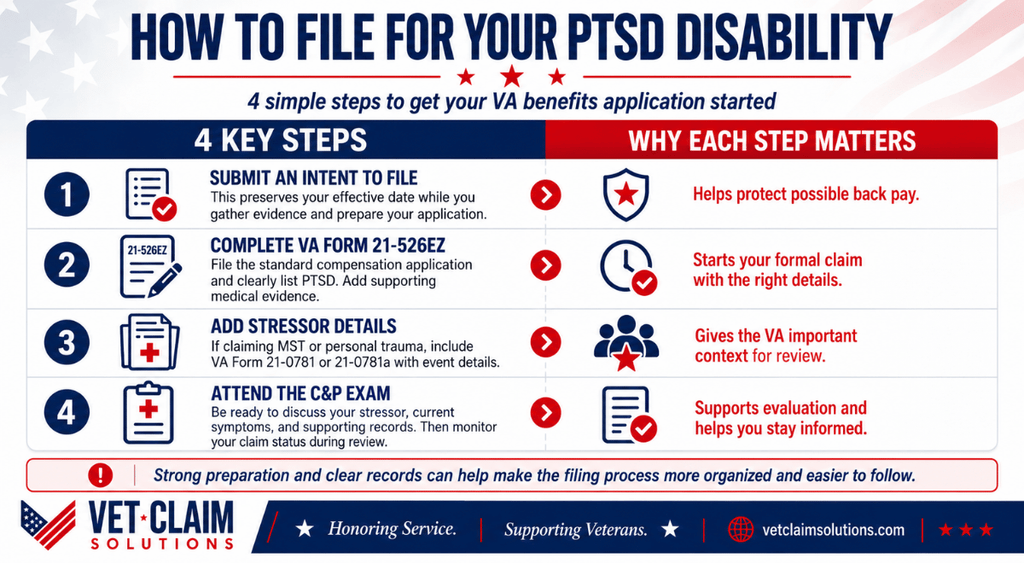
The C&P exam is often the most nerve-wracking part of the va disability process for many veterans. During this appointment, a doctor will ask you a series of questions to verify your diagnosis and assess your symptoms. It is important to remember that the examiner is not your treating physician; their job is to evaluate you for the va rating. Be honest and vulnerable about your struggles, even if it feels uncomfortable to discuss your traumatic event.
Many veterans make the mistake of “toughing it out” during the exam and downplaying their symptoms. This can lead to an inaccurately low PTSD rating that does not reflect your true level of impairment. Instead, describe your symptoms as they are on your very worst days to give the examiner a clear picture. If you have trouble sleeping, experience flashbacks, or struggle with hypervigilance, make sure those details are recorded in the exam report.
After the exam, the doctor will submit their findings to the regional office for a final decision. You can request a copy of the exam report through your local VA office or your Veterans Service Officer (VSO). Reviewing this report allows you to see if the examiner missed any key details or misrepresented your mental health. If the report is inaccurate, you may need to submit additional evidence or request a new exam during the appeals process.
It is also helpful to bring a spouse or close friend to the exam if the facility allows it. They can provide a different perspective on your behavior that you might not even notice yourself. For example, they can describe your night terrors or your tendency to check the locks on the doors repeatedly. This third-party observation can be very persuasive to an examiner who only sees you for a short period.
Understanding VA Disability Appeals for PTSD

If you receive a decision that you believe is too low or if your claim is denied, you have the right to appeal. The disability compensation appeals process has several levels, starting with a Higher-Level Review (HLR). In an HLR, a more senior rater looks at your existing evidence to see if an error was made. This is a good option if you believe the evidence already in your file supports a higher PTSD rating.
Another option is a Supplemental Claim, which allows you to submit “new and relevant” evidence to support your case. This is the best route if you have recently received a new PTSD diagnosis or have gathered more buddy statements. Finally, you can appeal directly to the Board of Veterans’ Appeals (BVA), where a judge will review your case. This process takes longer but allows for a more in-depth look at the PTSD VA Rating Evidence Veterans Need to Understand for a fair outcome.
Navigating the appeals process can be complex, so many veterans choose to work with an accredited attorney or VSO. These professionals understand the rating criteria and can help you identify the missing pieces in your disability claim. Whether you are filing for the first time or appealing a denial, persistence is key to getting the disability benefits you earned. Remember that your mental health is a priority, and the system is designed to support those who served.
Under the Appeals Modernization Act (AMA), you have more control over how your appeal is handled than ever before. You can choose the lane that best fits your situation, whether you need a quick review or a formal hearing. If you choose a BVA hearing, you can speak directly to a judge about how PTSD has affected your life. This personal interaction can often be the turning point in a long-running and difficult VA disability case.
Conclusion
Understanding the PTSD VA Rating Evidence Veterans Need to Understand is the first step toward a successful claim. By gathering strong medical evidence, proving your in-service traumatic event, and documenting your social impairment, you can secure a fair PTSD rating. Don’t be afraid to ask for help from professionals who specialize in VA PTSD claims and disability benefits. Your service to this country entitles you to support, and with the right evidence, you can achieve the va rating you deserve.
The journey to receiving your rightful disability compensation can be long and emotionally taxing for many. However, the financial and medical support provided by a successful claim can be life-changing for you and your family. Stay organized, keep copies of every document you submit, and never give up on your pursuit of justice. Your mental health matters, and the VA has a legal obligation to provide for those injured in the line of duty.