

If you are dealing with a brutal chronic cough that never seems to let up, you already know it is more than a small annoyance. It interrupts conversations, steals your sleep, and makes simple things like laughing with your family a chore If you served near burn pits, dust storms, or heavy smoke, it is hard not to wonder if there is a direct line between those deployments and the cough you have today That is where an irritable larynx VA claim chronic cough VA burn pit exposures start to connect. The symptoms feel random at first.
Over time, many veterans notice a pattern and begin to ask the right questions about benefits and proof. In this guide, we will walk through how chronic cough tied to an irritable larynx can connect to burn pit exposure. You will see how VA looks at these cases and what medical science says about toxic exposure. We will also outline the specific steps you can take to file a strong claim. You are not starting from scratch, and you are definitely not alone in this fight.
Many veterans from the Gulf War era and post-9/11 operations face similar health concerns. Understanding your options for VA benefits is the first step toward getting the help you deserve.

How Burn Pits Set The Stage For Irritable Larynx And Chronic Cough
Picture where you were deployed. You likely saw open air trash fires smoldering all day. Diesel fuel acted as an accelerant for plastic, metal, medical waste, and even human waste that was tossed in and burned. You did not have a choice about breathing that in. This was common practice in Southwest Asia and other deployment zones. The VA now openly acknowledges that airborne particulate matter from burn pits can damage the lungs and airways over time. This was a major shift announced in a 2021 VA ruling. That ruling started the move toward recognizing respiratory conditions from particulate matter.
Since then, legislation has continued to evolve to support those with military exposure. The PACT Act expanded access to health care and benefits for veterans with toxic exposures from the Vietnam era forward. This change expands benefits to millions who previously struggled to prove service connection. Burn pits were not some small local problem either. More than 200,000 veterans have already added their names and deployment history to the VA Open Burn Pit Registry.
This helps the government track trends. It also backs up what you and thousands of others have said for years about your service caused conditions. Science is catching up too. A 2024 study found that for every 100 days spent near burn pits in Iraq or Afghanistan, the risk of asthma rose by 1 percent. Chronic obstructive pulmonary disease risk went up 4 percent, and ischemic stroke 5 percent. Now imagine that level of inflammation sitting on your vocal cords and larynx year after year.
No surprise a simple cough from those years does not always go away once you come home. It lingers, gets worse, and starts to look a lot like an irritable larynx pattern.

What Doctors Mean By Irritable Larynx
Irritable larynx is not just a sore throat that flares during allergy season. It is more of a syndrome where the larynx becomes hypersensitive and overreacts to minor triggers. The reaction can set off coughing fits, choking feelings, or a need to clear your throat over and over. For many veterans with chronic cough, nothing big shows on basic imaging or a chest x ray.
Lung tests can look close to normal at first. But the symptoms do not line up with those “normal” results. That is where the concept of an irritable larynx comes in. The damage or long term irritation can sit in the upper airway instead of deep in the lungs. Those burned in memories of heavy smoke, jet fuel fumes, and dust storms can all feed this problem. In some cases, this mimics or overlaps with conditions like constrictive bronchiolitis.
This is a rare small airway disease often seen in veterans exposed to open burn pit smoke. Newer allergy and airway research, such as work discussed under 10.1016/j.anai.2023.06.012, looks at chronic cough and nerve sensitivity. It examines how environmental irritants “teach” the airway to overreact. For veterans exposed to burn pits, this science finally starts to sound like lived experience. Your body remembered those toxins, and your larynx has been paying the price ever since.
Symptoms Veterans Often Report With Irritable Larynx And Chronic Cough
You may see yourself in some of these patterns. Not everyone will have all of them, but they show up a lot in exposure symptoms cases.
The specific burn pit exposure symptoms can vary based on where and when you served.
- Daily coughing that lasts longer than eight weeks.
- Coughing spells triggered by talking, laughing, or cold air.
- A choking feeling when drinking thin liquids.
- Need to clear the throat constantly, even when mucus seems minimal.
- Hoarseness or voice that fades during the day.
- Tightness or a “lump” feeling in the throat.
- Shortness of breath out of proportion to mild activity.
- Difficulty sleeping due to coughing, sometimes confused with sleep apnea.
Many vets brush this off at first. They chalk it up to “I must be out of shape” or “Just a cold that never quit.” Years later, it is obvious something deeper is going on.

How VA Views Chronic Cough From Burn Pit Exposure
VA still does not list “irritable larynx” as its own separate disability code. But that does not mean your chronic cough cannot be service connected. Instead, the condition often fits under broader respiratory diagnoses. Examples include chronic bronchitis, asthma, COPD, or other airway diseases. Chronic bronchitis, for instance, is rated under diagnostic code 6600. Each respiratory code has rating levels that hinge on breathing test results and how much your condition limits daily life. The big question VA asks is the one you would expect.
Is your chronic cough at least as likely as not tied to your service? This is especially true regarding your time around an open burn pit or other airborne hazards. This is where exposure law has finally started to shift in your favor. The PACT Act bill greatly widened which veterans qualify for care and compensation due to toxic exposures across several eras. More than 20 new toxic exposure presumptive conditions were added for faster approvals.
Your chronic cough might link directly to a presumptive condition. It might also ride along as a key symptom of one of those now presumptive conditions. These lists include various types of lung disease and even different forms of cancer. Brain cancer, gastrointestinal cancer of any type, and skin conditions are all now on the presumptive list for eligible veterans.
While your claim is for cough, understanding the scope of toxic exposure presumptive conditions based on the PACT Act helps you see the bigger picture. It validates the severity of the toxins you lived with.
Why Evidence Matters So Much For An Irritable Larynx VA Claim Chronic Cough VA Burn Pit Exposures
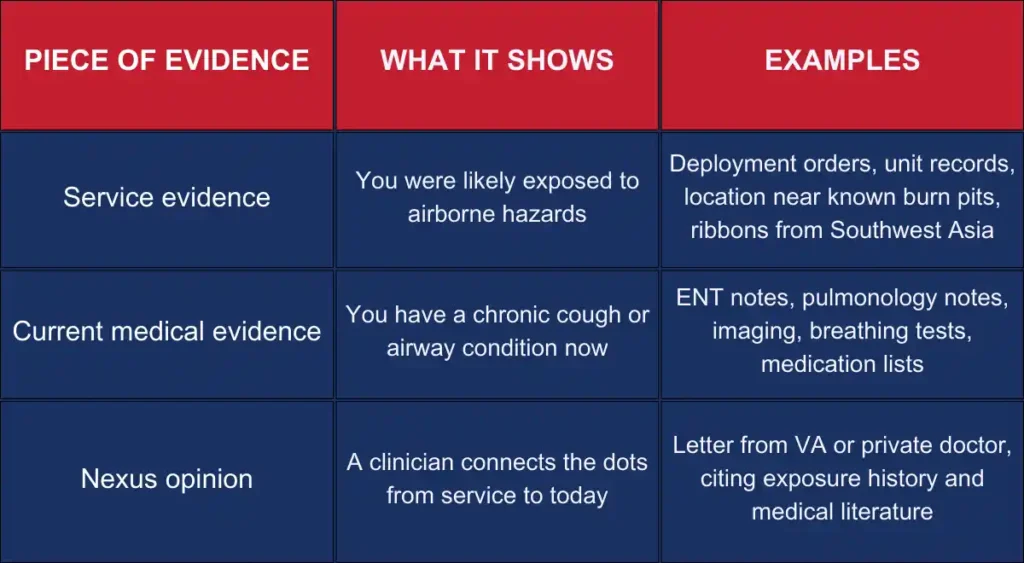
Even though burn pit exposure has more backing now, VA still wants a clean story with proof at each step. You cannot automatically assume your claim will be approved without proper documentation. That proof usually breaks down into three main pieces.
You need your service records, your current diagnosis, and a medical opinion that links the two. Meeting these service requirements is essential for a successful VA disability rating.
Here is how the evidence usually stacks up in a winning claim.
VA has started building more tools for providers and veterans to work through this exposure story. The Deployment Related Respiratory Disease Toolkit for Veterans helps you and your clinician track symptoms. You can note exposures and possible diagnoses in one place. It is a good document to bring into appointments and claim prep. VA also lists exposure topics A through Z.
You can look up background about burn pits, oil fires, and other hazards at the Public Health exposure topics page. These resources back up your personal story with data VA itself recognizes. That kind of alignment carries weight inside a claim file. It helps connect your disability claim to established public health findings.
Step By Step: Filing A Strong VA Claim For Chronic Cough Tied To Burn Pit Exposure
Even though every case is different, there is a simple road map most successful claims follow. You do not have to guess through it in the dark. Following these steps can help you secure the disability compensation you need.

1. Get Your Symptoms On Record With VA Health Care
If you are not yet enrolled in VA care, start there. You can review how to apply for health care through VA online. Once enrolled, schedule an appointment to talk through your cough and breathing issues.
Use that visit to build a full history. List the bases where you were exposed to smoke and trash fires. Share how long the symptoms have lasted and how they affect sleep, work, or family time.
2. Join The Open Burn Pit Registry
If you served in areas that used burn pits, add your story to the Open Burn Pit Registry. This is also sometimes referred to as the pit registry. This does two things for you. It supports research and it creates another formal record of your exposure history tied to your name.
The registry survey walks you through pit exposure symptoms and deployments. It might stir up hard memories, but it is a strong way to show that your exposure story matches what thousands of others report.
3. Get The Right Testing And Specialist Input
Ask your primary care doctor for referrals to a pulmonologist or ENT specialist. You want full breathing tests and possibly a laryngoscopy to view your vocal cords. Imaging might be recommended if your doctor suspects structural issues. This is not about collecting fancy records just for show. These tests rule out other causes and make the pattern clearer.
The goal is a specific diagnosis that sits under the broader respiratory codes VA already uses. Irritable larynx might appear in your notes. You might also see terms like chronic cough, paradoxical vocal cord motion, asthma, or chronic bronchitis. The more consistent those notes are across visits, the better. That consistency makes it much easier for VA to see that this is not a passing sore throat.
It confirms you have a long running disability tied to service. This is crucial for establishing VA disability eligibility.
4. File Your Claim With The Right Forms
To get disability started, you use VA Form 21 526EZ if this is your first claim for the condition. If you are asking VA to look again at a past denial, you will see VA Form 20 0995 referenced. This form is used for supplemental claims on the same page.
Either way, fill out the form completely and keep copies for yourself. List chronic cough and any specific airway diagnosis your doctor has documented. Mention burn pit or airborne hazard exposure directly in your claim description.
This puts the issue front and center from day one. It forces the VA to review your file under the lens of toxic exposure presumptive conditions. Make sure every detail aligns with your active duty service records.
5. Build A Clear Nexus Opinion
Your nexus opinion is often the bridge between “Yes, this veteran has a chronic cough” and “Yes, this cough is related to service.” A strong opinion will say something along specific lines. It should state that your condition is “at least as likely as not” related to your military exposure. The doctor should specifically mention burn pits and airborne particulate matter during your service.
Ask your VA or private doctor to write a short letter or complete a disability questionnaire. They can use VA sources such as the Deployment Related Respiratory Disease Toolkit for Veterans as support for that link. The opinion does not need fancy wording, just a clear stance and some reasoning.
This medical opinion helps overcome any doubt about whether the condition is service caused. It ties your current health directly to the war era you served in.
6. Prepare For The C And P Exam
VA will probably send you to a Compensation and Pension exam to review your respiratory symptoms. This exam carries a lot of weight, so go in ready. Bring a written list of symptoms, triggers, and how often they hit.
Talk through your worst days, not your rare good day. Describe cough fits, sleep problems, work impact, and social limits. If cold air or even simple talking sets off a coughing chain, say that clearly. Many veterans try to “tough it out” in these exams and downplay symptoms.
That habit is normal from service culture, but it can quietly crush a valid VA claims case. Honest and direct answers serve you best here.

How Chronic Cough Impacts Daily Life More Than People Think
To someone who has never had a lasting cough, it sounds minor. They think of the mild cold they shake in a week and move on. Your experience is nothing like that. Chronic cough can derail a normal life. You might avoid phone calls because the talking sparks fits.
You might stop going to events, churches, or meetings because you do not want to interrupt people. Many veterans sleep propped on extra pillows just to stop coughing long enough to get some rest. Fatigue from bad sleep adds to irritability, anxiety, and even depression over time. This creates a feedback loop where your physical and mental health feed into each other.
If your job depends on speaking, sales work, teaching, or regular briefings, this becomes a serious work issue too. You may lose income, miss promotions, or feel pushed to early retirement because the cough is always there. These are the things that deserve to show up clearly in a VA rating.
It should not be brushed off as a simple annoyance. Secondary conditions like sleep apnea or gastrointestinal issues from coughing can also arise. These should be documented as well.
Burn Pits, Chronic Cough, And VA News You Should Know
Awareness about burn pits and chronic conditions keeps rising. Coverage like the piece titled VA pushes millions of veterans exposed to burn pits to file claims highlights a major push. This comes from both lawmakers and VA leadership. The message is blunt. VA wants you to file. They finally recognize that long term breathing problems, cough, and serious illness in many veterans are tied to years of toxic smoke.
Your irritable larynx and chronic cough fit into this wider pattern of harm. This shift is largely thanks to the Sergeant First Class Heath Robinson Honoring our Promise to Address Comprehensive Toxics Act. Commonly known as the PACT Act, this legislation represents a massive change. The goal is to address comprehensive toxics that veterans were exposed to.
The Robinson honoring legislation honors his memory by helping others. Alongside this push, more benefits groups and advocates are raising funds and awareness. Organizations listed through DAV ways to give and similar programs support claims help.
They also provide outreach and community education. They fill some of the gaps that government systems still leave.
Health Support Beyond VA For Chronic Cough
VA care is a key part of your support, but it is not the only option for staying on top of airway health. Some veterans need refills or care in settings outside of VA clinics. There are online options that handle certain routine needs quickly.
For example, if your chronic cough includes asthma overlap, you might need quick help. Services such as getting a refill for asthma medication through online care can save time when you are in a pinch. This does not replace VA or specialist visits, but it can bridge short gaps.
The main thing is that you keep your symptoms controlled and documented. Having a record of outside care also supports your overall VA health file. It shows the continuity of your condition.
Chronic Cough, Vaccines, And Other Triggers Veterans Should Think About
Once your larynx and lungs are already irritated from burn pit exposure, many smaller triggers become bigger headaches. Common respiratory infections, dust, strong smells, or seasonal allergies can pile onto your baseline cough. Prevention steps start to matter more. If you are curious about protection against pertussis, which is another cause of bad cough spells, resources are available.
You can look at mainstream overviews like the whooping cough vaccine FAQ. Talk to your clinician before making any choice there. The main idea is simple. Your airways are more vulnerable now. Anything that can reduce extra inflammation is worth a careful look.
This includes avoiding smoking, managing weight, and steering clear of new chemical exposures where possible. You should also monitor for other serious issues like cancer gastrointestinal cancer or brain cancer gastrointestinal issues. Basic choices have more impact once damage from deployment years is in the picture.
Side Topics You Might See Online: Cough, Supplements, And Hype
Once you start searching cough topics online, you will bump into every type of health claim out there. Some pages that mention Java Burn or talk about Java Burn vs other supplements sometimes sprinkle in cough and general health angles. It is easy to get lost in that sea of advice.
A quick word of caution is needed. Weight loss or metabolism products may change energy or body weight. However, they do not replace a solid medical workup for chronic cough linked to service. If you are thinking about any supplement, check in with your VA clinician so nothing interacts with medications or conditions.
Healthy living steps that do help cough include steady movement within your limits. Hydration is also key, as is avoiding known triggers like smoke and strong chemical cleaners. These are less glamorous than some ad promises but matter a lot more for day to day life.
None of this changes the fact that your exposure history deserves fair recognition through a disability rating. Do not let internet distractions pull you away from filing your official claim.
Getting Extra Help If You Feel Overwhelmed
The claim process can feel like one more battle on top of an already hard situation. You do not have to manage it by yourself. VA lists accredited representatives at the VA claims representation page. You can also explore VA benefits through general benefits application guidance.
This helps you see the bigger picture of compensation and support. If health issues have forced job changes or blocked your usual career path, other programs exist. If you ever feel like the constant cough, lack of sleep, or frustration with the process is tipping you toward crisis, stop and reach for help right away.
Suicide prevention is a top priority for the veteran community. The Veterans Crisis Line offers support by call, text, or chat day and night. You can call 988 and press 1, text 838255, or use the chat option online for immediate help. Do not hesitate to use these resources. They are there because you served, and you matter.

Conclusion
You did not choose burn pit smoke, or dust clogged air, or nights spent breathing in toxic clouds that no mask could really block. Yet today, your life might be shaped by a stubborn, painful chronic cough and an irritable larynx that trace right back to those exposures. That is exactly the kind of harm an irritable larynx VA claim chronic cough VA burn pit exposures should recognize and support.
The law and science have finally moved closer to what you have known for years. VA now admits the role of particulate matter. They have built tools like the Deployment Related Respiratory Disease Toolkit for Veterans. They also track data through the Open Burn Pit Registry to understand conditions based on service.
The PACT Act and later rulings give more room than ever to argue that your chronic cough is part of recognized toxic exposure presumptive conditions. Your part now is to turn that progress into a claim that tells your story clearly. Get your symptoms on record and line up solid medical opinions.
Fill out the right forms and keep pushing until your rating reflects the real impact on your life. You have carried this burden for a long time. You deserve clear answers, real care, and fair compensation. That is not asking for too much. It is asking for what you already earned the hard way.