


VA ankle evaluations help document how ankle limited motion, pain, and instability affect your everyday life. If an ankle problem began during military service or is connected to an existing service-connected condition, accurate records can help VA understand both its history and its current impact.
This guide explains the rating criteria for limited ankle motion, what an examiner may assess, and how to prepare clear examples from home and work. An exam provides evidence for the decision; the examiner does not assign your final VA rating.

How ankle problems affect everyday life
Rucking, jumping, marching, and other demanding duties can place stress on the ankles. A sudden injury and a history of repeated strain are different starting points, so record the specific event or duties relevant to your own experience.
Lasting ankle trouble may make it harder to stand through a work shift, climb stairs, carry groceries, or walk on uneven ground. Describe what actually happens, rather than relying on a general statement that your ankle hurts. Include how long you can perform an activity before you need a break.
How VA rates limited ankle motion
VA applies the criteria in 38 CFR 4.71a. Diagnostic Code 5271 covers limited ankle motion. Dorsiflexion means lifting the foot upward; plantar flexion means pointing it downward.
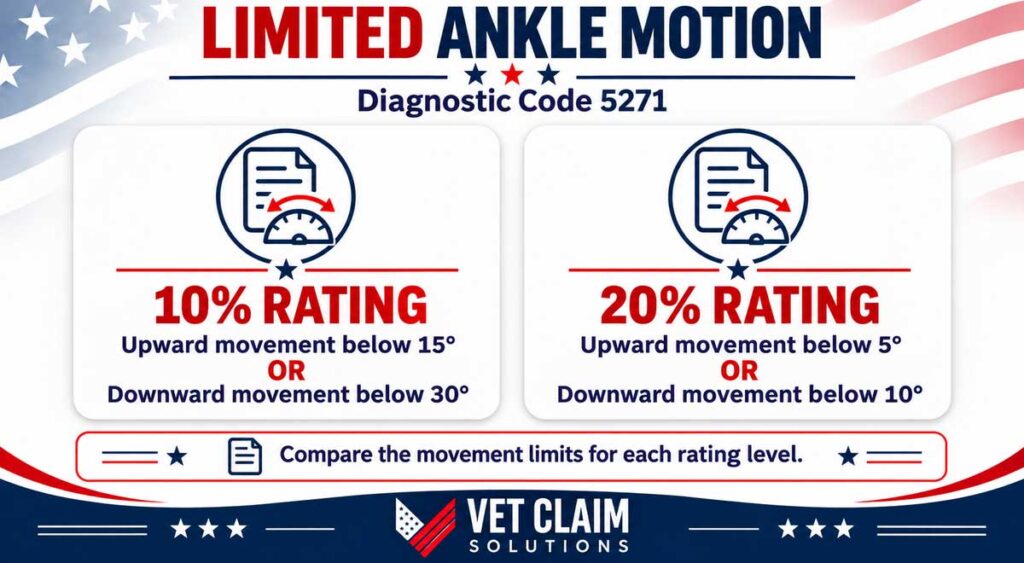
These are the schedule’s moderate and marked categories. The percentages are alternative evaluation levels for the ankle, not separate awards for each movement direction.
Ankylosis and arthritis
Ankylosis means the joint is fixed. Under Code 5270, a foot fixed downward below 30° is rated 20%; downward at 30°–40° or upward at 0°–10° is rated 30%; downward beyond 40°, upward beyond 10°, or specified deformity is rated 40%.
Code 5003 addresses degenerative arthritis, generally using affected-joint motion. Code 5010 directs evaluation of post-traumatic arthritis using limitation of motion, dislocation, or other specified instability. Arthritis is not automatically an additional award for the same limitation already rated.

What examiners assess during an ankle evaluation
An examiner may use a goniometer to measure movement in degrees. The public Ankle Conditions DBQ covers active and passive motion, pain, repeated use, flare-ups, stability, assistive devices, and effects on work. Testing may be limited when it is unsafe or medically inappropriate, with an explanation recorded.
The form uses reference ranges of 20° upward and 45° downward. Measurements matter, but so does a clear account of what happens after ordinary activity and during worse episodes.
Pain and functional loss
Tell the examiner when movement hurts and how pain changes what you can do. Pain beginning at a certain point does not automatically make that point the final rating measurement, and the rules do not require every test to end at the first sensation of pain.
38 CFR 4.59 recognizes painful or unstable joints and calls for pain assessment during active and passive movement and with and without weight bearing. The applicable criteria and documented loss of function determine how the evidence is evaluated.
Explain whether repeated walking, standing, or stair use leaves you with less movement or requires additional rest. Do not downplay your limitations or exaggerate them. Speak up promptly if a test causes significant discomfort or feels unsafe.
Limited motion and ankle instability
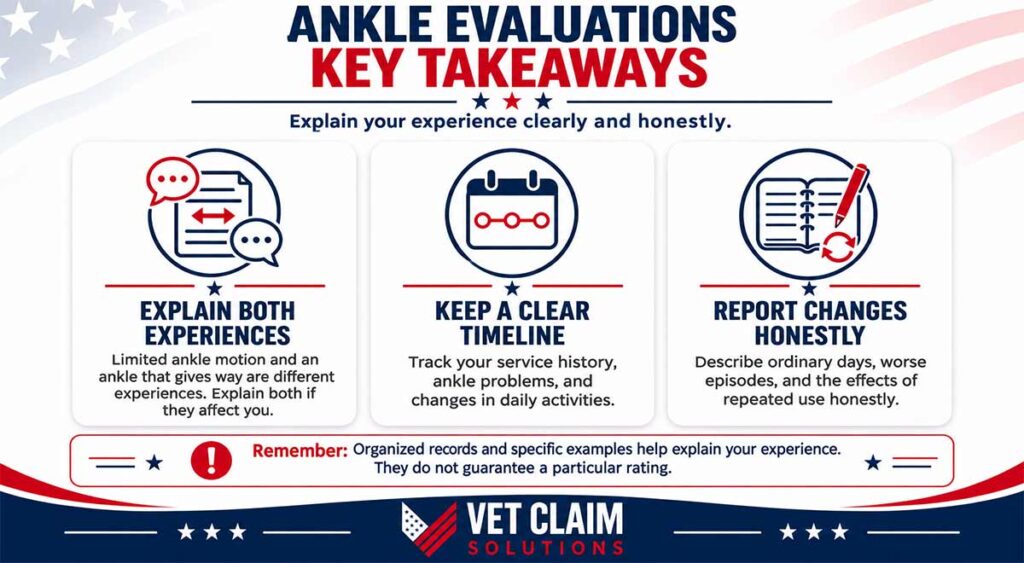
Limited motion means your ankle does not move through its usual range. Instability means it feels unreliable or gives way, such as when stepping off a curb or walking across grass. These experiences can occur together, so describe the frequency, triggers, and practical effects of each.
If you have recurring sprains, near-falls, swelling, or difficulty on uneven surfaces, record when they happen and what activity you must stop. Include whether a prescribed brace or other aid is part of your normal routine. Use specific examples rather than assuming that a diagnosis alone explains the severity.
A second rating is not automatic simply because both stiffness and instability are present. VA’s rule against pyramiding prevents rating the same manifestations more than once. The applicable code and any distinct, non-overlapping effects must be assessed for the individual case.
Secondary conditions connected to ankle problems
An ankle problem may change how you walk or distribute weight. If you also develop knee, hip, back, or opposite-leg problems, document them and discuss their possible relationship with a qualified clinician. A change in your walk does not by itself prove that the ankle caused another condition.
Under 38 CFR 3.310, secondary service connection may apply when a service-connected condition causes another condition or worsens it beyond natural progression. Evidence must support that relationship; aggravation cases also require evidence addressing the baseline level of severity.
A useful supporting opinion explains the history, relevant findings, and reasoning for the connection in your case. Avoid assuming that every later problem is automatically related to the original ankle injury.

Describe the full everyday impact
Explain changes in your work duties, household tasks, family activities, and ability to stand or walk. Personal statements and observations from people who see you regularly can add context to the records. If service-connected limitations prevent substantially gainful employment, review VA’s Individual Unemployability requirements with an accredited representative; difficulty standing alone does not establish eligibility.
How to prepare for your ankle appointment
Preparation helps you give a consistent account of your history and everyday limitations. Review your records before the appointment, then make a short list of the details you do not want to forget.
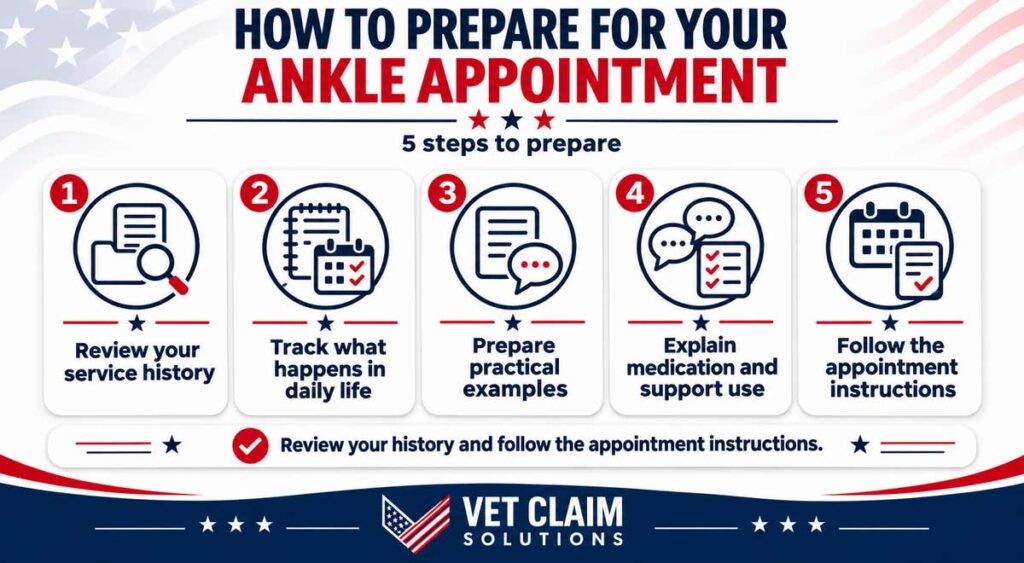
1. Review your service history
Identify when the problem began, any injury or incident, and the duties that affected your ankle. Gather available service records, relevant private and VA records, imaging reports, and any previous evaluation findings. Note gaps in the timeline so you can explain them accurately.
2. Track what happens in daily life
Keep a diary for several weeks if time allows. Record the activity, when difficulty starts, how long it lasts, and whether you need a break or support. Include worse episodes and how they differ from ordinary days. Describe both sides separately if both ankles are affected.
3. Prepare practical examples
- Walking and stairs: How far can you go, and what causes you to stop?
- Standing and work: Which duties require breaks, changes, or assistance?
- Giving way: When does it happen, and have others observed it?
- Worse episodes: How often do they occur, how long do they last, and what becomes harder?
4. Explain medication and support use
Tell the examiner about medications, their effects, and any brace or walking aid you normally use. Do not stop prescribed medication just to change the exam findings. Explain your experience before and after relief using factual examples and any available records.
5. Follow the appointment instructions
Review VA’s C&P exam guidance and the scheduling notice. Submit new records through the required VA channels rather than relying only on handing them to the examiner. If you believe important information was missed, write down the details promptly and follow VA’s guidance for reporting exam concerns.
Preparing your VA Benefits application
For direct service connection, the evidence generally needs to show a current condition, a relevant event or injury during service, and a link between them. Review VA’s eligibility guidance for the requirements that apply to your circumstances.
A separate private nexus letter is not a universal requirement for every application. Whether an additional opinion is needed depends on the existing evidence and the basis for service connection. An accredited Veterans Service Organization representative, attorney, or claims agent can help you assess what is missing.
Keep your evidence organized
- Service records and a timeline of relevant duties or incidents.
- Current records describing the ankle problem and its everyday effects.
- Personal statements and relevant observations from family, coworkers, or fellow service members.
- Any additional opinion or supporting evidence needed to explain the connection.

If you are still gathering records, an intent to file may preserve a potential earlier effective date. VA generally gives you one year after receiving it to submit the completed application. Starting certain applications online while signed in can establish the intent automatically. The eventual effective date depends on the applicable rules and approval.
If you disagree with a decision
Read the decision letter to understand the reason and available review options. A Higher-Level Review or Supplemental Claim may be appropriate depending on the issue. Higher-Level Review uses the existing record; a Supplemental Claim requires new and relevant evidence. Board appeal options are also available. Follow the deadline and instructions in your decision notice.
Prepare with clear records and everyday examples
VA ankle evaluations are easier to understand when you know what information to bring. Review your history, explain how your ankle affects your routine, and make sure your records reflect the changes you have experienced.
For help organizing your questions and learning about VCS education and coaching, request a consultation with Vet Claim Solutions. For formal representation with an application or review, use a VA-accredited representative.