


Veterans face many health challenges after military service, often dealing with complex conditions that require specialized care, long-term treatment, and strong medical documentation. When seeking VA Disability Benefits for Granulomatous Disease (CGD), it is important to understand how this chronic immune disorder may affect your health and how the VA reviews a VA claim for this type of condition.
Chronic granulomatous disease can make it harder for the immune system to fight certain infections, which may lead to recurring health issues, ongoing medical care, and complications that affect daily life. For veterans, securing disability benefits requires more than showing a diagnosis. You must provide clear medical evidence, establish service connection, and show how the condition is linked to or worsened by your time in service.
The VA may review factors such as your diagnosis, treatment history, recurring infections, complications, and how the condition limits your ability to function. Understanding the right VA rating approach, possible diagnostic code, and VA rating criteria used for immune system disorders can help you build a stronger claim. If your condition is connected to service, worsened during service, or related to another service-connected disability, you may qualify for VA disability compensation and health care support.

Because granulomatous diseases can vary in severity, veterans should keep detailed records of symptoms, hospital visits, medications, specialist care, and any complications such as burn pits or exposure-related concerns. Strong documentation can help support your disability rating and give the VA a clearer picture of how the condition affects your life.
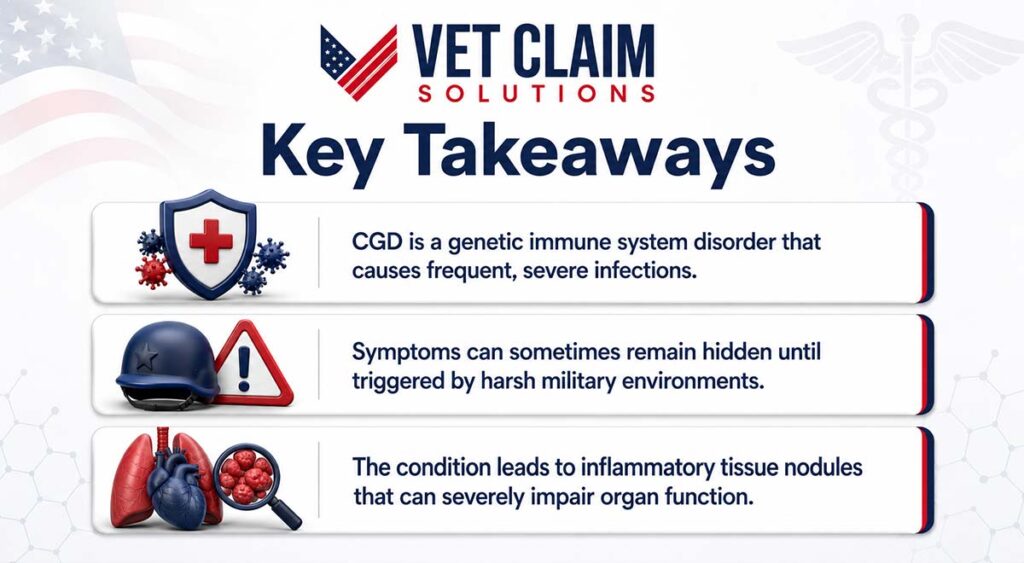
Chronic Granulomatous Disease (CGD) is an inherited primary immunodeficiency disease that affects how the body fights infections at a cellular level. It prevents certain white blood cells, specifically phagocytes like neutrophils and macrophages, from properly neutralizing specific bacteria and fungi through the production of reactive oxygen species. Because of this, veterans with chronic granulomatous disease may experience frequent and sometimes life-threatening infections that require long-term medical care, antibiotics, antifungal medications, and close monitoring.
This condition can affect oxygen consumption at the cellular level because immune cells are unable to produce the normal oxidative burst needed to destroy certain pathogens. In some cases, doctors may use specialized testing to evaluate immune cell function, while the VA may also review related medical records, specialist notes, and any relevant diagnostic code when considering a VA claim. Strong medical evidence is important when trying to show how granulomatous disease affects daily life, physical function, and long-term health.
Medical professionals often diagnose CGD during childhood because of recurrent illnesses and unusual infections that do not respond well to standard treatment. However, some mild cases may remain undetected until adulthood or until a person experiences extreme physical stress. For veterans, military service may expose the body to harsh environments, dangerous pathogens, burn pits, toxins, smoke, or even carbon monoxide, all of which may worsen symptoms or reveal an underlying immune disorder.

The condition can cause the immune system to form granulomas, which are small nodules of inflamed tissue that develop when the body cannot clear infection effectively. These nodules may affect organs such as the stomach, intestines, urinary tract, or lungs. When the lungs are involved, veterans may experience symptoms similar to lung disease, reduced exercise capacity, shortness of breath, fatigue, or abnormal results on pulmonary function tests.
For VA purposes, medical records showing reduced pulmonary function, decreased diffusion capacity, limited maximum exercise capacity, or abnormal function test results may help explain the severity of the condition. These findings can support a stronger VA disability claim, especially if the condition limits work, movement, stamina, or daily activities. In some cases, veterans may also need evidence showing whether CGD is a service-connected condition or whether military service aggravated a pre-existing condition.
Veterans with CGD may find that symptoms become more difficult to manage after the physical and psychological toll of active duty service. Chronic infections, inflammation, fatigue, and organ complications can create serious functional impairment. These limitations may affect employment, daily routines, and overall quality of life, which may be relevant when discussing VA rating, disability rating, or possible disability benefits.
The psychological impact of living with chronic immunodeficiency should also be considered. Constant concern about infection risks, medical restrictions, and reduced physical ability may contribute to anxiety, depression, or other secondary health conditions. Veterans may also explore other support options, including Veterans Affairs health care or Social Security disability programs, depending on the severity of their condition and how it affects their ability to work.
Addressing both the physical and mental effects of granulomatous diseases is important for a comprehensive VA disability claim. A strong claim should include diagnosis records, treatment history, specialist evaluations, pulmonary testing, service records, and medical opinions explaining how the disease is connected to service or worsened by service. This helps the VA better understand the veteran’s total level of impairment and the need for proper benefits.
Establishing Service Connection: VA Disability Benefits for Granulomatous Disease (CGD) and Military Aggravation
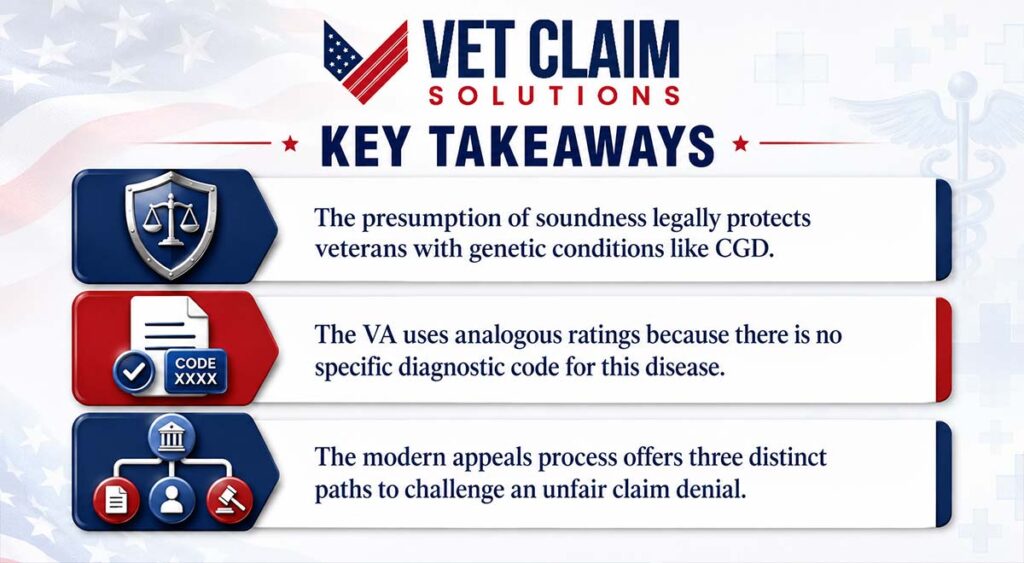
Veterans often wonder how they can receive VA compensation for a genetic disorder that technically existed before their enlistment. The Department of Veterans Affairs operates under a legal principle called the presumption of soundness, which is a cornerstone of veterans’ law. This federal regulation assumes you were in perfect health when you first entered active military duty, provided your entrance physical exam was clear and noted no defects.
If your initial military entrance exam showed no signs of an immune disease or chronic infection, the VA presumes you were completely healthy at that time. To successfully deny your claim, the government must prove with clear and unmistakable evidence that the condition existed before service and was not aggravated by your duties. This legal standard places the primary burden of proof directly on the VA rather than on the veteran, which provides a significant procedural advantage in these complex cases.
You can successfully claim service connection through a concept known as military aggravation, which is specifically governed by 38 CFR § 3.306. You must demonstrate that your military service permanently worsened your preexisting genetic condition beyond its natural biological progression. Exposure to hazardous chemicals, extreme physical stress, or specific endemic infections during deployment can permanently accelerate the disease and increase the frequency of debilitating flare-ups.

To prove aggravation, you should compare your medical status before enlistment with your clinical status upon discharge from active duty. If you had no hospitalizations for infections prior to service but required multiple intensive treatments during your time in the military, this serves as strong evidence. The VA must compensate you for the “increase in disability” that occurred due to the rigors of your service environment and the unique exposures you encountered. Documenting specific incidents, such as exposure to burn pits, contaminated water, or high-stress combat zones, can further strengthen the link between your service and the disease’s rapid progression.
Pro Tip: Obtain a strong nexus letter from a board-certified immunologist who specializes in phagocyte disorders. This medical opinion must explicitly state that your military service environment aggravated your condition beyond its normal biological progression using the phrase “at least as likely as not.”
Rating Criteria for VA Disability Benefits for Granulomatous Disease (CGD)

The VA does not maintain a specific diagnostic code exclusively for Chronic Granulomatous Disease in its current rating schedule for disabilities. Raters typically evaluate the condition under the general rating formula for immune disorders or by assessing the specific affected body systems that show the most impairment. This standard administrative procedure is widely known as analogous rating, where the VA uses the code for a similar condition, such as HIV or other immunodeficiencies, to determine your percentage.
Raters look very closely at the frequency, duration, and severity of your documented bacterial and fungal infections over a specific period. A veteran experiencing continuous infections requiring prolonged immunosuppressive therapy or frequent hospitalization receives a much higher disability percentage than one with stable symptoms. Final disability ratings can range from 0 to 100% based on your overall occupational and social impairment caused by the disease’s impact on your daily life.
Secondary service connection provides another highly effective avenue for obtaining fair and accurate compensation for the full scope of your illness. The disease frequently causes severe secondary conditions like chronic lung disease, persistent gastrointestinal issues, or painful liver abscesses that require surgical intervention. You can receive separate and distinct disability ratings for each of these documented secondary medical complications, which are then combined using the VA’s “combined rating” table to reach a final percentage.
In cases where the combined rating does not fully reflect the veteran’s inability to work, Total Disability based on Individual Unemployability (TDIU) may be a viable option. If your immune system is so compromised that you cannot maintain “substantially gainful employment” without risking your life, you may qualify for the 100% pay rate. This is particularly relevant for CGD patients who must avoid public spaces, high-stress environments, or certain physical labors to prevent life-threatening infections from occurring.
Secondary Conditions and VA Disability Benefits for Granulomatous Disease (CGD)

Veterans with this disorder frequently develop severe respiratory issues from recurrent fungal pneumonia infections that leave permanent scarring in the lung tissue. The VA evaluates these secondary respiratory conditions using the diagnostic codes for restrictive lung disease, chronic asthma, or pulmonary fibrosis depending on the clinical presentation. Your rating will depend heavily on the results of your pulmonary function tests (PFTs), which provide objective data on how well your lungs move air and oxygenate your blood.
If your breathing capacity drops significantly due to granulomatous inflammation, your corresponding disability rating will increase accordingly to reflect that loss of function. You must undergo specialized breathing tests to provide objective medical data for the VA raters to review during your mandatory C&P exam. Documentation of required daily inhaler use, supplemental oxygen therapy, or frequent antibiotic courses will also maximize your final rating percentage for these secondary respiratory complications.
Beyond the lungs, many veterans suffer from granulomatous colitis, which closely mimics the symptoms of Crohn’s disease or ulcerative colitis. These gastrointestinal issues can lead to severe weight loss, malnutrition, and the need for specialized diets or surgical resections of the bowel. When filing for VA Disability Benefits for Granulomatous Disease (CGD), it is imperative to include these digestive issues as secondary claims to ensure your total disability rating accurately reflects your physical state.
Medical Evidence Required for VA Disability Benefits for Granulomatous Disease (CGD)

A successful VA disability claim relies entirely on comprehensive and accurate medical documentation that spans your entire history of illness. You must provide extensive medical records detailing your initial diagnosis, complete treatment history, and all related hospitalizations for acute infections. These crucial documents establish the true severity of your condition and its daily impact on your functional abilities, especially regarding your immune response and recovery time.
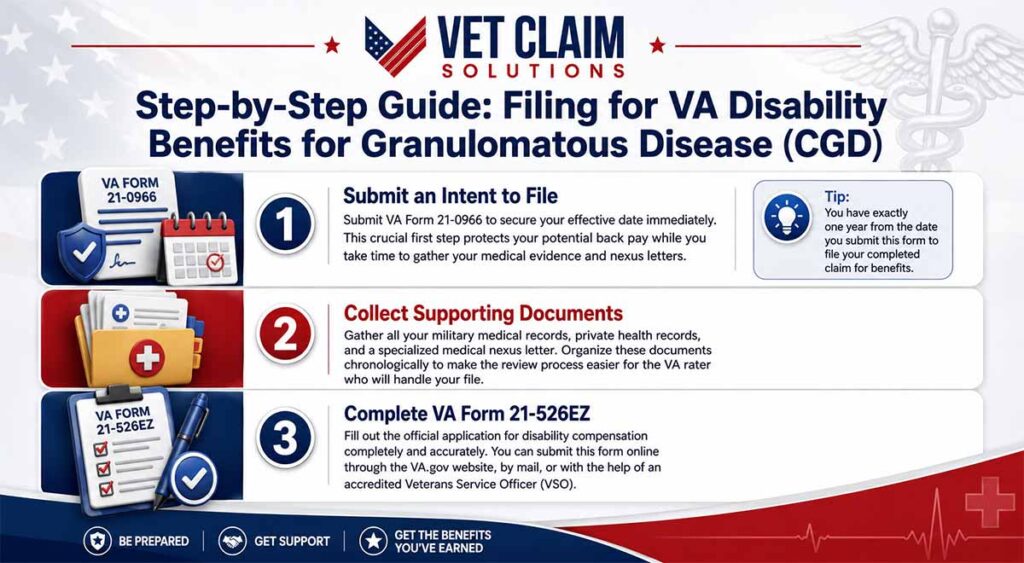
Private medical records hold just as much weight as your official military service treatment records in the eyes of the VA adjudicators. If you receive ongoing medical care from civilian immunologists or infectious disease specialists, you must actively submit those specific records to the VA. The VA will not automatically retrieve health records from private hospitals unless you explicitly sign a release authorizing them to do so via VA Form 21-4142, which can delay your claim if forgotten.
Specific diagnostic tests are vital for proving the presence and severity of CGD beyond any reasonable doubt. Results from a Dihydrorhodamine (DHR) 123 flow cytometry test or a Nitroblue Tetrazolium (NBT) slide test provide the objective proof needed to confirm the phagocyte dysfunction. Including these laboratory reports in your claim file ensures that the VA rater has scientific evidence of the underlying biological impairment that drives your clinical symptoms.
Disability Benefits Questionnaires (DBQs) play a vital and necessary role in the final evaluation process by providing a structured format for medical evidence. A qualified physician should complete this standardized form to officially document your symptoms, physical limitations, and the frequency of your infections. This structured medical paperwork helps VA raters translate your complex health history into a specific disability percentage based on the established rating schedule for immune system disorders.
The C&P Exam for VA Disability Benefits for Granulomatous Disease (CGD)
The Compensation and Pension (C&P) exam is a critical step in the process of securing VA Disability Benefits for Granulomatous Disease (CGD). During this exam, a VA-contracted physician will review your medical history and perform a physical examination to determine the current severity of your condition. It is vital that you are honest and thorough during this appointment, describing your “worst days” rather than how you feel at that specific moment. Because CGD is characterized by periods of relative health interrupted by severe infections, the examiner needs to understand the frequency and impact of these flare-ups.
You should prepare for the C&P exam by bringing a list of all current medications, including prophylactic antibiotics and any treatments for secondary conditions. If the examiner is unfamiliar with Chronic Granulomatous Disease, do not hesitate to provide a brief explanation of how the phagocyte dysfunction affects your daily life. The goal of the exam is to establish a clear picture of your functional loss and how the disease limits your ability to work and engage in social activities.
Managing Claim Denials: VA Disability Benefits for Granulomatous Disease (CGD) Appeals
The VA frequently denies initial claims for complex genetic disorders due to a lack of understanding regarding the aggravation principle and how it applies to service members. Raters might incorrectly conclude that the condition progressed naturally and was not aggravated by your military service or environmental exposures. Do not let an initial denial letter discourage you from actively pursuing your rightful financial compensation for your service-connected illness and its secondary effects.
You have three distinct appeal options under the current Appeals Modernization Act (AMA) framework that allow you to challenge a negative decision. You can request a Higher-Level Review (HLR) if you firmly believe the original rater made a factual or legal error based on the evidence already in your file. This specific option involves a much more experienced senior adjudicator taking a fresh look at your file without considering any new evidence or testimony.
A Supplemental Claim allows you to submit new and relevant medical evidence to support your case, which is often the best route for CGD claims that were denied for lack of a nexus. If you recently obtained a stronger nexus letter or new diagnostic test results that clarify the severity of your condition, this path is often highly effective. Finally, you can appeal directly to the Board of Veterans’ Appeals (BVA) for a formal hearing with a Veterans Law Judge, though this process typically takes the longest to resolve and may require legal representation.
During the appeals process, “buddy letters” from fellow service members can provide critical evidence of your symptoms while you were on active duty. These statements can describe the frequency of your illnesses, your physical appearance during flare-ups, or your inability to perform duties during periods of infection. When combined with professional medical opinions and lab results, these personal accounts create a powerful narrative that can help overcome a previous denial based on a lack of service records.
Conclusion and Next Steps
Securing VA Disability Benefits for Granulomatous Disease (CGD) demands patience, resilience, and thorough preparation from the initial filing to the final decision. The genetic nature of the condition requires a very strong strategy focused entirely on service aggravation rather than just the diagnosis itself, which is often misunderstood by raters. Comprehensive medical evidence, including lab results and specialist opinions, remains your most powerful tool in proving your case to the VA and ensuring you receive a fair rating that reflects your reality.
Document every single infection, hospitalization, and secondary complication related to your initial diagnosis to build a robust medical timeline that spans your entire post-service life. Work closely with medical specialists who understand both your physical condition and the strict VA legal requirements for service connection and aggravation. Their expert medical opinions can bridge the legal gap between your military service and your current health struggles, providing the “nexus” required for a successful claim.
You served your country honorably, and you fully deserve support for the health challenges you now face as a direct result of that service and its unique stressors. Take a highly proactive approach to your disability claim and utilize all available appeals options if your initial application is not successful. Persistence and proper documentation will ultimately maximize your chances of receiving the appropriate financial compensation and healthcare benefits you need to manage this lifelong condition.