


Numb fingers at night, an aching wrist, and a grip that keeps steadily weakening can severely compromise your everyday life. If you are experiencing these symptoms, you may be suffering from nerve entrapment, making a VA disability claim wrist pain and carpal tunnel syndrome an essential pathway to securing financial support and medical care. When military active duty duties directly cause or aggravate nerve damage in your hands, you have the right to seek monthly compensation from the Department of Veterans Affairs.
Carpal tunnel ranks among the most common nerve conditions claimed by veterans, yet many filings fail because of thin evidence or a weak link to service. Navigating the veterans disability claims process requires an intimate understanding of diagnostic standards, evidentiary thresholds, and military service records. This guide explains how the VA evaluates wrist pain, how the carpal tunnel VA rating schedule works, and which steps give your claim the strongest chance of approval.

Carpal tunnel syndrome develops when the median nerve gets squeezed as it passes through a narrow passage in your wrist. That pressure interrupts normal nerve signals and produces pain, numbness, and weakness in the hand. According to the National Institute of Neurological Disorders and Stroke, carpal tunnel affects millions of Americans and remains one of the most frequently diagnosed nerve disorders.
The carpal tunnel itself is a rigid corridor formed by wrist bones and the transverse carpal ligament. When inflamed tendons swell within this confined space, the median nerve bears the brunt of the pressure. Over extended periods, chronic compression leads to motor weakness, sensory deterioration, and permanent damage in the hand tissues.
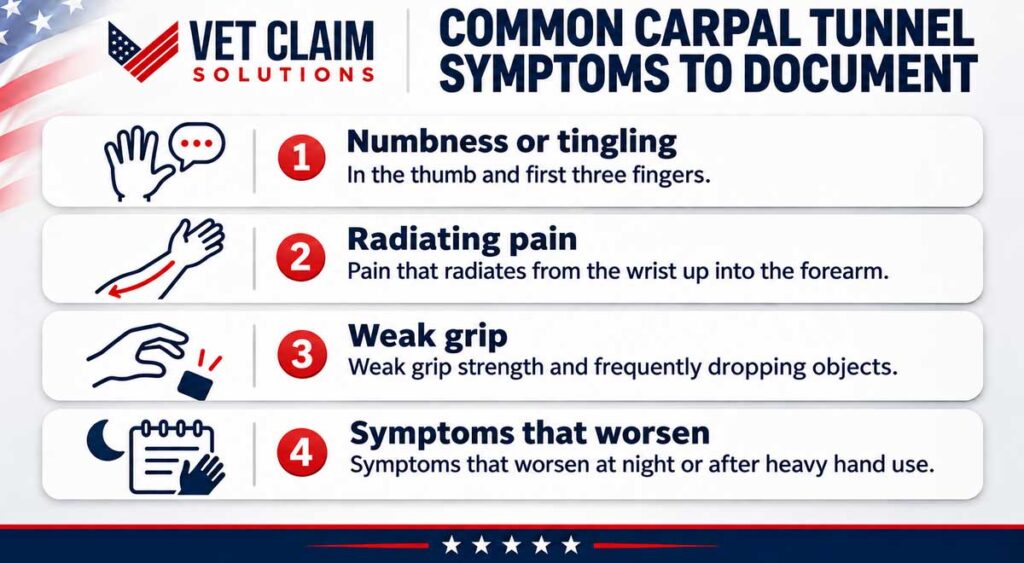
Documenting these carpal tunnel symptoms matters because the VA bases your disability rating on severity and functional loss. Write down when symptoms flare, how long episodes last, and which daily tasks they limit. Do these symptoms interfere with your ability to work or sleep? That information becomes valuable evidence later.
Clinical examinations typically include provocative tests such as Tinel’s sign and Phalen’s maneuver to reproduce pain. Objective electrodiagnostic evaluations, including nerve conduction velocity studies and electromyography, confirm whether nerve signals are significantly delayed. Securing these objective diagnostic reports establishes the hard clinical backing necessary to prove your ongoing physical impairment.
Why Military Service Elevates Carpal Tunnel and Median Nerve Risk
Military duties often involve exactly the kind of hand strain that triggers carpal tunnel. Repetitive motion from tools, weapons maintenance, typing, and vehicle operation loads the wrist over years of service. Prolonged exposure to vibrating equipment adds even more stress on the median nerve.
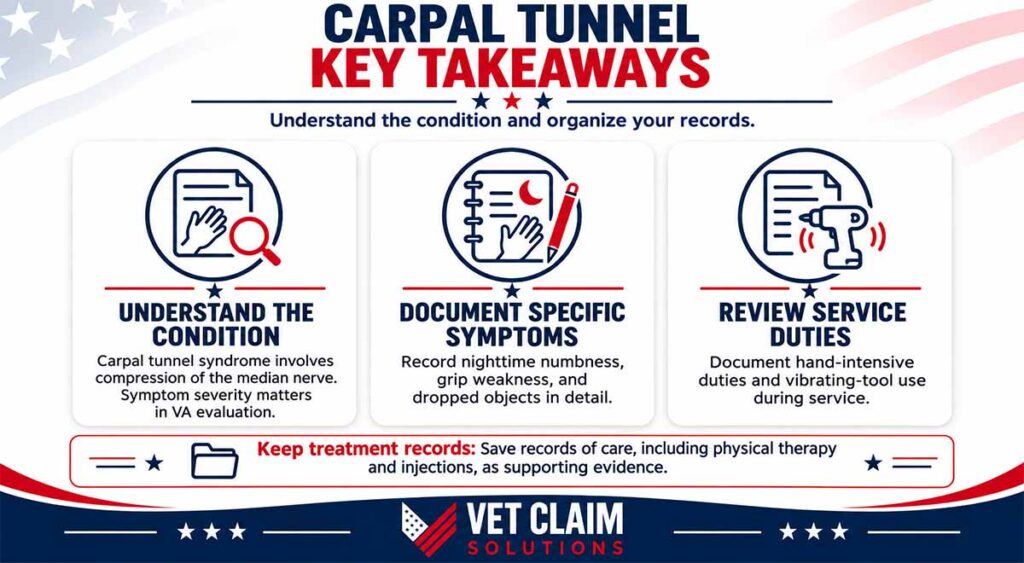
Certain health conditions also raise your risk, including diabetes, hypothyroidism, and some infectious diseases that cause tissue inflammation. Treatments such as physical therapy, wrist splints, and steroid injections can manage symptoms, but severe cases may require surgery. Keep records of every treatment you receive, because each one strengthens your eventual file.
Federal statutes establishing modern veterans benefits offer clear pathways for conditions caused by occupational repetitive trauma. Service personnel subjected to continuous manual labor during deployments frequently carry micro-tears and chronic tendinitis in their wrists. When left untreated in rigorous field environments, these repetitive joint stresses accelerate median nerve impingement long before discharge.
Establishing Service Connection for Wrist Pain: VA Claim and VA Eligibility
To establish direct service connection for wrist pain, you must present three essential evidentiary components to the regional office. First, you need an official diagnosis of carpal tunnel syndrome or underlying wrist disorder confirmed by an acceptable clinical practitioner. Second, your military personnel file or medical record must demonstrate an in-service injury, repetitive trauma, or initial onset of symptoms during active duty. Third, your file must include a persuasive medical opinion that links your present diagnosis to the in-service event.
Meeting standard va eligibility thresholds requires showing that your military duties generated ongoing stress on your hands and wrists. Infantry soldiers, mechanics, aircraft maintainers, administrative clerks, and combat engineers frequently log prolonged hours operating heavy machinery or typing under intense conditions. Demonstrating direct service connection depends heavily on matching these occupational specialty demands directly with your documented nerve impairment.
When preparing documentation for veterans disability examiners, establishing the military nexus remains paramount. A private physician or specialist can write an independent medical nexus letter stating your nerve damage is at least as likely as not related to your service. This definitive clinical reasoning bridges the gap between your active duty duties and current wrist condition.
Veterans can also pursue secondary service connection if their wrist pain stems from an already approved service-connected condition. For example, cervical spine injuries often generate radiculopathy down the arm that aggravates carpal tunnel pain, creating distinct grounds for service connection. Alternatively, if a preexisting service condition worsened during military duty beyond its natural progression, you can claim entitlement based on statutory aggravation rules.
Consulting official va resources before filing prevents common clerical errors and missing documentation that delay initial adjudications. Reviewing your Official Military Personnel File (OMPF) ensures that all duty assignments, commendations, and hazardous exposure details are presented clearly. Providing a coherent timeline of physical demands simplifies the rating specialist’s review during the initial evaluation process.
How the Carpal Tunnel VA Rating System and Disability Benefits Work
The Department of Veterans Affairs rates carpal tunnel syndrome under diagnostic code 8515, which covers paralysis and neuropathy of the median nerve. The carpal tunnel va rating schedule separates severity into mild, moderate, and severe functional impairment. Because the carpal tunnel va evaluation assesses functional loss in daily life, your rating directly mirrors the degree of motor and sensory loss you experience.
The median nerve evaluation represents a cornerstone of upper-extremity ratings within the broader veterans disability framework. These established schedules ensure former service members receive vital va benefits tailored to their functional impairments. Adjudicators evaluate whether your nerve compression manifests as paralysis, neuritis, or neuralgia when assigning an appropriate disability percentage.
Ratings are differentiated depending on whether the condition impacts your dominant hand or non-dominant hand. The VA disability rating scale awards higher percentages for the dominant limb because impairment there poses a larger barrier to earning a living and performing ordinary tasks. The standard diagnostic code 8515 schedule follows this general breakdown:
- Mild carpal tunnel va rating: 10% rating 10% non-dominant limb involvement. Mild ratings reflect tingling, slight sensory loss, and occasional pain with minimal functional reduction.
- Moderate carpal tunnel va rating: 30% for dominant hand, 20% for non-dominant hand. Moderate impairment includes noticeable loss of grip strength, frequent dropping of tools or utensils, and chronic numbness.
- Severe carpal tunnel va rating: 50% for dominant hand, 30% for non-dominant hand. Severe impairment involves significant muscle atrophy in the thenar eminence, profound sensory loss, and severe loss of hand dexterity.
When both hands suffer from carpal tunnel syndrome, the VA applies a bilateral factor before determining your final combined va disability score. The bilateral factor adds an extra 10% calculation to compensate for having dual service-connected disabilities that limit both upper extremities. Veterans can reference an online VA disability calculator to understand how multiple ratings interact under VA math rules.
Each service-connected va benefit is designed to mitigate functional impairment resulting from military duties. Understanding how diagnostic code 8515 pairs with pain-based ratings under diagnostic code 5003 gives you an advantage during evaluation. Presenting thorough clinical notes outlining physical restrictions ensures the rating official selects the code that best captures your overall loss.
Filing a VA Disability Claim for Wrist Pain and Carpal Tunnel Syndrome: Carpal Tunnel VA Rating Criteria
Initiating a successful disability claim requires gathering comprehensive medical evidence before submitting your paperwork. Submitting an intent to file locks in your effective date for these valuable va benefits while you gather documentation. Secure private treatment notes, your service medical record, and statement letters from former colleagues or supervisors who observed your physical difficulties.
Lay evidence plays a pivotal role in illustrating how your symptoms develop across ordinary daily routines. Spouses, family members, or coworkers can submit formal lay statements describing observable functional difficulties such as dropping dishes or struggling with buttons. These firsthand observations bridge gaps between formal clinical appointments and substantiate the continuous severity of your wrist pain.
Preparing for the Carpal Tunnel VA Claim Exam
After filing, the VA will schedule you for a specialized va claim exam, commonly known as a Compensation and Pension (C&P) examination. During this claim exam, an appointed medical examiner will evaluate wrist range of motion, test sensory responses, and measure grip strength using a dynamometer. The examiner will also review your complete medical records to determine the degree of functional loss during active flare-ups.
Be completely transparent about your worst days during the examination rather than downplaying your physical limitations. Explain how carpal tunnel syndrome impedes daily hygiene, prevents you from lifting objects, or forces you to take frequent breaks from work. The examiner’s nexus findings and functional assessment will ultimately form the core foundation of your final va disability rating.
Medical examiners rely on a standardized Disability Benefits Questionnaire (DBQ) to rate median nerve entrapment and wrist mobility. You can request a private orthopedic specialist to complete this exact DBQ before your scheduled government exam. Presenting a privately completed DBQ alongside your claim creates persuasive documentation that adjudicators must weigh against government examiner reports.
Essential Evidence Checklist for Your VA Claim:
- Electromyography (EMG) and nerve conduction study results confirming median nerve compression
- Complete military and civilian medical records detailing wrist pain treatments and steroid injections
- A detailed nexus letter providing an independent medical opinion linking wrist damage to military service
- Personal lay statements and buddy letters describing hand weakness and dropped objects

Secondary Conditions, Mental Health Disability Benefits, and Total Disability Ratings
Chronic pain rarely remains confined to a single anatomical region over decades of daily physical compensation. Veterans struggling with constant wrist pain and bilateral carpal tunnel syndrome frequently develop secondary service-connected disabilities. Overuse of adjacent joints can trigger degenerative arthritis, tendinitis, and rotator cuff pathology in the elbows and shoulders.
Veterans often realize that a single condition expands into a wider veterans disability portfolio involving adjacent joints. For example, compensating for weak wrists often leads individuals to alter their lifting techniques and upper-body posture. Over time, these unnatural physical compensations strain the neck, resulting in thoracic outlet syndrome or secondary cervical degenerative disc disease.
Carpal Tunnel and Secondary Mental Health Conditions
Severe physical limitations and chronic discomfort also carry profound psychological consequences that warrant dedicated disability benefits. Many veterans experience chronic sleep fragmentation due to nighttime wrist pain, which often leads to clinical depression and anxiety disorders. You can file for secondary mental health service connection when ongoing nerve pain measurably degrades your emotional well-being and daily psychological stability.
Combining multiple service-connected conditions significantly enhances your overall compensation profile and broadens your access to comprehensive va health care. When your combined rating climbs, you unlock critical va benefit avenues, including expanded prescription coverage and specialized therapy programs. Consulting specialized va resources for health care ensures you leverage all therapeutic options available through the veteran healthcare network.
Total Disability Based on Individual Unemployability (TDIU)
When severe carpal tunnel syndrome destroys your hand dexterity, continuing gainful employment in trade or office work becomes virtually impossible. If your carpal tunnel va rating and associated impairments prevent you from maintaining substantially gainful employment, you may qualify for total disability based on individual unemployability (TDIU). TDIU awards compensation at the 100% rate even if your schedule va disability rating falls below a permanent total disability threshold.
Under 38 CFR § 4.16(a), a veteran can qualify for TDIU with one service-connected disability rated at 60% or more, or a combined rating of 70% with at least one condition rated at 40%. Severe bilateral median nerve entrapment combined with secondary joint issues frequently meets these numerical thresholds. Proving that hand numbness prevents sustained computer input or manual dexterity substantiates claims for total unemployability.
In catastrophic scenarios where you suffer near-complete loss of hand function, the VA may grant special monthly compensation (SMC). This additional tier provides increased financial restitution beyond standard monthly compensation for severe anatomical or functional extremity loss. Checking your cumulative percentages through an official disability calculator helps project your financial outlook accurately.
VA Decision Review, Carpal Tunnel VA Rating Appeals, and Compensation Options
Receiving an initial rating decision from the VA does not conclude your journey if the granted percentage seems too low. The VA routinely undervalues nerve entrapment claims by overlooking bilateral impacts or classifying severe functional limitations as mild symptoms. Understanding your statutory appeal and compensation options empowers you to dispute an adverse finding effectively.
Under the Appeals Modernization Act, veterans have three primary avenues to challenge an unfavorable disability claim rating:
- Higher-Level Review (HLR): A senior adjudicator reevaluates your existing medical records for legal or factual errors without accepting new evidence.
- Supplemental Claim: You submit new and relevant medical evidence, such as updated nerve conduction studies or an independent medical opinion, to reopen your claim.
- Board of Veterans’ Appeals (BVA): You appeal directly to a Veterans Law Judge for a comprehensive review of your service-connected condition.

Understanding how these distinct veterans benefits interact allows claimants to make informed strategic decisions during appellate reviews. An experienced advocate can identify whether the regional office failed in its duty to assist by ordering inadequate medical exams. Requesting a Higher-Level Review informal conference offers a strategic platform to point out clear misapplications of rating criteria directly to senior adjudicators.
If you encounter repeated denials or complicated procedural hurdles, working with an accredited benefits attorney or Veterans Service Officer (VSO) can make a significant difference. A knowledgeable benefits attorney ensures your medical record documentation complies with stringent legal criteria and pushes for every va benefit to which you are entitled. Beyond standard va compensation, qualifying low-income wartime veterans may also investigate va pension benefits while claims remain pending.
Unlike disability compensation, wartime pension benefits depend strictly on financial need and permanent disability status rather than military trauma links. This financial assistance offers crucial stability for older veterans unable to maintain employment while fighting prolonged appeal battles. Utilizing all available programs guarantees comprehensive financial protection across every stage of your post-service life.
The Bottom Line on Carpal Tunnel Syndrome Service Connection Claims
A well-prepared VA disability claim for wrist pain and carpal tunnel syndrome can provide life-changing financial relief and access to long-term health care. Navigating the carpal tunnel va rating schedule requires strategic clinical evidence, objective diagnostic tests, and clear nexus documentation linking your median nerve damage to military service. By securing thorough medical records and articulating the genuine impact of your wrist pain on daily activities, you position your claim for maximum success.
Do not let persistent numbness, weak grip strength, and sleepless nights derail your personal well-being or career. Pursuing your veterans disability entitlements ensures your physical sacrifices receive appropriate legal recognition and monthly financial support. Explore your full spectrum of veterans benefits, monitor local va resources, and claim the compensation options you earned through honorable service. With the right evidence and determination, obtaining a fair va disability rating for carpal tunnel syndrome remains well within your reach.