

Sinusitis and rhinitis are commonly dismissed as “just a runny nose,” but chronic forms can be debilitating—causing pain, sleep problems, impaired breathing, sinus infections, and missed work. The VA has specific rating rules for sinusitis and rhinitis; with the right evidence you can win benefits and the rating you deserve. This guide shows what the VA looks for, the tests that matter, how to prove flare-ups, and how to get a nexus letter that holds up to VA review.

How the VA evaluates sinusitis and rhinitis (the legal framework)
- Sinusitis is rated under the VA Schedule for Rating Disabilities (general sinusitis formula / Diagnostic Codes 6510–6514) in 38 C.F.R. §4.97. Ratings depend on frequency, presence of headaches/pain/purulent discharge, number of incapacitating episodes, and whether radical surgery or chronic osteomyelitis is present.
- Rhinitis (allergic or vasomotor) falls under diagnostic codes such as 6522 (allergic/vasomotor rhinitis), with higher ratings for nasal polyps or significant obstruction. The VA uses objective findings and treatment to assign percentages.
What this means: the VA expects medical documentation of a diagnosis, objective testing or findings (imaging, endoscopy, allergy testing, nasal obstruction measurements), treatment history (topical vs systemic therapy; surgeries), and statements describing functional impact and incapacitating episodes.
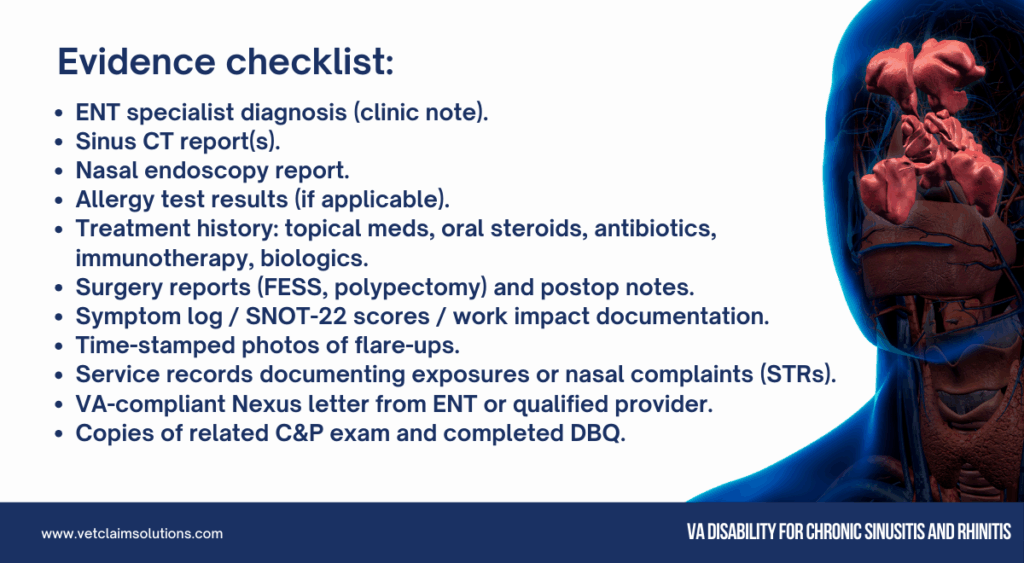
Evidence that actually moves the needle (what to collect)
1) Current medical diagnosis and specialist documentation
- ENT/OTOLARYNGOLOGY notes explicitly diagnosing chronic rhinosinusitis (CRS), allergic rhinitis, or other specified diagnoses.
- Documentation showing symptom duration (chronic means symptoms lasting ≥12 weeks for CRS) and whether disease is recurrent despite treatment.
2) Objective ENT testing (high-value evidence)
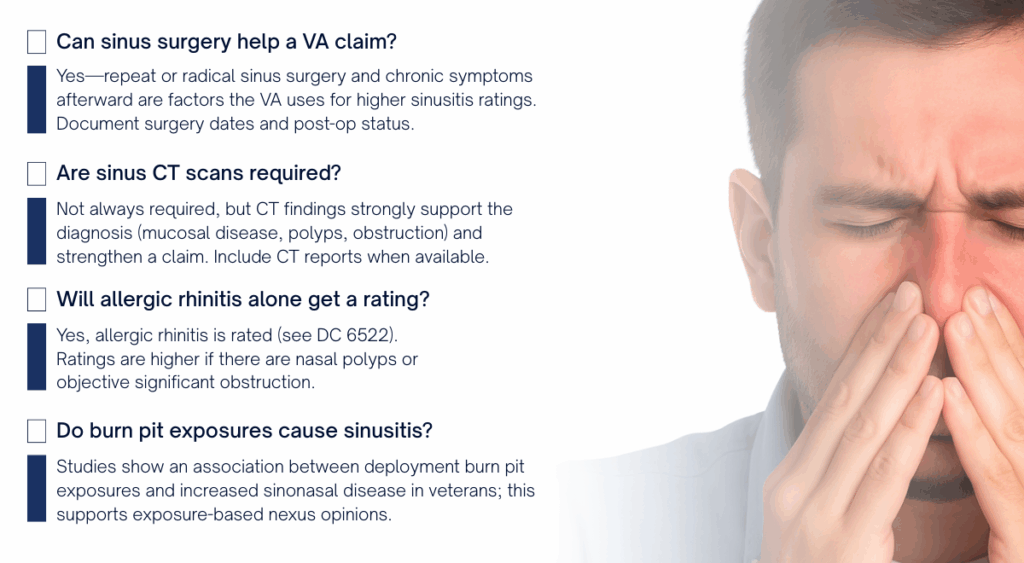
- CT scan of the sinuses (non-contrast sinus CT) — shows mucosal thickening, polyps, obstruction, anatomic issues.
- Nasal endoscopy findings (polyps, purulence, edema).
- Allergy testing (skin or IgE panels) for allergic rhinitis claims.
- Culture or biopsy results if infections or granulomatous disease are in question.
VA DBQs ask for these tests and exam findings—so include them.
3) Treatment history & response
- Records showing systemic therapy (oral steroids, repeated courses of antibiotics, immunomodulators) or repeat sinus surgeries (FESS, polypectomy). Systemic therapy and repeated surgery are directly relevant to higher ratings under the sinusitis formula.
4) Symptom and functional documentation
- SNOT-22 or similar validated symptom scores (helpful to show severity).
- Symptom diary: number of flare-ups per year, days bedridden or limited, ER visits, urgent care visits.
- Work impact evidence: missed shifts, limited duties, official work restrictions.
5) Photos and contemporaneous notes
- Photos of nasal polyps or visual redness during flares (time-stamped) and clinic notes that describe purulent drainage, constant nasal obstruction, or facial pain during attacks.
6) SAR/Exposure records & lay statements
- If you were exposed to burn pits, particulate matter, dust, or chemicals during deployment, collect deployment records and any references in service treatment records (STRs). Lay statements (unit members, family) who observed your breathing problems during/after deployment are valuable. Recent studies link deployment exposures to increased sinonasal disease.

The DBQ & C&P exam: don’t go in empty-handed
- The Sinusitis/Rhinitis DBQ (used by VA examiners) asks about CT/endoscopy, frequency of exacerbations, surgeries, systemic therapy, and functional impact. Submitting your testing and symptom log with the DBQ/C&P exam helps examiners record a full, accurate narrative. Recent VA DBQ templates explicitly capture these fields—use that to your advantage.
Tip: Bring printed copies of CT reports, ENT notes, SNOT-22 score, and your flare diary to the C&P exam and politely ask the examiner to include them in the record.
How sinusitis & rhinitis are rated (brief overview)
VA rating examples (simplified — see CFR for exact wording):
- Sinusitis (DC 6510–6514): 0%, 10%, 30%, or 50% depending on frequency of incapacitating episodes, near constant sinusitis with headaches/purulent discharge after surgery, or chronic osteomyelitis.
- Allergic rhinitis (DC 6522): generally 0%, 10% (significant obstruction without polyps), or 30% (with polyps). Presence of polyps (nasal polyps) typically increases rating and may require sinus surgery documentation.
Proving service connection: common scenarios & nexus approaches
Direct service connection
If sinus symptoms began during active service (STRs documenting ear/nose/throat visits for nasal obstruction, infections, or allergies), pair those STRs with current ENT evidence. That continuity of symptomatology helps establish direct service connection.
Aggravation of pre-existing disease
If you had mild seasonal allergies pre-service that became chronic/worse after exposures in service (e.g., burn pits, long desert deployments), an aggravation claim argues that service made the condition permanently worse. Medical opinion should explain how exposure plausibly increased disease burden.
Secondary service connection
Sinusitis and rhinitis can also be secondary to service-connected conditions or their treatments. Examples:
- GERD: reflux aggravating laryngopharyngeal symptoms.
- Asthma: sinonasal disease often coexists and worsens symptoms.
- Medications: some drugs cause nasal dryness or rhinitis that leads to chronic problems.
Exposure/presumptive pathways
Recent research links deployment exposures (burn pits, fine particulates) with higher sinonasal disease among veterans. If you have documented deployment exposure and chronic sinonasal disease afterward, a nexus letter referencing the exposure and medical literature helps.
How to Get a Nexus Letter That Helps (The Practical Checklist)
A nexus letter is often the make-or-break factor in winning a VA disability claim for chronic sinusitis or rhinitis. Many claims are denied simply because veterans don’t provide the right medical opinion—or worse, they rely on vague, unsupported letters. Here’s a practical checklist to ensure your nexus letter carries real weight with the VA:

From the Right Medical Provider
The VA gives more credibility to opinions from specialists. For sinusitis or rhinitis, the most persuasive nexus letters often come from:
- ENT specialists (Otolaryngologists)
- Pulmonologists
- Board-certified MDs or DOs familiar with chronic respiratory/ENT diseases
Tip: A general practitioner can write a nexus letter, but a specialist’s opinion adds credibility and can tip the scales in your favor.
Uses VA-Compliant Language
The VA requires a clear standard of proof. Your nexus letter should include language like:
“It is at least as likely as not (50% or greater probability) that the veteran’s chronic rhinosinusitis is related to exposure to [deployment hazard, chemical, burn pits, or environmental conditions] during military service.”
This phrase “at least as likely as not” is critical—without it, the VA may dismiss the opinion as inconclusive.
References the Veteran’s Medical Records
A nexus letter that doesn’t tie the opinion back to your specific medical history often carries little weight. A strong letter should cite:
- Service Treatment Records (STRs) showing respiratory complaints, sinus infections, or allergy symptoms in service
- Diagnostic tests like CT scans, sinus imaging, or nasal endoscopy findings
- Surgical reports (e.g., sinus surgery, septoplasty, turbinate reduction)
- Medication history documenting long-term use of antibiotics, corticosteroids, or antihistamines
The VA values opinions that are anchored in evidence, not just generic medical statements.
Explains Biologic Plausibility
A credible nexus letter doesn’t just state an opinion—it explains why the condition is connected to service. For sinusitis and rhinitis, the provider should reference established medical reasoning, such as:
- Inhalational exposures (dust, sand, smoke, burn pits) causing mucosal irritation
- Particulate deposition in the nasal passages leading to chronic inflammation
- Allergic sensitization due to repeated environmental exposure during deployment
- ENT medical guidelines that support service-related triggers of chronic sinonasal disease
This explanation shows the VA that the provider’s opinion isn’t just speculative—it’s backed by science.
Cites Supporting Studies or VA Guidance
To further strengthen the nexus, providers can reference:
- VA publications or fact sheets linking deployment exposures to respiratory illnesses
- Peer-reviewed studies on military burn pit exposure, desert dust inhalation, or chemical irritants
- ENT association guidelines that establish risk factors for chronic rhinosinusitis
Even a single cited study makes the nexus letter more persuasive, because it shows the provider relied on recognized research, not just personal opinion.

Common Mistakes That Cause Sinusitis/Rhinitis Claim Denials (and How to Avoid Them)
Far too many veterans receive low ratings—or outright denials—for chronic sinusitis or rhinitis simply because of preventable mistakes. Understanding these pitfalls can help you build a much stronger, evidence-backed claim.
Missing Objective Testing
- The problem: Many veterans file claims with only self-reported symptoms or basic treatment notes. Without objective evidence—like a CT scan or nasal endoscopy—the VA often questions severity or even the existence of chronic disease.
- The fix: Schedule an ENT evaluation. Ask for diagnostic testing (CT scan, sinus X-rays, or nasal endoscopy) and make sure those reports are included with your VA claim. These tests provide the objective medical proof the VA relies on.
Only Topical Treatments Documented
- The problem: If your records only show topical sprays (like Flonase or saline rinses), the VA may assign a lower rating. Higher ratings typically require proof of systemic therapy (e.g., oral corticosteroids, antibiotics, immunosuppressants) or repeated sinus surgeries.
- The fix: Document everything. Save prescriptions, pharmacy printouts, and medical notes that show all treatments, including oral steroids, prolonged antibiotic courses, or surgical interventions. The VA’s rating schedule specifically considers systemic therapy and surgery frequency.
No Nexus to Service or Exposure
- The problem: A diagnosis alone doesn’t establish service connection. Without a medical nexus linking your chronic sinusitis or rhinitis to service exposures (burn pits, dust, chemicals, harsh environments), the VA can—and often will—deny your claim.
- The fix: Secure a VA-style nexus letter from a qualified medical provider. The letter should:
- Reference your specific exposures or in-service events
- Use VA language (“at least as likely as not”)
- Cite medical rationale and research supporting the connection
C&P Exam Under-Capture of Flares
- The problem: If your condition is in remission or mild during your Compensation & Pension (C&P) exam, the examiner may underestimate your true severity. Since sinusitis and rhinitis often flare up unpredictably, this is a common cause of low ratings.
- The fix: Bring your own evidence of flare-ups to the exam, including:
- Photos of swollen sinuses, nasal obstruction, or drainage (time-stamped if possible)
- A flare diary documenting frequency, duration, and missed activities
- Symptom questionnaires like the SNOT-22 (Sino-Nasal Outcome Test), widely recognized in ENT practice
This ensures your claim reflects the real-world impact of your condition, not just a snapshot from a quiet day.
Key takeaway: Many sinusitis and rhinitis claims fail not because veterans don’t have the condition, but because the evidence wasn’t complete, objective, or tied directly to service. By getting proper testing, documenting systemic treatments, securing a nexus letter, and proving flare-ups, you can dramatically improve your chances of approval and a fair VA rating.
Real-world example (short)
- Veteran A: Deployed 2010–2012, heavy burn pit/dust exposure; began having chronic nasal congestion and repeated sinus infections post-deployment. ENT CT showed pansinusitis, required two FESS procedures and repeated oral steroid bursts. With STRs noting nasal complaints, ENT records, surgery reports, and a nexus letter linking exposure to chronic rhinosinusitis, the veteran secured service connection and an increased rating. (Example uses the evidence types described above and is illustrative.)
Next steps & how Vet Claim Solutions helps
If your breathing issues from chronic sinusitis or rhinitis are affecting your life and you believe they are connected to service or service-related exposures, don’t navigate this alone. Vet Claim Solutions helps veterans by:
- Reviewing your medical and service records to identify gaps.
- Ordering or recommending ENT testing and assisting to document flare-ups.
- Preparing VA-compliant nexus letters from qualified ENT or pulmonary providers.
- Completing DBQs and coaching you for the C&P exam.
Contact Vet Claim Solutions to schedule a records review and learn whether an independent nexus letter or targeted ENT workup could strengthen your claim. We specialize in converting medical reality into VA-acceptable evidence so veterans get the ratings they deserve.