

Why Skin Conditions Matter in VA Disability Claims
The VA uses the Schedule for Rating Disabilities (VASRD) to determine disability percentages. For skin conditions, the VA focuses on:
- The percentage of your body affected (visible area, exposed area, or entire body)
- Treatment type and frequency (e.g., systemic therapy such as corticosteroids or immunosuppressants)
- Impact on daily life (pain, itching, disfigurement, or infections)
👉 Translation: A skin condition isn’t “minor” if it covers large areas, requires strong medications, or significantly impacts your quality of life.
VA Requirements for a Successful Skin Condition Claim
Just like with any other VA disability claim, proving service connection for a skin condition requires you to satisfy three core elements. These are the non-negotiable building blocks of a strong claim:
1. Current Diagnosis
The VA will not approve a disability claim for vague “skin problems” or self-reported rashes alone. You need a formal, current medical diagnosis—eczema, psoriasis, dermatitis, or another recognized skin condition—confirmed by a qualified medical provider. A dermatologist’s evaluation, treatment history, and documented flare-ups add weight to your claim.
Tip: Even if your condition is intermittent, a provider can still confirm a chronic diagnosis based on history, photos, and prior treatment records.
2. In-Service Event, Exposure, or Onset
Next, you must show that something in your military service triggered, worsened, or caused your skin condition. This evidence doesn’t have to be a direct diagnosis of eczema or psoriasis in your service treatment records—it can be broader patterns of exposure or symptom documentation, such as:
- Chemical exposure (fuel, solvents, burn pits, Agent Orange, or other toxins)
- Environmental conditions (desert heat, jungle humidity, cold weather, or prolonged wet environments)
- Allergic reactions or chronic irritation noted in medical records or sick call logs
- Lay statements from fellow service members or family describing when symptoms first appeared
The VA accepts both medical records and lay evidence to help establish this in-service connection.

3. Medical Nexus
Finally—and most importantly—you need a medical nexus opinion. This is where many otherwise strong claims fall apart. A nexus is an expert medical opinion, often written in a VA-compliant Nexus letter, stating that your current skin condition is “at least as likely as not” connected to your service or to another service-connected disability.
For example, a nexus might connect eczema flare-ups to chemical exposure during deployment, or psoriasis worsening due to medications prescribed for a service-connected condition like PTSD.
Critical Point: Without a nexus opinion, even the best-documented claim is often denied. The VA is strict about requiring this medical link, and it must come from a qualified medical provider who uses the right language and rationale.
Bottom Line:
To succeed in a VA skin condition claim, you need more than just proof that your skin acts up—you need a diagnosis, evidence of how service played a role, and a professional medical opinion that ties it all together. At Attain Med Group, we specialize in bridging those gaps so veterans aren’t left with denials or underrated claims.
How the VA Rates Skin Conditions
Skin conditions such as eczema, psoriasis, and dermatitis are rated under 38 CFR § 4.118 (Schedule of Ratings – Skin).
General Rating Criteria for Dermatitis or Eczema (Diagnostic Code 7806):
- 60% – More than 40% of the entire body or exposed areas affected; or constant systemic therapy (e.g., corticosteroids, immunosuppressants) for 12+ months.
- 30% – 20–40% of body or exposed areas; or systemic therapy for 6+ weeks but not constantly.
- 10% – 5–20% of body or exposed areas; or intermittent systemic therapy less than 6 weeks in 12 months.
- 0% – Less than 5% of body affected, topical therapy only, no systemic medications.
Psoriasis (Diagnostic Code 7816):
Rated identically to dermatitis, but may also be rated as psoriatic arthritis if joint involvement exists.
The Challenge of Flare-Ups
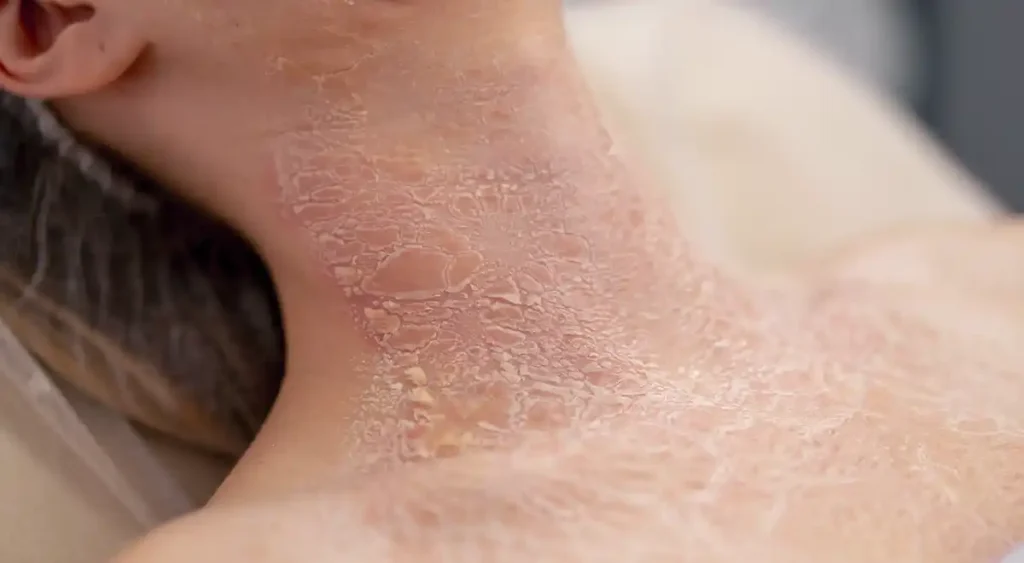
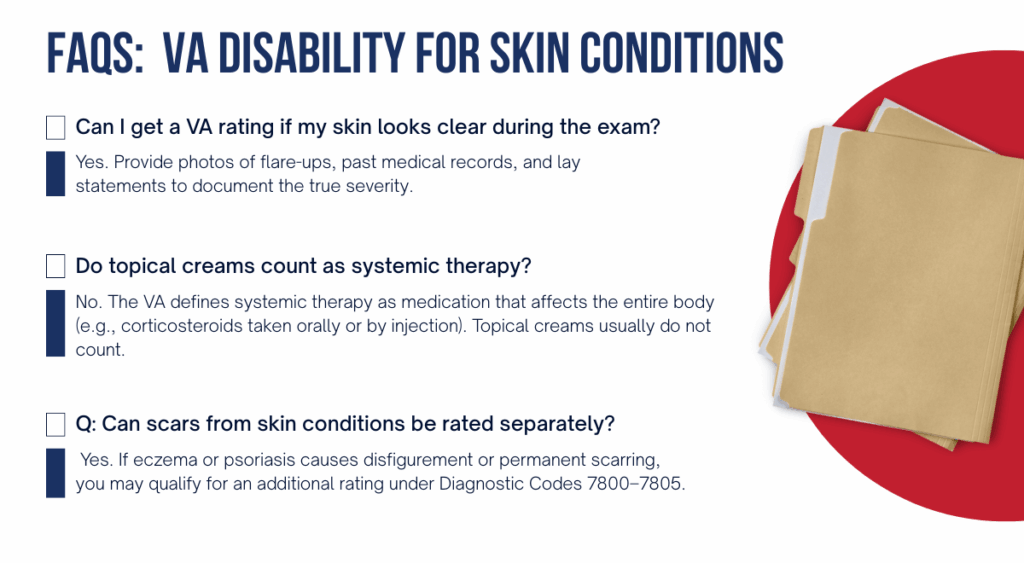
One of the biggest problems veterans face is that skin conditions aren’t always active during a C&P exam. If your skin looks clear that day, the VA may underrate your disability.
Tip: Provide photos of flare-ups, emergency visits, and medical records showing your condition at its worst. Veterans are allowed to submit “lay evidence” (your own statements or buddy statements) describing frequency and severity.
Common Mistakes That Lead to Denials
Even strong skin condition claims get denied because of avoidable errors. Understanding these pitfalls can save you time, stress, and unnecessary appeals. Here are the most common mistakes veterans make:
Filing Without a Current, Formal Diagnosis
The VA will not approve benefits for vague “skin problems” or self-reported rashes. You need a diagnosed condition—eczema, psoriasis, dermatitis, or another recognized disorder—confirmed by a qualified provider. Without it, your claim stalls immediately.
Submitting Claims Without Photos, Treatment History, or Flare-Up Documentation
Skin conditions often flare and fade, so a single exam may not capture their severity. If you don’t provide photos, dermatology notes, or treatment records showing the frequency and intensity of your flare-ups, the VA may underrate your condition.
Pro tip: Time-stamped photos and consistent medical visits build a strong paper trail.
Relying on Topical Treatments Only (When Systemic Medications Are Prescribed)
The VA rates skin conditions differently depending on the type of treatment required. If you’re prescribed systemic medications (like oral corticosteroids or immunosuppressants), that typically signals a more severe condition. Many veterans fail to highlight this in their claim, leading to lower ratings than they deserve.
Failing to Connect the Condition to Service
Even with a confirmed diagnosis, you must prove a service link. Common service-related triggers include:
- Chemical exposure (fuels, solvents, Agent Orange, burn pits)
- Harsh climates (desert heat, jungle humidity, cold weather)
- Allergic reactions or chronic irritation noted in service
Without this connection, the VA often denies claims by default.

Submitting Without a Medical Nexus Letter
This is the most critical mistake. A VA-compliant nexus letter explains, in expert medical terms, how your skin condition is “at least as likely as not” connected to your service. Without this professional opinion, the VA usually denies the claim—even if you have a diagnosis and in-service evidence.
Bottom Line:
Each of these mistakes can derail a claim that otherwise has strong merit. Avoiding them—and strengthening your case with a well-written nexus letter, detailed documentation, and clear evidence of flare-ups—can mean the difference between a denial and the rating you deserve.
Secondary Service Connection for Skin Conditions
Many veterans don’t realize that skin conditions can qualify as secondary disabilities under VA rules. This means your skin disorder doesn’t need to have started in service to be compensable—it can be connected to another service-connected disability or the treatment you receive for it. Here are some common examples:
PTSD or Depression → Stress-Related Skin Flare-Ups
Psychological stress is a well-documented trigger for eczema, psoriasis, and dermatitis flare-ups. Veterans with service-connected PTSD or depression may notice worsening skin irritation, itching, or outbreaks during periods of high anxiety. Medical research supports this connection between mental health and inflammatory skin disorders, which can provide the basis for a secondary service connection.
Gulf War Illness or Burn Pit Exposure → Chronic Rashes & Sensitivity
Veterans exposed to toxins in Southwest Asia, Afghanistan, or Iraq often develop chronic skin rashes, hives, or unexplained dermatological issues. The VA already recognizes Gulf War Illness and burn pit exposure as contributing to a wide range of secondary health problems, including persistent skin conditions. If your skin symptoms developed after such exposures, they may be compensable.
Medication Side Effects → Drug-Induced Skin Reactions
Many commonly prescribed medications for service-connected conditions list skin problems as side effects. Examples include:
- Blood pressure medications → Can trigger rashes, hives, or photosensitivity
- Antidepressants → Sometimes cause chronic itching or dermatitis
- Pain relievers or anti-inflammatories → Linked to rashes, eczema flare-ups, or even psoriasis exacerbations
If a medication prescribed for a service-connected condition directly led to or worsened your skin disorder, you may qualify for secondary service connection.
Bottom Line:
You don’t need to prove your skin condition began in the military. If it worsened because of another service-connected disability or the treatment for it, the VA may grant secondary service connection. The key is medical evidence—especially a nexus letter clearly explaining the causal link.
Proving Your Case: Evidence That Strengthens a Skin Condition Claim
The VA places a high burden of proof on veterans seeking disability benefits for skin conditions. Unlike broken bones or obvious injuries, rashes and flare-ups often come and go, making them harder to document. That’s why gathering the right evidence is critical—not just to win service connection, but also to secure the highest possible rating.
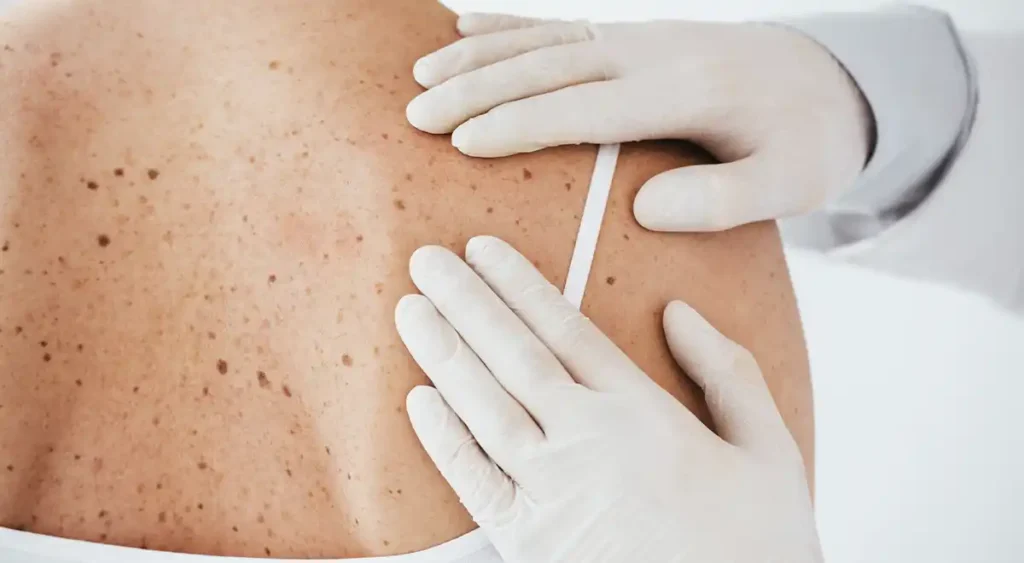
Here’s what can make or break your claim:
Dermatology Records (Diagnosis & Treatment History)
The VA does not grant compensation based on self-reported “rashes.” You’ll need a formal diagnosis from a qualified medical provider. Dermatology records should:
- Identify the condition (eczema, psoriasis, dermatitis, etc.)
- Document the onset date and progression over time
Show whether the condition is chronic, recurring, or resistant to standard treatment
Medication Records (Proof of Systemic Therapy)
The VA’s disability rating criteria for skin conditions are tied to treatment type. For example:
- Topical creams only → May support a lower rating
- Systemic therapy (oral corticosteroids, immunosuppressants, biologics) → Can support much higher ratings (sometimes up to 60% or more)
Proving that your condition requires ongoing systemic therapy is one of the strongest ways to maximize your rating.
Photos of Flare-Ups (Time-Stamped if Possible)
Because skin conditions often improve between flares, a Compensation & Pension (C&P) exam might not capture the worst periods. Veterans should:
- Take clear, dated photos of rashes or outbreaks during flare-ups
- Submit these with their claim as visual evidence
Show the extent of the body affected (percentage of exposed areas matters for ratings)
Lay Statements (First-Hand Accounts)
Your personal statement—or those from family, coworkers, or friends—can demonstrate how your skin condition:
- Impacts sleep due to itching or pain
- Causes social withdrawal or embarrassment
- Leads to missed work or daily limitations
Lay evidence is especially valuable when flare-ups are unpredictable or not always visible at medical appointments.

A Strong Medical Nexus Letter
Even with diagnosis and treatment records, the VA often denies claims for lack of a clear nexus. A strong nexus letter from an independent provider should:
- Use VA-compliant “at least as likely as not” language
- Explain medical pathways (e.g., chemical exposure, PTSD stress response, or medication side effects)
- Cite supporting medical research or guidelines
- Bridge gaps if service records don’t fully document your skin condition
Without a nexus letter, even otherwise strong cases may be denied or underrated.
Example: VA Skin Condition Rating in Action
- Veteran A develops psoriasis after Gulf War deployment. A private dermatologist prescribes systemic medication (methotrexate). Because it requires constant systemic therapy, the veteran qualifies for a 60% rating.
Veteran B has eczema that covers 15% of the body and requires topical steroid creams but no systemic therapy. This veteran qualifies for a 10% rating.
FAQs About VA Disability for Skin Conditions
The Attain Med Group Advantage
Most VA denials for skin conditions come down to missing medical evidence. At Attain Med Group, we bridge the gap between veterans and independent medical providers to deliver the proof the VA requires.
We provide:
- Independent medical opinions and Nexus letters written in VA-compliant language
- Medical record reviews that identify gaps in your claim
- Disability Benefits Questionnaires (DBQs) completed by experienced providers
- Diagnoses and documentation tailored to VA standards
Our mission is simple: help veterans secure the benefits they deserve.
If you’re struggling with eczema, psoriasis, or dermatitis—and your claim has been denied or underrated—don’t leave it to chance. The VA requires precise evidence, and that’s where we come in.
Contact Attain Med Group today to schedule a consultation and get the medical evidence you need to win your VA skin condition claim.