


A successful VA tinnitus claim hearing damage veterans ringing ears VA case starts with understanding your rights. That constant ringing in your ears serves as a reminder of your sacrifice. It is a legitimate disability that the VA recognizes and compensates veterans for. If you served in the military and now deal with tinnitus or hearing damage, you deserve benefits. Getting them approved can feel frustrating or confusing at times. Many veterans give up before they receive the compensation they earned.
I have seen too many veterans struggle with their VA tinnitus claim because they lacked the right strategy. They often do not know what evidence to submit or how to frame their case effectively. You are not alone in this fight for your health care benefits.
Understanding Your VA Tinnitus Claim and Hearing Damage
Tinnitus stands as the top disability among veterans receiving benefits today. Hearing problems affect roughly 37.5 million Americans aged 18 and older. This number includes a significant portion of the veteran population. What makes this condition so common in the military? Exposure to loud noises during active service creates lasting damage to your ears. This damage often manifests as a persistent ringing buzzing sound.
The Centers for Disease Control and Prevention reports that tinnitus affects nearly 15% of American adults. However, veterans face this condition at much higher rates than civilians. The constant exposure to high-decibel environments is the primary culprit. Your ears took a beating during service. Gunfire, aircraft engines, heavy machinery, and explosions all contributed to your hearing damage. These specific incidents serve as the foundation for your disability claim.
The VA understands this connection well. They know that military service often leads to hearing problems and ringing ears long after discharge. Establishing this link is vital for your case. Filing a claim means proving your tinnitus links back to your time in uniform. You will need medical evidence and service records to back up your case. This documentation proves the connection between your service and your health issues.

How Military Service Causes Hearing Damage and Tinnitus
Combat zones expose service members to extreme noise levels on a daily basis. These sounds damage the delicate structures inside your ears permanently. Once these structures are damaged, they cannot repair themselves. A 2019 study by researchers at the South Texas VA Health Care System showed tinnitus rates climbing significantly among active duty members. The numbers keep going up year after year as monitoring improves. This data supports the need for comprehensive hearing protection.
Blast exposures create particular problems for ground troops. Research from the VA Portland Health Care System confirmed that blast exposure increases the likelihood of decreased sound tolerance. This affects both veterans and current service members. Even non-combat roles put your hearing at risk during daily operations. Working around aircraft, vehicles, or industrial equipment creates constant exposure to hazardous noise. Many administrative or support roles also work near generators or firing ranges.
Studies linked exposure to jet propulsion fuel to auditory processing problems back in 2014. Your job might have damaged your hearing in ways you did not expect. Chemical exposure is now a known factor in hearing loss. The damage does not always show up right away. Sometimes tinnitus began years after you left the military. This delayed onset is common and does not disqualify you from benefits.
Secondary Conditions That Worsen Tinnitus
Other service-connected conditions can make your tinnitus worse over time. Granulomatous disease impacts ear health when inflammation affects the ear canal or auditory system. This adds another layer of discomfort to your daily life. Research shows this happens in over 60% of patients with the condition. The inflammation can lead to or worsen tinnitus symptoms significantly. You must document these flare-ups for your medical records.
One Marine Corps veteran who served from 1970 to 1974 successfully argued his tinnitus was a secondary condition. He proved it was secondary to service-connected hypertension and medications. These connections matter for increasing your overall disability rating. Traumatic brain injury also increases your risk of developing ear ringing. Researchers at the VA San Diego Healthcare System assessed 2,600 Marines before and after deployment. They found clear links between traumatic brain injury and hearing problems.
Mental health plays a major role in how you perceive the ringing. A 2021 study found that veterans with moderate to severe tinnitus are more likely to screen positive for PTSD. Depression and anxiety are also common comorbidities. If you suffer from mental health issues due to the ringing, you can file a secondary claim. This allows you to receive compensation for conditions caused by your primary service-connected disability. It is a critical path for increasing your monthly support.
What Evidence You Need for Your VA Tinnitus Claim
Medical documentation forms the backbone of your claim success. You need a current diagnosis and treatment records showing your tinnitus exists. Without a current diagnosis, your claim will likely be denied. Audiologist exams provide objective evidence of hearing damage. The VA typically requires a compensation and pension exam to evaluate your condition formally. This exam determines the severity of your hearing loss.
Service records help connect your hearing damage to military service definitively. Look for documentation of noise exposure during your time in uniform. Your MOS usually serves as proof of likely noise exposure. Lay statements from friends or family are powerful pieces of evidence. Buddy statements from fellow service members strengthen your case immensely. They can verify the loud environments you worked in together.
You can also submit personal statements describing how tinnitus affects your daily life. Be specific about the ringing, buzzing, or other sounds you hear constantly. Describe how it affects your sleep and concentration. You will need to complete VA Form 21-526EZ to start your disability claim properly. This form captures all the basic information about your condition. It is the starting point for most compensation requests.
The concept of a “medical nexus” is vital here. This is an opinion linking your current condition to your in-service event. A doctor must state that your tinnitus is “at least as likely as not” caused by service. Sometimes you need a private doctor to provide this medical opinion linking. This is often called a nexus letter. It bridges the gap between your service and your current health issues.

Medical Research Supporting Your Claim
The VA and medical community have extensively studied hearing problems in veterans. This research backs up your claim with hard science. It proves that military environments are inherently hazardous to hearing. Back in 1992, the VA and NIH began collaborating to develop more advanced hearing aids. This partnership recognized the massive need among veterans returning from duty. It highlighted the prevalence of auditory damage.
The Hearing Aid Clinical Trial launched in 1996 as the first large-scale study. Results showed all three types tested provided substantial improvement in both quiet and noisy settings. This paved the way for modern treatment options. A massive 2019 study by VA Portland Health Care System researchers surveyed census data covering 19.9 million veterans. The scope of hearing problems became crystal clear through this data. It showed that auditory issues are a widespread epidemic.
Research following over 600,000 veterans from 2011 to 2016 found nearly 4% met diagnostic criteria for tinnitus. That represents tens of thousands of veterans dealing with constant ear ringing. This statistical evidence supports individual claims.
Understanding Your VA Disability Rating for Tinnitus
The VA rates tinnitus at a 10% disability maximum under current laws. This rating applies whether you have ringing in one ear or both ears. You do not get double the rating for both ears. You generally cannot get a higher percentage for tinnitus alone. The 10% rating is the ceiling for this specific condition. However, this small rating opens the door to other benefits.
That 10% rating translates to $165.92 in monthly benefits based on 2022 rates. The 2024 rates increased based on cost-of-living adjustments significantly. It provides a steady stream of tax-free income. Hearing loss gets rated separately from tinnitus in the VA system. If you have both conditions, you can receive compensation for each distinct issue. This is an important distinction for maximizing your claim.
The VA rates hearing loss based on specific audiometric measurements during testing. Your hearing test results determine the percentage you receive. Severe hearing loss can result in much higher ratings. Combined ratings work differently than simple addition in VA math. The VA uses a specific formula to calculate your overall disability percentage. You might want to use a VA disability calculator to estimate your total.
Understanding the difference between VA ratings and social security disability is important. Social security requires total disability that prevents working. The VA compensates for service connection regardless of your employment status.

Recent Research on Iraq and Afghanistan Veterans
A 2017 study by the Chronic Effects of Neurotrauma Consortium looked at Iraq and Afghanistan veterans specifically. They found 7.8% had diagnosed hearing loss among the group. This focused on the specific hazards of modern warfare. The study also noted that 6.5% had tinnitus alone. Furthermore, 6.2% of the veterans studied dealt with both conditions simultaneously. These overlapping conditions complicate daily life significantly.
These numbers matter because they show how common your experience is. You are not making this up or exaggerating your symptoms. Your content tinnitus claim is valid and supported by data. Processing difficulties often accompany hearing damage in these groups. Research from 2021 by VA Portland and Oregon Health & Science University showed these difficulties stem from auditory processing problems. This affects how the brain interprets sound.
Common Mistakes Veterans Make When Filing Claims
Not getting a current diagnosis before filing hurts many claims instantly. You need recent medical documentation showing active tinnitus within the last year. Old records might not be enough to prove current severity. Failing to connect your condition to military service weakens your case significantly. The VA needs to see the link between your hearing damage and service. This is where the service evidence becomes critical.
Skipping the compensation and pension exam causes immediate problems. You must show up prepared and describe your symptoms accurately. Missing this appointment often leads to an automatic denial. Downplaying symptoms during exams backfires on many veterans. Be honest about how bad the ringing gets and how often it bothers you. Do not try to be tough during your medical evaluation.
Missing deadlines for submitting evidence can delay or deny your claim entirely. Stay on top of what the VA requests and when they need it. Organization is vital during the claims process. Not appealing denials leaves valuable benefits on the table. Many claims get approved on appeal after an initial denial decision. Persistence is often the deciding factor in winning your case.
Many veterans forget to mention how the condition impacts their mental health. If the ringing causes anxiety, you might have a claim for that too. Do not overlook these secondary connections.
How Sound Therapy and Treatment Options Work
Treatment options exist even though there is no absolute cure for tinnitus. Sound therapy helps many veterans manage symptoms effectively during the day. It works by distracting the brain from the internal noise. A 2017 study randomly assigned 60 tinnitus patients to sleep with different sound therapy devices. The results showed promise for symptom management and better sleep. Quality of rest is often a major issue for sufferers.
Researchers explored deep brain stimulation in 2019 as a potential treatment. The VA San Francisco Health Care System and University of California investigated safety and effectiveness. This is for severe cases where other treatments fail. The VA conducted a trial in 2019 testing telephone-delivered coping skills education. This approach made treatment more accessible to veterans in rural areas. It allows you to get help without traveling to a major medical center.
Hearing aids often help with both hearing loss and tinnitus simultaneously. They amplify external sounds which can mask the ringing internally. This is often the first line of defense prescribed by audiologists. Progressive Tinnitus Management offers a structured approach to relief. The VA developed this program specifically for veterans dealing with ear ringing. It combines counseling with acoustic therapy techniques.
Long-Term Research and Ongoing Studies
The VA continues studying hearing problems in veterans to improve care. The NOISE study aims to better understand long-term effects of military noise exposure. It focuses on how noise impacts life decades later. This research looks at causes of hearing loss and tinnitus specifically. The findings will help future claims and treatment protocols. It ensures the system adapts to the needs of modern veterans.
A 2020 national study examined end-of-life care for older veterans with hearing and vision loss. Results showed these veterans receive the same level of care as those without sensory loss. This confirms equal access to critical services. Understanding these research efforts matters because they validate your experience. The medical community recognizes hearing damage as a serious service-connected issue. You have science on your side when you file.

Key Factors in Winning Your Tinnitus Case
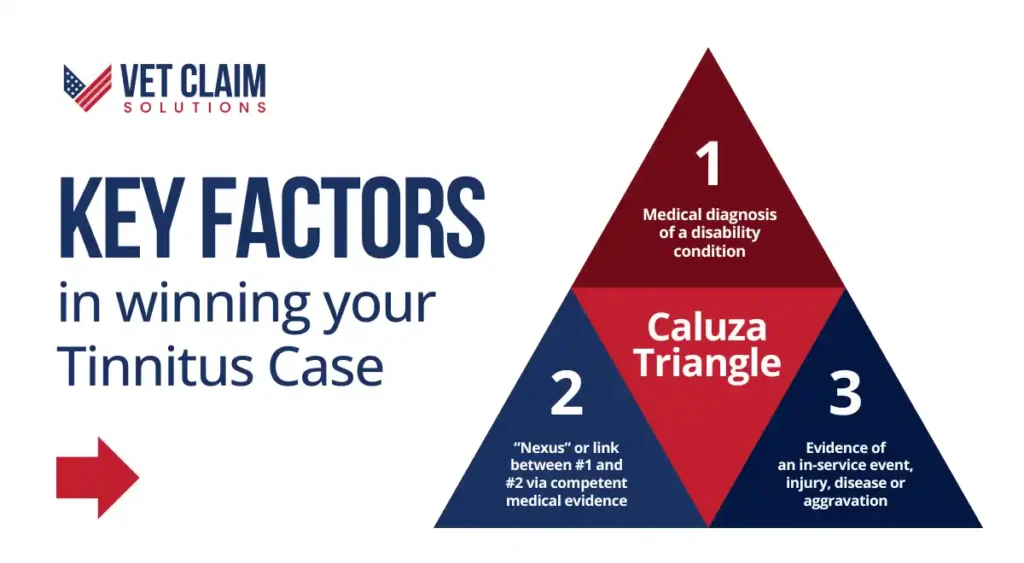
Success relies on three main elements often called the Caluza Triangle. First, you need a current medical diagnosis of tinnitus. Without this medical evidence, the claim cannot move forward. Second, you need proof of an in-service event or occurrence. This could be your MOS or a specific blast exposure. Your service records usually provide this necessary proof.
Third, you need a medical opinion linking the first two elements. This nexus connects your current ringing to that service caused event. This is the glue that holds your claim together. Fellow service members can write statements to support the second element. They can confirm the noise levels you were exposed to. This helps if your service records are incomplete.
You should also understand how a disability calculator estimates your payment. Tinnitus adds 10% to your total, which moves you up the pay scale. Every percentage point counts towards your total compensation. Veterans law can be complex regarding personal injury and service connection. Understanding these three pillars simplifies the process greatly. Focus your efforts on satisfying these three specific requirements.
Conclusion
Your VA tinnitus claim for hearing damage deserves approval if you have the right evidence. That constant ringing in your ears stems directly from your military service. It is a burden you should not have to carry without compensation. The research backs you up completely. Studies show how common hearing problems are among veterans like you. They prove how military noise exposure causes lasting damage to the auditory system.
Getting your VA tinnitus claim approved means gathering medical documentation, service records, and personal statements. Connect your hearing damage to your time in uniform with a clear nexus. This connection is the key to unlocking your benefits. You have earned these benefits through your sacrifice. Your ears took a beating while you served the country. The VA recognizes tinnitus as a legitimate service-connected disability for this very reason.
Do not let the paperwork or bureaucracy stop you. File your claim today or appeal if you were denied. Keep pushing until you get the compensation you deserve for your hearing damage and ringing ears. Your health and financial stability are worth the effort.