


Understanding disability amounts for veterans is important when determining how much VA disability compensation you may qualify to receive. The Department of Veterans Affairs calculates monthly compensation based on your VA disability rating, the severity of your service-connected conditions, and your dependent status. Veterans with multiple conditions may also receive a combined disability rating, which affects their total VA disability pay.
This guide explains VA disability compensation rates, how disability ratings affect monthly payments, and which factors may increase your VA disability benefits. You will also learn how annual cost-of-living adjustments work, how to use a VA disability calculator, and what steps to take when filing a disability claim or requesting a higher rating.
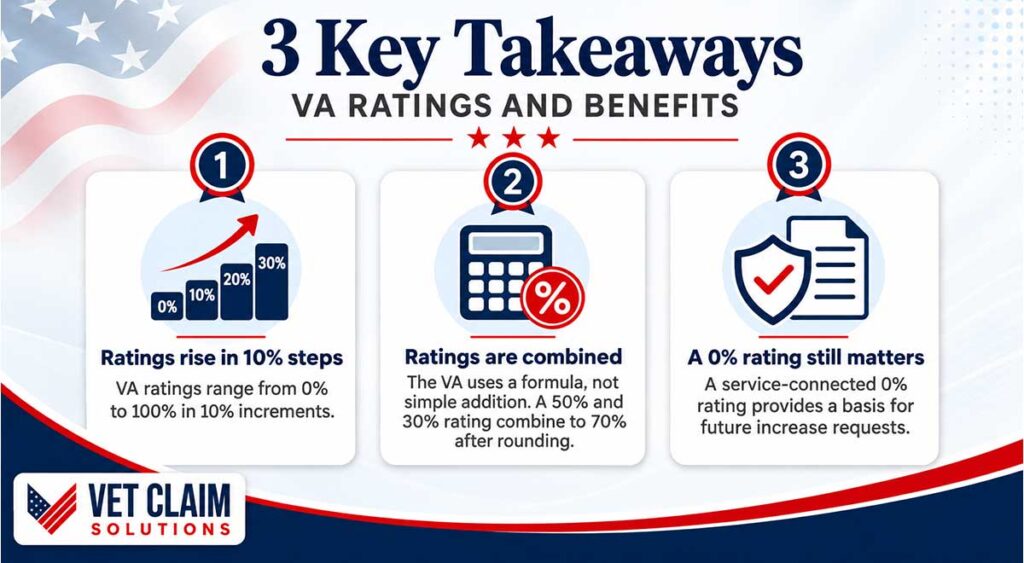
The Department of Veterans Affairs assigns VA disability ratings in 10% increments, ranging from 0% to 100%. Your VA disability rating reflects the severity of your service-connected condition and its impact on your daily activities and ability to work. Higher disability ratings generally result in increased monthly compensation, making it important for veterans to understand how their ratings affect their overall disability amounts for veterans.
The VA determines disability ratings using the VA Schedule for Rating Disabilities, established under 38 CFR Part 4. Each condition has a diagnostic code with specific evaluation criteria. For example, a knee condition may qualify for a 10% rating based on limited motion, while more severe functional limitations may support a higher rating. Veterans with multiple service-connected conditions receive a combined disability rating, which determines their overall VA disability compensation rates.
Even a 0% VA disability rating establishes service connection, although it does not provide monthly disability pay. Veterans with a non-compensable rating may qualify for VA health care benefits and can request an increased rating if their condition worsens. Understanding these VA disability benefits helps veterans prepare stronger disability claims and ensure their ratings accurately reflect their service-connected conditions.
The Combined Ratings Formula, Often Called VA Math
Here is where many veterans get confused. If you have more than one rated condition, the VA does not simply add your percentages together. Instead, it applies each rating to your remaining efficiency using the combined ratings approach described on VA.gov.
Consider a veteran with a 50% VA disability rating for PTSD and a 30% rating for a back injury. Instead of simply adding these disability ratings, the VA uses a combined ratings calculation to determine the veteran’s overall percentage. The VA starts with the highest rating, leaving the veteran 50% efficient. The additional 30% rating applies to that remaining 50%, resulting in a combined value of 65%, which rounds to a final combined disability rating of 70%.
This calculation explains why increasing a VA disability rating from 90% to 100% can be challenging. Each additional rating applies to the remaining efficiency rather than the original 100%. Understanding this formula helps veterans estimate their disability amounts for veterans and how multiple service-connected conditions affect their VA disability compensation. A VA disability calculator can help veterans understand the combined rating process before filing a VA disability claim or requesting a rating increase.
2025 VA Disability Pay Rates

Following the 2.5% cost-of-living adjustment that took effect December 1, 2024, monthly payments rose at every rating level. The table below shows the 2025 base rates for a veteran with no dependents, drawn from the official VA compensation rate tables.
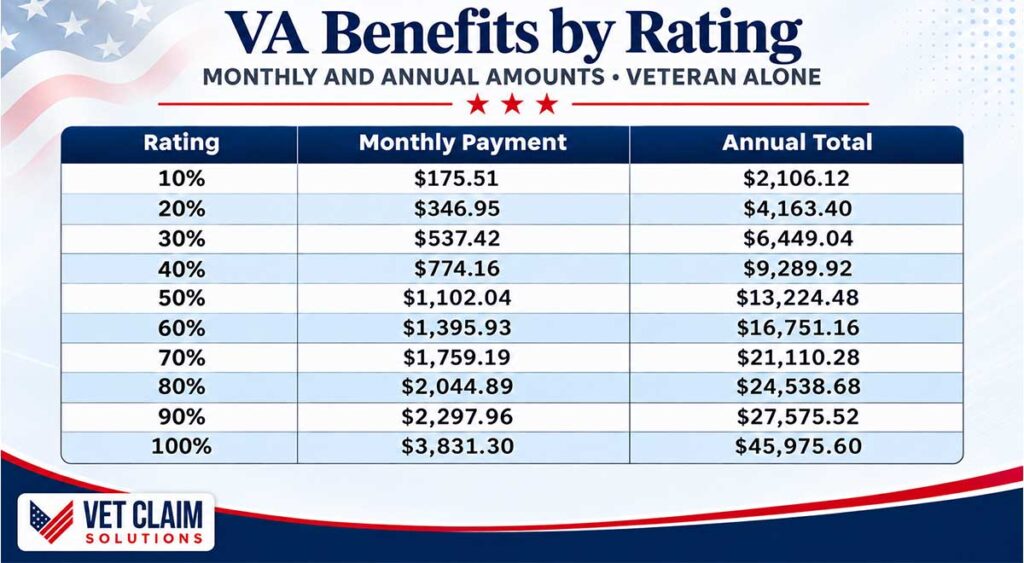
Notice the steep jump between 90% and 100%. That single increment adds more than $1,533 per month, which is why pursuing a full rating can transform a household budget. Every dollar arrives tax-free, so the real value exceeds what a comparable taxable salary would deliver.
Rates for Veterans With Dependents
Veterans with a combined disability rating of 30% or higher may qualify for additional VA disability compensation based on their dependent status. Eligible dependents may include a spouse, children under 18, qualifying children between 18 and 23 attending school, and dependent parents. These additional VA disability benefits can increase the overall disability amounts for veterans. For example, in 2025, a veteran with a 100% VA disability rating and a spouse, but no children, received $4,044.91 in monthly compensation, compared with the base rate of $3,831.30 for a veteran without dependents.
Adding qualifying children can further increase monthly compensation. At the 100% rating level, each additional child under 18 added approximately $106 per month in 2025, while a spouse eligible for Aid and Attendance benefits could qualify the veteran for an additional dependent allowance. Veterans can review the official VA disability compensation rates for veterans with dependents to understand how disability ratings, family size, and dependent status affect their monthly payments.
Pro Tip:Report marriages, divorces, births, and school enrollment changes to the VA right away. The VA does not automatically learn about life events, and unreported changes can create overpayment debts that get withheld from future checks.
What Can Raise Your Monthly Disability Amount

Your combined rating and dependent status form the foundation of your payment, but several programs push veteran disability amounts higher. Many eligible veterans never claim these add-ons simply because nobody told them the programs exist.
Special Monthly Compensation
Severe disabilities can qualify you for Special Monthly Compensation, commonly called SMC. This benefit pays above the standard 100% rate for conditions such as loss of use of a hand or foot, blindness, or the need for daily personal care. SMC levels range from SMC-K, which adds $136.06 per month in 2025, to higher tiers that exceed $4,000 monthly for the most serious cases.
Total Disability Based on Individual Unemployability
What happens if your service-connected conditions prevent you from holding steady work, but your combined rating falls short of 100%? Total Disability based on Individual Unemployability, or TDIU, pays you at the full 100% rate anyway. You generally qualify with one condition rated at 60% or higher, or a combined 70% rating with at least one condition rated at 40%. Our TDIU eligibility guide walks through the evidence you need.
Concurrent Receipt for Military Retirees
Military retirees once watched their retirement pay shrink dollar-for-dollar when VA compensation began. Programs like Concurrent Retirement and Disability Pay and Combat-Related Special Compensation now restore much of that offset. If you retired with 20 or more years of service and hold a VA rating of 50% or higher, you likely qualify for both payments in full.
Survivor Benefits for Families
Disability amounts for veterans matter to surviving family members as well. If a veteran passes away from a service-connected cause, the surviving spouse may qualify for Dependency and Indemnity Compensation. The 2025 base rate sits at approximately $1,653 per month, tax-free, and you can review current figures on the VA survivor benefits page.
How the Annual COLA Changes Your Payment
VA disability compensation adjusts annually through a cost-of-living adjustment (COLA) to help veterans maintain their purchasing power as inflation rises. These adjustments follow the Social Security COLA announced by the Social Security Administration. Annual increases help improve disability amounts for veterans by raising monthly payments without requiring veterans to submit a new disability claim or request a higher VA disability rating.
Recent COLA increases included 8.7% in 2023, 3.2% in 2024, and 2.5% in 2025. These adjustments directly affect VA disability pay rates and the total annual compensation veterans receive. For example, the monthly base payment for a veteran with a 100% VA disability rating increased from $3,621.95 in 2023 to $3,831.30 in 2025. That represents approximately $209 more per month, or over $2,500 in additional annual VA disability benefits compared with the 2023 rate.
The annual COLA generally takes effect on December 1, with the increased monthly VA disability compensation reflected in the payment issued at the beginning of January. Veterans can review the official VA disability compensation rates to see how these adjustments affect their disability amounts for veterans. COLA increases are applied automatically to eligible payments, so veterans do not need to file additional paperwork to receive the updated rates.
How to File a Claim or Request a Rating Increase
Whether you are filing for the first time or seeking a higher rating for a worsening condition, the process follows the same general path. Strong preparation at the front end saves months of frustration later, and our claim evidence checklist covers the documents in more detail.
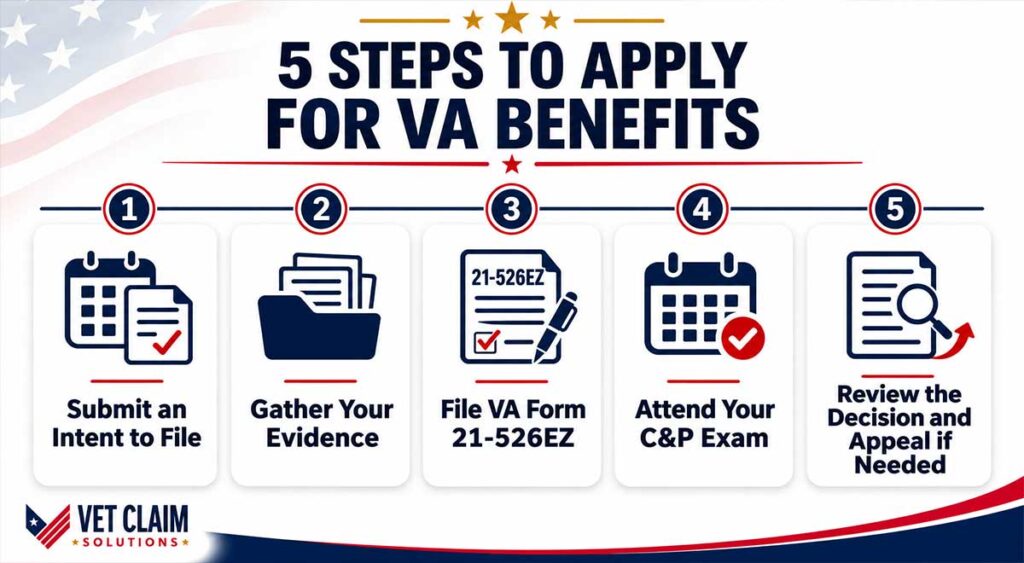
Steps to File Your Claim
1. Submit an Intent to File
Notify the VA of your plan to file before you gather paperwork. This simple step locks in your effective date and gives you up to one year to complete the full claim.
Tip: An early effective date can mean thousands of dollars in back pay once your claim is approved.
2. Gather Your Evidence
Collect service treatment records, private medical records, and a current diagnosis for each condition. A nexus letter from a qualified physician can connect your condition to your service when the link is not obvious.
3. File VA Form 21-526EZ
Submit your application online through VA.gov, by mail, or in person at a regional office. Online filing gives you instant confirmation and lets you track status updates in real time.
4. Attend Your C&P Exam
The VA will likely schedule a Compensation and Pension exam to evaluate your condition. Describe your worst days honestly, because examiners document the severity you report and demonstrate.
Tip: Bring a list of symptoms and limitations so you do not forget important details under pressure.
5. Review the Decision and Appeal if Needed
Read your decision letter carefully, since it explains the rating, the effective date, and the reasoning behind both. If you disagree, you can pursue a Supplemental Claim, Higher-Level Review, or Board Appeal within one year.
The VA disability claim process can take several months, depending on the complexity of the claim, the evidence required, and the VA’s current workload. Veterans can review the average VA claim processing time to better understand how long a decision may take. Submitting a Fully Developed Claim (FDC) with complete supporting medical evidence may help reduce unnecessary delays, although faster approval is not guaranteed. Proper preparation can help veterans establish their eligibility for VA disability compensation and understand how their disability amounts for veterans are determined.
If a service-connected condition worsens after receiving an initial VA disability rating, veterans may qualify for a VA disability rating increase. They can request an increased rating by submitting updated medical records and evidence demonstrating greater severity. A higher VA disability rating may increase monthly VA disability benefits, depending on the veteran’s combined rating and eligibility. Understanding the VA disability compensation rates can help veterans estimate how an approved rating increase may affect their monthly payments.
Common Mistakes That Shrink Disability Amounts for Veterans
Plenty of veterans receive less than they deserve because of avoidable errors. Some mistakes cost a few dollars each month, while others cost tens of thousands over a lifetime. Here are the problems that show up most often:
- Failing to report dependents after reaching a 30% rating or higher
- Skipping a scheduled C&P exam without rescheduling promptly
- Ignoring secondary conditions, such as depression caused by chronic pain or nerve damage from a back injury
- Accepting a low initial rating without filing an appeal within the one-year window
- Filing alone instead of using free help from an accredited Veterans Service Officer
️ Warning: Missing a C&P exam can lead to a denial or even a reduction of an existing rating. If you cannot attend, contact the VA immediately to reschedule rather than simply skipping the appointment.
Secondary service-connected conditions deserve special attention because they may qualify veterans for additional VA disability compensation. For example, a service-connected knee injury may contribute to hip or back problems over time. When medical evidence establishes a connection between these conditions, veterans may qualify for a secondary service-connected disability. Each approved condition contributes to the VA combined disability rating, potentially increasing the overall disability amounts for veterans and their monthly VA disability benefits.
Veterans can also seek free assistance from VA-accredited representatives, including Veterans Service Officers (VSOs) from organizations such as the Veterans of Foreign Wars (VFW), American Legion, and Disabled American Veterans (DAV). These professionals help veterans understand VA disability ratings, organize supporting evidence, and navigate the disability benefits process. Working with an accredited VSO can help veterans prepare more complete applications, understand their eligibility, and identify potential opportunities to request a VA disability rating increase.