


Your VA hip range of motion rating depends on how your service-connected hip condition limits movement and daily function. Although the measurements matter, VA also considers pain, weakness, flare-ups, and the supporting evidence.
Start with the movement criteria below, then review what a C&P exam records. This guide also explains hip replacement ratings and how to organize records for a VA Benefits review.

Key points to remember
- Different hip movements have different rating criteria.
- Explain how your limitations affect daily activities, including during flare-ups.
- Hip replacement has separate criteria from ordinary limits on movement.
VA Hip Range of Motion Rating Criteria
VA uses diagnostic codes in 38 CFR 4.71a to evaluate limited movement. For example, flexion means lifting your thigh toward your chest, while extension means moving your leg backward. Abduction moves it outward; adduction moves it inward. Rotation turns the leg.
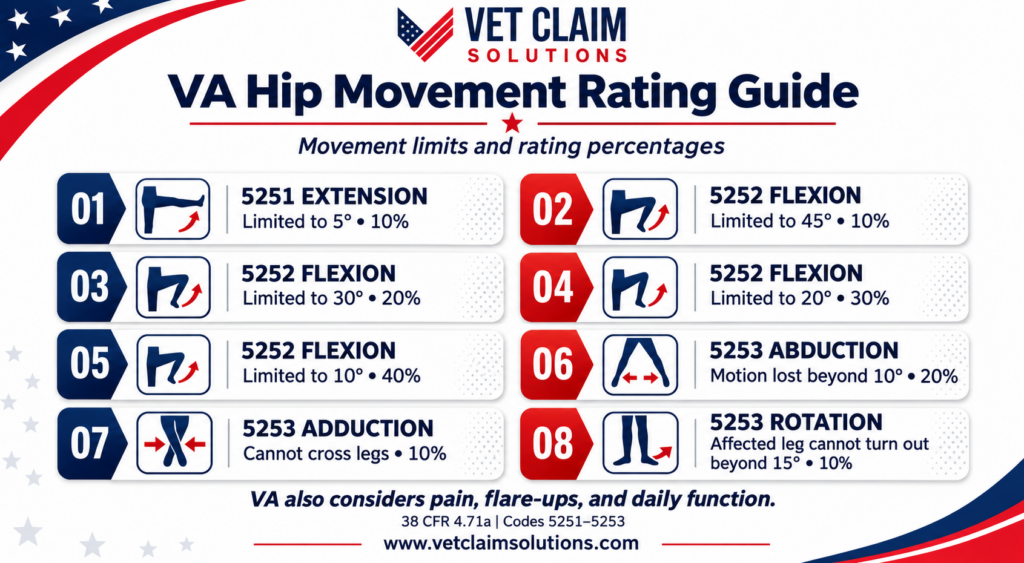
The table explains the movement limits in the rating schedule. However, your rating also depends on the applicable code and the evidence VA reviews.
Why pain and daily function matter
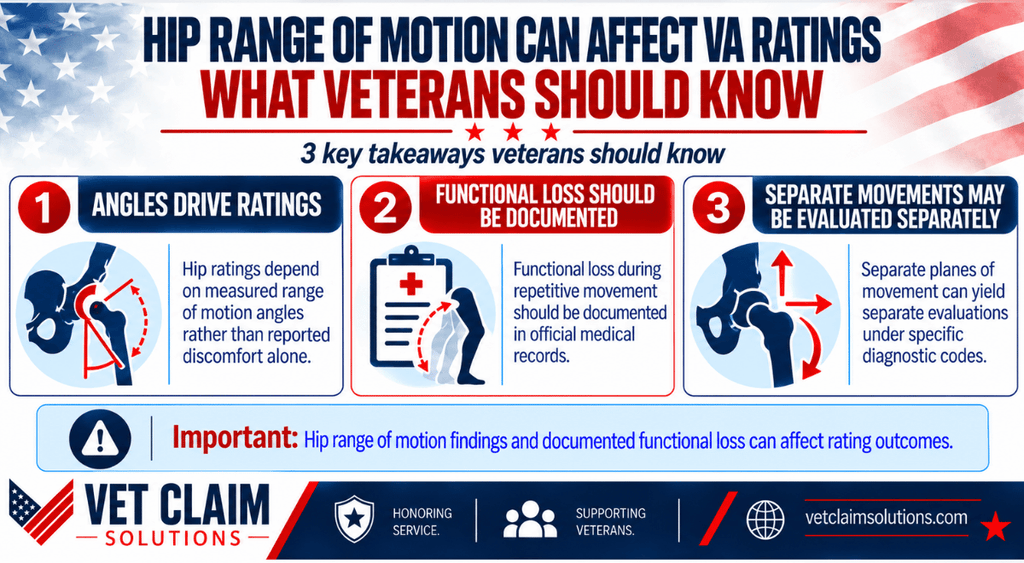
A range-of-motion measurement is one part of the evaluation. Functional loss means difficulty using the joint in ordinary activities. For example, pain, weakness, fatigue, or reduced endurance may limit walking, standing, sitting, or climbing stairs. Because these limits affect daily function, VA regulations require consideration of them.
Under 38 CFR 4.59, qualifying painful, unstable, or misaligned joints may warrant at least the minimum compensable rating for the joint. However, a report of pain does not automatically produce a particular percentage. VA considers the applicable criteria and evidence.
When pain begins during movement, that point does not automatically become the final rating measurement. Instead, explain when pain starts and how it limits movement so the examiner can record pain and any resulting loss of function.
What your VA exam records
A compensation and pension exam, often called a C&P exam, helps VA evaluate your condition. During movement testing, the examiner uses a goniometer to measure angles in degrees. You do not need to know or guess those angles yourself.
The Hip and Thigh Conditions Disability Benefits Questionnaire, or DBQ, records movement measurements. In addition, it addresses repeated use and flare-ups. Testing includes active and passive movement and pain with and without weight-bearing, when appropriate. If testing cannot be performed, the examiner should explain why.
Even if you are not having a flare-up during the appointment, describe how often episodes occur and how long they last. Also explain what brings them on and which activities become harder. The DBQ asks the examiner to estimate additional movement loss using the available information. If an estimate is not feasible, the examiner should explain why.
Describe your experience clearly
Use specific, truthful examples from your routine. For example, describe how long you can stand, whether stairs are difficult, or when you need breaks after walking. Then explain how those limits change during a flare-up without minimizing or overstating your experience.
During testing, follow the examiner’s instructions and communicate pain or difficulty as it occurs. This helps the examiner understand your everyday function.
When separate hip ratings may apply
Different movement limitations may qualify for separate ratings when the requirements are met. However, VA cannot compensate the same symptom or functional loss twice. This rule is called avoidance of pyramiding.
Because the symptoms may overlap, limits in several directions do not automatically establish multiple compensable ratings. Review the code and explanation in your decision to see how VA evaluated the evidence.
How hip replacement ratings differ
Hip resurfacing and prosthetic replacement fall under Diagnostic Code 5054. By comparison, Code 5255 covers femur impairment.
Code 5054 provides a 100% rating for 4 months following implantation or resurfacing. Under the schedule’s Note 5, this period begins after the initial 1-month total rating under 38 CFR 4.30 following hospital discharge. After that period, the criteria below address remaining limitations following prosthetic replacement.
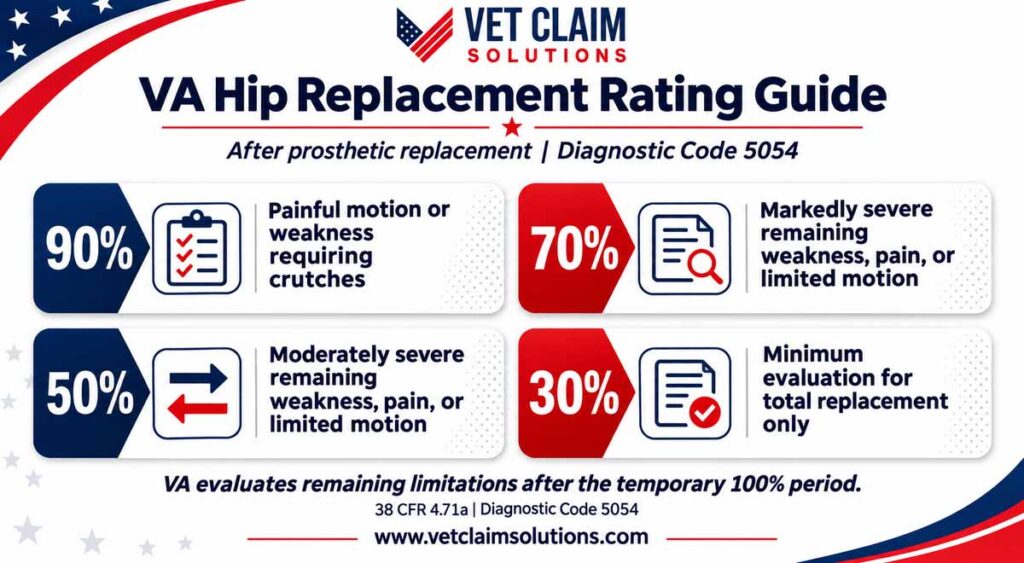
After the temporary 100% period, VA evaluates resurfacing under Codes 5250-5255, without a guaranteed minimum under Code 5054. An arthroscopic repair is a different procedure, so it does not automatically qualify as a replacement.
After surgery, keep the procedure report, discharge summary, and follow-up records together. These records identify the procedure and show any limitations that remain.
How VA combines multiple ratings
VA combines ratings rather than adding them. For example, a 30% hip rating and a separate 20% back rating combine to 44%. That rounds to 40% if those are the only ratings and no other adjustment applies. If you have more ratings, VA rounds the final value after combining them all. [7]
When compensable service-connected conditions affect both legs, the bilateral factor may also apply. It changes the combined-rating calculation, rather than automatically adding 10 points to your final rating.
Prepare your records for a VA Benefits review
Before your next VA Benefits review, organize the records that show your limitations and any changes over time. Start with these steps:
- First, gather relevant service, VA, and private records. Include movement findings, imaging reports, and surgery records when applicable.
- Next, keep a dated account of daily limitations and flare-ups. Use your own observations and specific examples.
- Then, organize documents in date order and request missing visits or reports. Keep copies of what you submit.
- Finally, if you already have a decision, compare its explanation with your records. Note questions about the evidence or rating criteria.
To understand your VA hip range of motion rating, review the movement criteria alongside your daily limitations. Then organize records that show those limits clearly. VA reviews the evidence and determines service connection and the rating.
Get support with your preparation
Vet Claim Solutions provides education and coaching to help veterans understand VA Benefits and organize their preparation. If you have questions about getting started or understanding the process, contact our team.
Get your FREE consultation now: vetclaimsolutions.com/sign-up/