


Knee pain often makes everyday tasks feel impossible for veterans after years of active duty. Understanding the VA Knee Pain Rating Evidence Veterans Need to Know is vital to secure proper support. Physical strain during military service takes a heavy toll on your joints over time, leading to significant mobility issues. You might struggle to walk up stairs or stand for long periods without severe pain, but getting an accurate disability rating for this damage provides crucial financial support for your future.
Many veterans live with a chronic knee condition but fail to receive the proper va disability compensation they deserve. The claims process requires specific medical evidence and a clear understanding of the rules regarding knee injuries. Knowing how to document your knee pain effectively can change the outcome of your va claim, so this guide explains the exact evidence you need to secure a fair va rating.
The Department of Veterans Affairs evaluates your knee condition based on how much it limits your daily life and mobility. Evaluators look at your range of motion, stability, and pain levels during a physical exam to determine your va disability rating. They use specific criteria to determine your final disability rating for monthly disability compensation.
You will typically need to complete a disability benefits questionnaire with a qualified medical provider. This disability benefits questionnaire helps the examiner document your symptoms accurately for the rater. Your medical provider must record every detail about your functional loss during this process, as a poorly completed benefits questionnaire often leads to a denied claim.
A major factor in any va rating involves the concept of painful motion during the physical evaluation. Even if you have full range of motion, experiencing knee pain can warrant a 10 percent knee rating. The examiner must observe and document this pain during your evaluation to support your va disability rating.

Knee Injury Diagnostic Codes: Common Knee Conditions and Their VA Diagnostic Codes
Veterans suffer from many different common knee conditions after leaving the military due to physical strain. The VA assigns a specific diagnostic code to each type of injury to standardize the evaluation process. These diagnostic codes dictate exactly how the government calculates your disability benefits for your service-connected knee condition.
Limitation of Flexion and Extension in a Service-Connected Knee
Most VA knee evaluations focus on how well the knee joint can bend and straighten. When a veteran cannot bend the knee normally, the VA may evaluate the condition based on limited flexion. When the leg cannot fully straighten, the condition may be evaluated based on limited extension. These motion measurements are important because they help show the severity of functional loss caused by a service-connected knee condition.
During a VA examination, the examiner generally measures the knee’s range of motion using a goniometer. The results document how many degrees the knee can flex and extend and whether pain, weakness, or repeated movement further limits function. Accurate motion measurements can directly affect the VA disability rating assigned for the knee condition.
A veteran may potentially receive separate evaluations when both flexion and extension are limited and the symptoms meet the applicable rating criteria. More severe limited extension can support a higher disability rating, with the highest rating under the applicable limitation-of-extension criteria reaching 50 percent.
Limited flexion is also common among veterans dealing with long-term joint wear, arthritis, or the effects of a previous knee injury. However, range-of-motion numbers are only part of the evaluation. The examiner may also document painful motion, weakness, flare-ups, repeated-use limitations, and other forms of functional loss that affect walking, standing, climbing stairs, or performing everyday activities.
Veterans should describe their symptoms accurately during the examination and avoid forcing the knee beyond its normal functional limits. If pain begins during movement, explain when it starts and how it affects continued motion. Clear documentation of pain and range-of-motion limitations can provide a more complete picture of the current knee condition and help ensure the VA rating reflects the veteran’s actual level of impairment.
Pro Tip: Stop moving your leg the exact moment you feel knee pain during your C&P exam. Pushing through the discomfort will result in an inaccurate measurement of your true limitations and a lower va rating.
Ligament and Meniscus Ratings: VA Disability Ratings for Ligament Tears and Meniscus Injuries
Many veterans experience a serious knee injury involving damage to the ligaments or cartilage during military service. A ligament tear causing persistent instability can make the knee buckle, shift, or give way unexpectedly during walking, climbing stairs, or other daily activities. When this instability is connected to an in-service injury, it may become an important factor in determining the appropriate VA disability rating for the knee condition.
The severity of the instability depends on the extent of the injury and its effect on normal knee function. A complete ligament tear causing persistent instability may produce greater functional loss than a minor sprain or partial tear. A ligament tear causing repeated episodes of buckling or excessive movement should therefore be clearly documented through treatment records, examination findings, and descriptions of how the condition affects everyday mobility.
Veterans with persistent instability may also rely on an assistive device, such as a prescribed knee brace or cane, to improve stability while standing or walking. Documentation showing how often an assistive device is needed can help demonstrate the severity of the current knee condition and provide important evidence for a VA claim.
If a veteran has undergone a surgical repair for ligament damage, records should also describe the results of the procedure and any remaining symptoms. A failed repair, or a repair that does not fully resolve instability, may leave the veteran with continued weakness, buckling, pain, or functional loss. In these situations, evidence showing a complete ligament tear causing persistent problems can help provide a clearer picture of the veteran’s current limitations.
Even when the injury is less severe, a tear causing persistent instability should not be overlooked. Veterans should document episodes of giving way, limitations with walking or standing, use of braces or other assistive devices, and any related functional loss. Complete documentation helps the VA evaluate the knee condition based on its actual impact rather than the diagnosis alone.
Surgical Ratings: Total Knee Replacement and Joint Resurfacing Disability Ratings
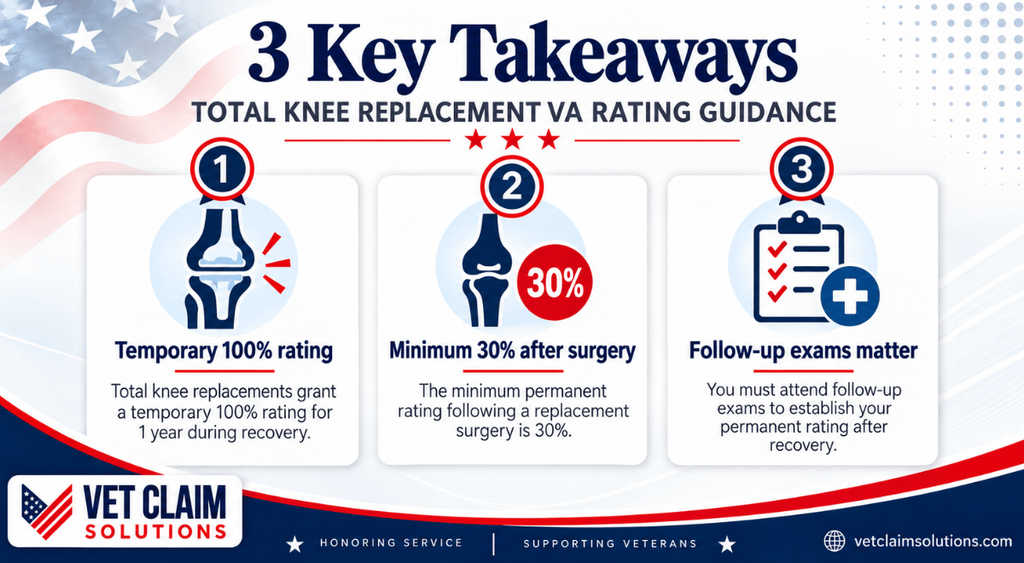
Severe joint damage sometimes forces veterans to undergo a total knee replacement surgery to regain mobility. A total knee replacement automatically qualifies you for a 100 percent disability rating for one year. This temporary va rate gives you time to recover from the major operation before a permanent rating is assigned.
After the recovery year, the VA reevaluates your joint function and knee pain to determine a long-term rating. The minimum rating after a knee replacement surgery is usually 30 percent, depending on your functional loss. If you still suffer from chronic pain or weakness, the VA rating can remain significantly higher.
Your medical provider should document any lingering issues after the surgical procedure to support your disability compensation. Significant functional loss post-surgery can justify a permanent 60 percent disability rating for your knee condition. Make sure you attend all follow-up exams to maintain your va disability compensation and accurate VA rates.

Establishing Service Connection: Proving Service Connection for Your Service-Connected Knee Condition
You must establish a direct service connection to receive va disability benefits for your knee injuries. This means proving your military service caused or aggravated your current knee problems through medical evidence. You need medical records linking your active duty incidents to your ongoing knee pain and functional loss.
A single knee injury in service can lead to decades of joint problems and secondary conditions. You should submit buddy statements and service treatment records to support your va claim case. These documents help establish that your knee condition started during your enlistment and has persisted since discharge.
Military service often requires carrying heavy gear over rough terrain for miles, which damages the knee joint. This constant pounding wears down the cartilage and stresses the ligaments in your legs over time. When you file your claim, include buddy letters from fellow service members who witnessed your knee injuries.
Maximizing Benefits: How to Maximize Your VA Disability Compensation and Knee Rating
Veterans should understand how the VA combines multiple disability ratings for the same joint to maximize their benefits. You can receive separate ratings for different knee conditions, like arthritis and instability, if they are distinct. However, the VA rules prevent pyramiding, which means compensating you twice for the same symptom in your va claim.
Reviewing the official rating chart helps you understand what evidence you need for a higher va rating. You must present clear evidence of functional loss and painful motion to succeed in your application. Frequent knee pain alone will not maximize your benefits without documented loss of motion or instability.
Always report how your va knee problems impact your daily routine and work life to the examiner. If your service-connected knee requires a wheelchair or another assistive device, state this clearly during your evaluation. The right medical evidence and a completed benefits questionnaire will support your va disability rating and monthly compensation.
Working with a knowledgeable Veterans Service Officer can streamline your application process for va disability compensation. They understand the specific language the evaluators look for in your medical files and diagnostic codes. A VSO can help you gather the right documents before you submit your paperwork to avoid delays.
C&P Exam Tips: Common Mistakes to Avoid During Your VA Knee Pain Rating Exam
Many veterans try to push through their knee pain during the examination, which often results in a lower va disability rating. This is a massive mistake because the examiner only records the functional loss they witness during the physical evaluation. You must stop moving your leg the exact moment you feel any knee pain to ensure your va rating is accurate.
Your va disability rating depends entirely on an accurate assessment of your physical limitations and range of motion. If you hide your discomfort, the final va rating will not reflect your reality or your need for support. Tell the examiner about your worst days, especially if you experience frequent patellar instability or severe pain.
Bring all relevant private medical records to your appointment with the examiner to ensure they have the full picture. Do not assume the VA already has every document from your medical provider regarding your knee injuries. Providing complete records helps secure the correct va rates for your specific knee conditions and functional loss.
Another frequent error involves guessing answers when the examiner asks specific questions about your military service history. If you do not know the exact date an injury occurred, tell them you cannot remember the specific details. Guessing can create inconsistencies in your file that raters might use to deny your va disability compensation claim.
Conclusion
Securing the right disability rating for your va knee takes patience and preparation to ensure you receive full benefits. You must gather solid evidence that clearly shows your physical limitations and knee pain for the medical provider. Understanding the diagnostic code system gives you a significant advantage when filing your va disability compensation claim.
Never downplay your symptoms when speaking with doctors or VA examiners about your service-connected knee condition. Your va disability benefits depend on honest, detailed reporting of your daily struggles and functional loss. A well-documented diagnostic code evaluation is your best tool for success in obtaining a fair va rating.
With the right approach, you can get the disability benefits you rightfully deserve for your military service. If your knee pain worsens over time, you can always file for an increase in your disability rating. Protect your future by making sure your disability rating accurately reflects your current knee condition and mobility needs.
Do not let chronic knee pain ruin your quality of life without getting the va disability support you earned. If you need a mobility aid, get a prescription for an assistive device to document your functional loss. This final step solidifies your va rating and maximizes your va disability compensation for all your knee conditions. Finally, proper documentation of your knee pain validates your true disability rating and supports your overall knee condition claim.