

Military grooming standards demand clean shaven faces, yet daily shaving creates severe dermatological complications for many individuals. Folliculitis and pseudofolliculitis barbae represent painful, chronic inflammations of hair follicles that frequently begin or worsen during active duty. Veterans living with chronic lesions, permanent scarring, and secondary bacterial infections can pursue va disability compensation through the Department of Veterans Affairs. Securing an accurate Folliculitis VA Disability Rating and the Evidence Veterans May Need requires comprehensive medical records, service documentation, and an understanding of federal evaluation criteria.
Folliculitis develops when bacteria or fungi infect microscopic hair follicles, producing red papules, tenderness, and pustules across the neck, scalp, or torso. In contrast, pseudofolliculitis barbae occurs when tightly curled hairs curve back into the surrounding skin, causing foreign-body inflammation commonly known as razor bumps. Both forms of skin condition provoke intense itching, chronic swelling, and recurrent drainage that disrupt personal and professional activities.
Rigid grooming policies often force service members with curved facial hair to shave daily against their skin grain. This persistent mechanical trauma causes pseudofolliculitis barbae to develop rapidly, generating painful pustules that make subsequent shaving unbearable. Active service personnel frequently request shaving waivers or medical profiles to manage the persistent irritation and secondary infections.
When left untreated, chronic pseudofolliculitis barbae can lead to deep follicular destruction, hyperpigmentation, and disfiguring keloidal scars. While civil society views razor bumps as an aesthetic annoyance, the clinical reality involves chronic bacterial colonization and tissue breakdown. Demonstrating how these skin conditions affected your daily life during military service forms the foundation of a successful disability claim.
Folliculitis VA Disability Rating and the Evidence Veterans May Need: VA Rating Criteria for Folliculitis
The Department of Veterans Affairs rates skin disorders under 38 CFR § 4.118. Most dermatological conditions utilize diagnostic code 7806 for general dermatological infections or diagnostic code 7828 for acne conditions. The agency evaluates your pseudofolliculitis barbae va disability rating using either the percentage of body area affected or the duration of prescription medication therapy.
The general rating formula assesses impairment based on whether your condition impacts exposed areas like the face and neck, or the entire body. A 60 percent va rating applies if the skin condition involves more than 40 percent of the entire body or requires continuous systemic therapy like oral antibiotics or immunosuppressive drugs. A 30 percent va disability rating requires characteristic lesions involving 20 to 40 percent of the body, or systemic therapy lasting six weeks or more over the past year.
A lower 10 percent va rating applies when lesions affect at least 5 percent of the body, or when topical therapy continues for six weeks within a twelve month timeframe. Mild presentations that respond swiftly to over the counter creams typically receive a 0 percent non-compensable disability rating. Understanding this rating formula enables you to present treatment records that reflect the true severity of your chronic condition.
️ Warning: Do not stop your prescribed medication before a compensation exam simply to show active lesions. Raters examine continuous pharmacy refill records to verify the necessity of systemic or topical therapy.
Establishing Service Connection for Skin Conditions
To win disability benefits, veterans must establish direct service connection by linking their diagnosis to their active military service. Direct va disability service connection requires three critical elements under federal law: a current diagnosis, evidence of an in-service event or aggravation, and a medical nexus connecting the two. Service personnel who developed razor bumps during deployment must secure their complete military treatment folders.
How does one prove that facial bumps started during active duty? Shaving waivers, sick call slips, and commander memos represent exceptional evidence of an in-service service event. Medical records showing topical corticosteroid prescriptions or oral antibiotic regimens while in uniform confirm the early development of pseudofolliculitis barbae va conditions. Reviewing official VA filing guidelines will clarify which medical forms substantiate this link.
In cases where environmental exposures occurred during overseas service, veterans can explore presumptive service connection rules under recent legislative updates. Contaminated water systems, burn pits, or toxic chemicals often trigger prolonged immune system dysfunction and chronic skin conditions. When toxic exposures cause persistent follicular inflammation, establishing presumptive service eliminates the requirement to prove an exact date of onset during military duty.
If your condition began after separation, you must rely on an expert medical nexus letter to achieve disability service connection. A board-certified dermatologist should review your service records, document current lesions, and explain the biological progression from past service trauma. Strong clinical reasoning bridges the gap between your discharge date and your current claim for va benefits.
Secondary Claims and Scars Related to Folliculitis Skin Conditions
Chronic pseudofolliculitis barbae frequently generates severe complications that warrant their own secondary service connection evaluations. When deep bacterial infections spread through dermal layers, tissue loss and gross distortion of normal facial contours can occur. In these scenarios, the department evaluates superficial scars or deep scarring under diagnostic code 7801 or 7805 alongside your primary skin condition.
Furthermore, facial disfigurement and unceasing physical pain often cause significant emotional distress, social withdrawal, and clinical depression. Veterans can file for secondary service connection for major depressive disorder or anxiety stemming from their service-connected disability. The va rate for mental health conditions depends on occupational and social impairment rather than the general rating for skin.
Do physical scars alter your total va ratings? Yes, because the department uses separate evaluation codes for scarring that causes pain, instability, or substantial tissue loss across exposed areas. Combining a barbae va rating with separate disability ratings for painful scars produces a higher monthly disability compensation payment. This combined approach protects veterans whose chronic lesions cause multifaceted functional damage.
Pro Tip: Request that your examiner measure each scar individually in centimeters during your physical examination. Scar ratings depend heavily on total surface area, tissue texture, and documented tenderness or pain upon palpation.
Step-by-Step Evidence Gathering Process
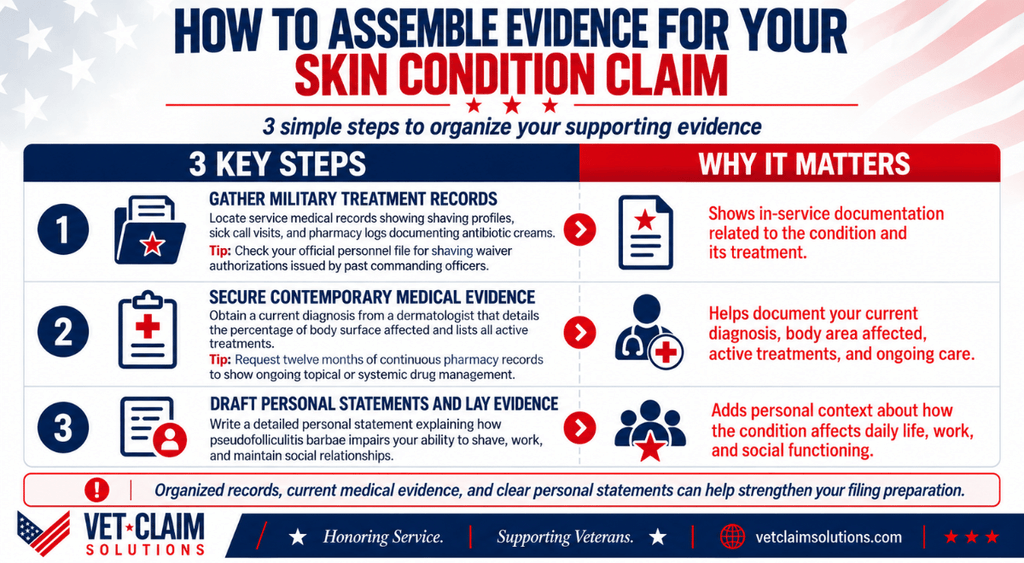
Winning a barbae va disability claim requires organized preparation and objective documentation. Raters examine whether your pseudofolliculitis barbae qualifies for compensation by evaluating historical medical frequency and current medical compliance. Following a structured submission process prevents common procedural delays and rating denials.
Every piece of evidence should support the core elements required by federal regulations. Veterans must highlight their initial military diagnosis, continuous prescription therapy, and the physical progression of pseudofolliculitis barbae over time. Careful attention to details in your personnel and treatment jackets makes the difference between approval and rejection.

Examiners will inspect your face, neck, and other regions to determine whether pseudofolliculitis barbae causes secondary crusting, bleeding, or keloid formation. Clear photographs taken during peak flare ups provide undeniable proof of how your condition manifests outside the clinical setting.
Veterans must also ensure their doctors record the exact medications prescribed, including dosages and therapeutic courses. The va rating schedule directly ties percentage levels to whether you take systemic antibiotics or rely solely on topical ointments. Thorough medical records eliminate ambiguity and assist adjudicators in granting proper va disability benefits during the initial review.
Finally, obtain buddy letters from fellow veterans who witnessed your severe skin flare ups during your military service. Lay statements confirm that your razor bumps were persistent, painful, and directly caused by mandated shaving regimens. These credible witness statements hold immense legal value when formal base clinic logs lack full diagnostic documentation.
Conclusion and Final Thoughts
Living with chronic pseudofolliculitis barbae brings constant discomfort, social frustration, and potential long-term disfigurement. Federal va disability regulations recognize the severe toll that recurrent follicular infections take on an individual’s wellbeing. By gathering service records, documenting continuous medication use, and filing thorough medical claims, you can obtain rightful disability service compensation.
Do not allow initial claim difficulties or lower ratings to deter you from pursuing complete justice. If your initial pseudofolliculitis barbae va rating fails to reflect your true impairment, consult with an accredited representative to appeal. Veterans affairs adjudicators must evaluate the combined impact of pain, disfigurement, and mental stress when assigning your final barbae va disability rating.
With an organized presentation of personal statements and dermatological evidence, you can establish an indisputable va disability service connection. Take the initiative today to request your military medical jackets, consult a skin specialist, and protect your earned benefits.